
Inevitably, as daylight hours increase and British Summer Time begins, activity within the section diminishes somewhat, and bad weather has been an issue throughout. Nevertheless, three members have produced a total of thirteen images of deep sky objects this month:
David Davies imaged galaxy NGC 4236 in the constellation of Draco with a 250mm Richey Chretien telescope, 0.72x focal reducer, QSI 683 mono camera plus red, green and blue fiters:

NGC 4263 is a barred spiral galaxy 11.7 million light years from the Earth and a possible member of the M81 group of galaxies, indeed slightly closer to us than M81 (see below) but it has a much lower surface brightness; magnitude 9.6 compared to M81 which is magnitude 7.
Alan Clitherow, SPA planetary section director, used a Skywatcher Maksutov-Newtonian MN 190P telescope and QHY 268 C colour camera plus a dual narrow band filter to capture galaxies M81 and M82 in the constellation of Ursa Major:
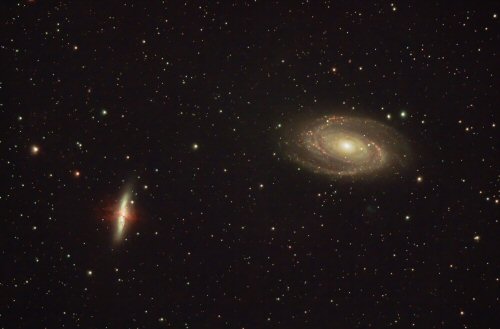
M81, Bode’s Galaxy (upper right) and M82 the Cigar galaxy are gravitationally bound and have had a series of close interactions over many millions of years, leading to starburst activity in both. Their ultimate fate will be to merge and become a single galaxy.
Steve Norrie sent in eleven images taken with four telescope/camera combinations. The first pair are of NGC 1499 the California emission nebula in the constellation of Perseus, first with an EDR 72mm refractor and Altair Astro 26C colour camera with added dual narrow band filter data, then with a WO Redcat 51mm refractor and Starlight Xpress Trius 694 mono camera plus narrow band filters to give the Hubble palette:


Another pair of images taken with the telescope/ camera/ filter combinations described above are of IC 443 the Jellyfish supernove remnant in Gemimi:
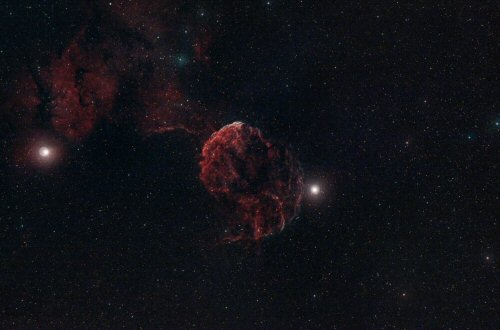
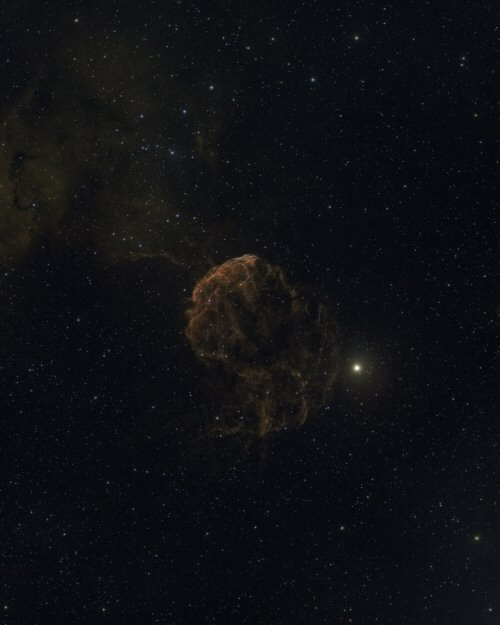
IC 443 is the remnant of a massive star that ended its life as a type II supernova, leaving behind a dense, hot neutron star, which is currently moving toward the lower left edge of the nebulosity at a very high velocity, leaving a wake of high energy particles. There are long-term professional studies ongoing to try to answer the many unexplained featues of this object.
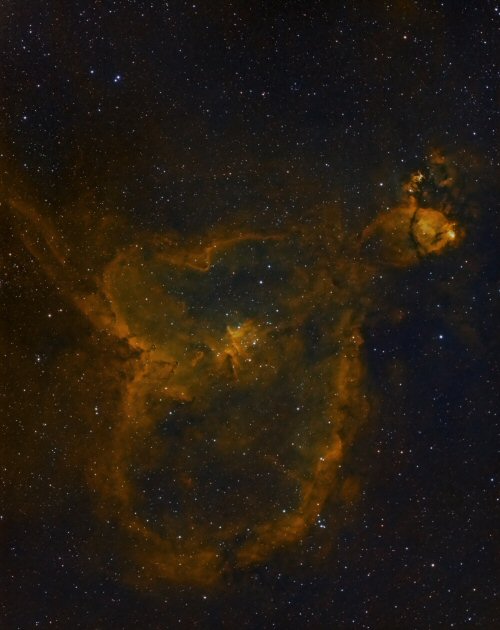
Next are two more images taken with the Redcat/Trius/narrow band setup, !C 1805 the Heart emission nebula in Cassiopeia and IC 2177 the Seagull emission nebula on the Monoceros/ Canis Major border:

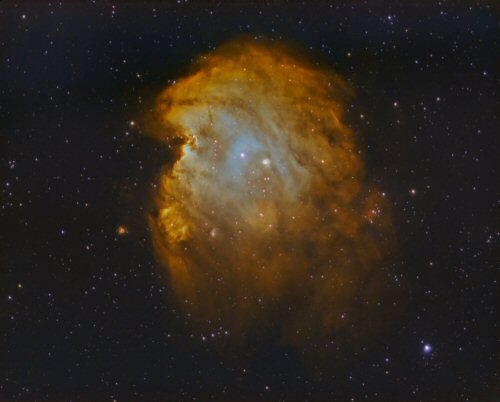
Next is the Monkey Head emission nebula NGC 2174/5 in Orion, this with an ES 127mm refractor and Trius camera plus narrow band filters:
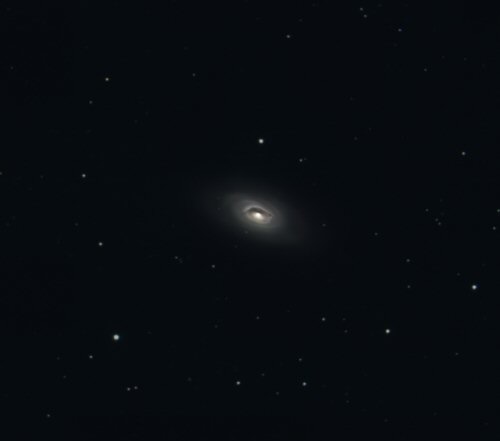
Steve also imaged four galaxies. Taken with a Celestron C8 SCT and ZWO ASI294 MC colour camera are M64 the Black Eye galaxy and NGC 4725 both in Coma Berenices:

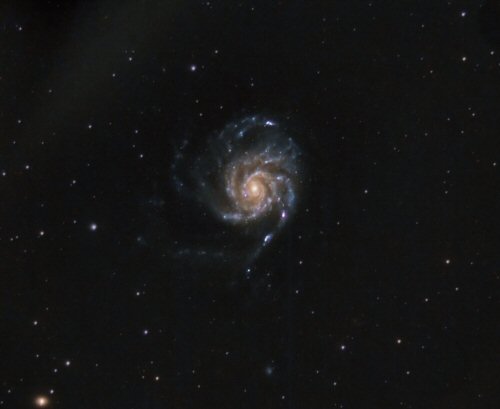
Below are M101 the Pinwheel galaxy in Ursa Major and M51 the Whirlpool galaxy in Canes Venatici, taken with an ES 127mm refractor and ZWO ASI294 MC colour camera:

Dave Finnigan