
An improvement in weather conditions brought an upturn in the number of observations received by the section; eight members sent in a total of twenty-nine digital images, four drawings and one visual report.
Richard Lewis, observing from Suckley, used a Takahashi 106mm f5 refractor and ZWO ASI 294 colour camera to capture NGC2244 the Rosette emission nebula in the constellation of Monoceros. Adding a 1.6 x Extender Q to give an f8 focal ratio Richard also imaged M1 the Crab supernova remnant in Taurus:
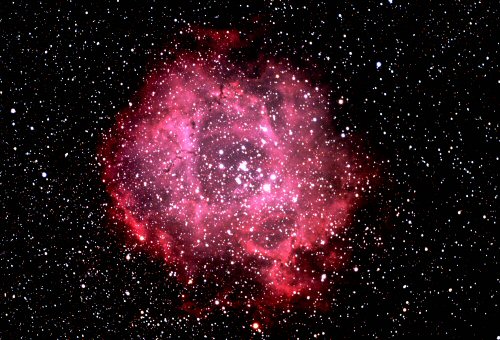
NGC 2244, also known as Caldwell 50, is a young open cluster with an estimated age of under 5 million years. There are stars within the cluster which are 50 times the mass and 400,000 times the luminosity of the sun.

Lewis Parry, a new contributor to this section, employed an equatorially mounted Canon 700D DSLR and 200mm telephoto lens from his location in Fife to image wide-angle views of M42 emission/reflection nebulosity in the constellation of Orion, galaxies M81 and M82 in Ursa Major and the emission nebulocity around γ (gamma) Cygni, Sadr:


IC 1318 is much more distant from the Earth at about 4,900 light years than Sadr, which is around 1,800 light years away. The Crescent nebula is visible at the far centre right of the image.
David Davies sent in images of The Soul emission nebula IC 1849 in the constellation of Cassiopeia and galaxy NGC 3718, also known as Arp 214, in the constellation of Ursa Major:


NGC 3718 shows evidence of gravitational interaction with the second galaxy in this image, NGC 3729. This pair of galaxies is about 52 million light years from the earth: the group of five galaxies above NGC 3718 in this image is known as Hickson 56 and is about eight times further away at 400 million light years.
David used an 8” Richey Chretien telescope and QSI 683 camera for the galaxy image, and an APM 107 APO refractor for the nebula image from his observatory in Cambridge.
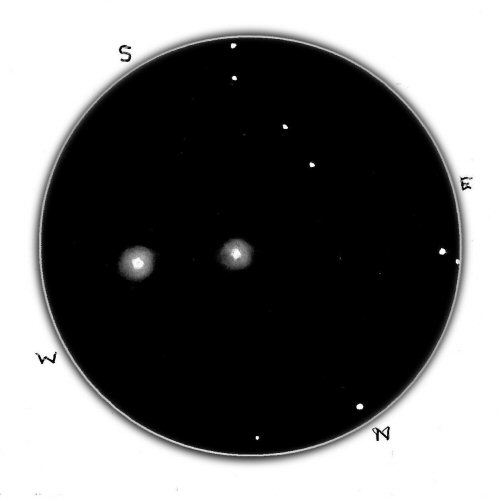
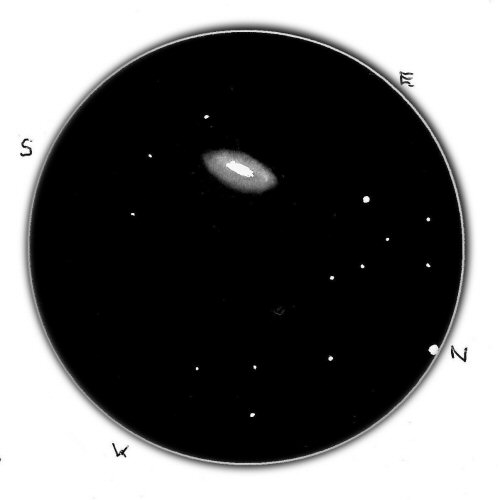
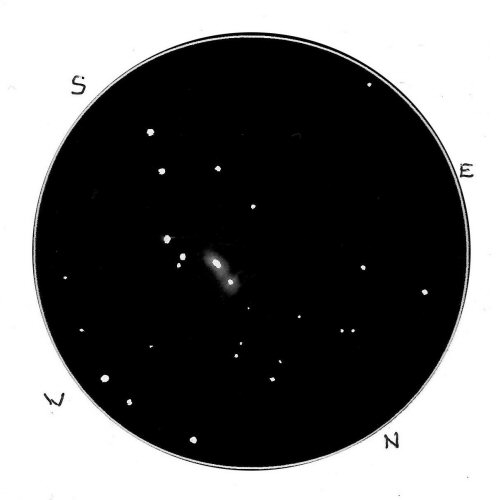
Michael Kinns of Eastry sent in four sketches, open cluster NGC 1245 in the constellation of Perseus and three galaxies in Leo: M105, NGC 2903 and Arp 94:
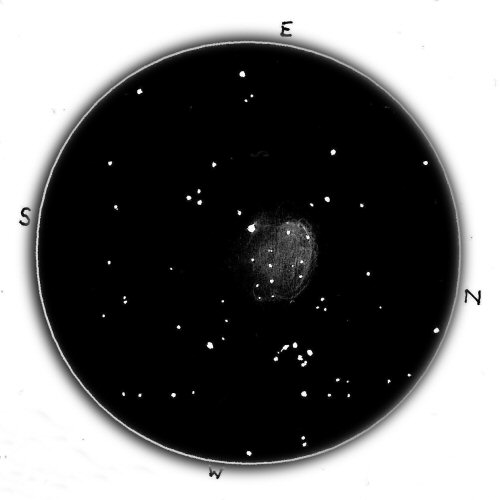
NGC 1245 is thought to be of the order of one billion years old: much more ancient than the Sword Handle clusters in Perseus which are about 12.8 million years old. It is possible that lower mass members of the cluster have migrated away the rest. There are evolved orange stars present, fusing hydrogen in their shells, as well as main sequence stars.
Mark Beveridge imaged six galaxies, four in the constellation of Coma Berenices: M64, M91, M98 and M100
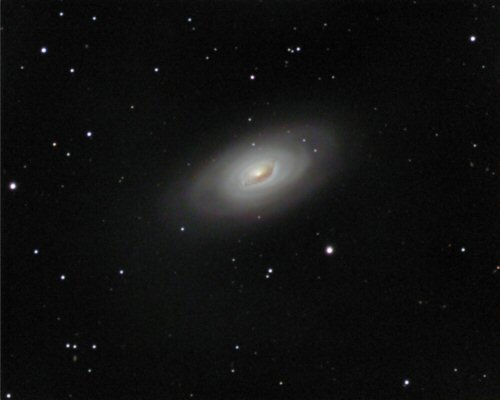
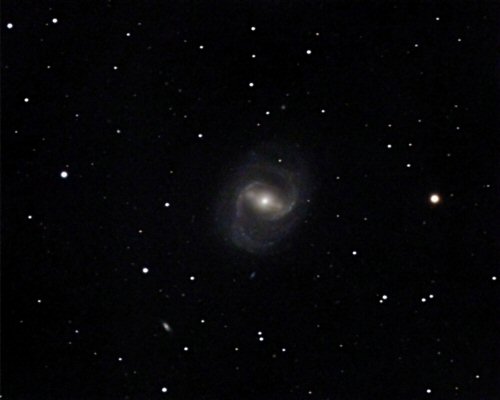
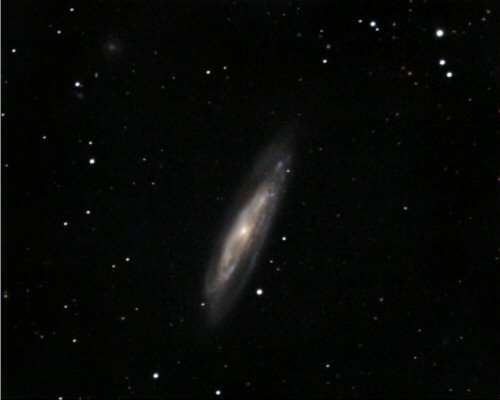
M98 is an intermediate spiral galaxy inclined to our line of sight. It is about 45 million light years from the Earth, and around 160,000 light years across. It has an active nucleus and may have interacted with another spiral galaxy, M99 (not in this image) in the distant past. It’s spectrum is blue shifted, indicating a velocity component of 140 km/sec towards the milky way.

Mark also imaged NGC 2541 in Lynx and NGC 2768 in Ursa Major:


Mark observes from Thainstone with a 200mm Celestron Edge HD f10.4 SCT, an SXR H814 mono camera and red, green and blue filters.
Ian Papworth used a Skywatcher 150P Newtonian reflector and an Altair Hypercam 183C Pro colour camera to capture five deep sky images; globular clusters M53, M3 and M92 in the constellations of Coma Berenices, Canes Venatici and Hercules respectively and M63 the Sunflower galaxy in Canes Venatici plus M97 the Owl planetary nebula in Ursa major:


M63 lacks clearly defined spiral arms and belongs to a type known as Flocculent Galaxies. It has a weakly active nucleus: the emissions are unresolved so the presence of a super massive black hole hasn’t been confirmed.

Steve Norrie, observing from Fife, sent in eleven images, all but one of galaxies. First are two of M51 the Whirlpool galaxy in Canes Venatici, one using a Celestron C8 SCT the other an ES 127mm refractor:


In a similar fashion Steve imaged M106 in Canes Venatici twice with different telescopes:
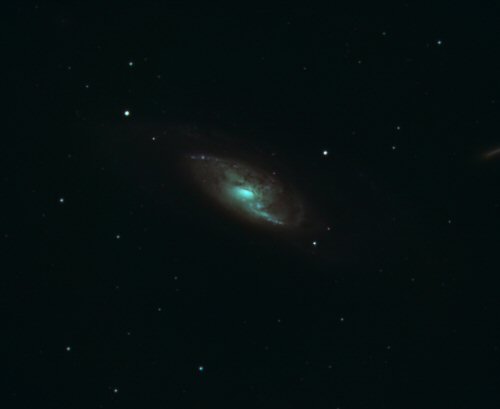
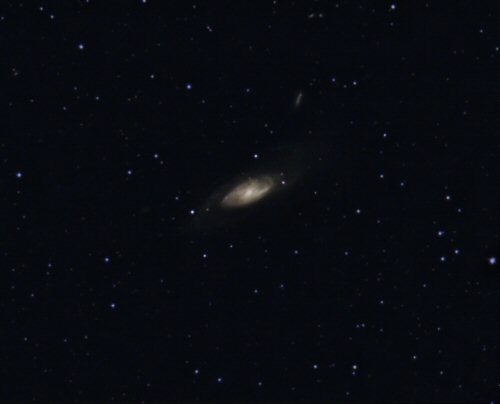
The next images are galaxies M63 the Sunflower galaxy in Canes Venatici, M65 amd M66 in Leo, M94 in Canes Venatici, M101 the Pinwheel galaxy in Ursa Major then NGC 4631 and NGC 5033 both in Canes Venatici:


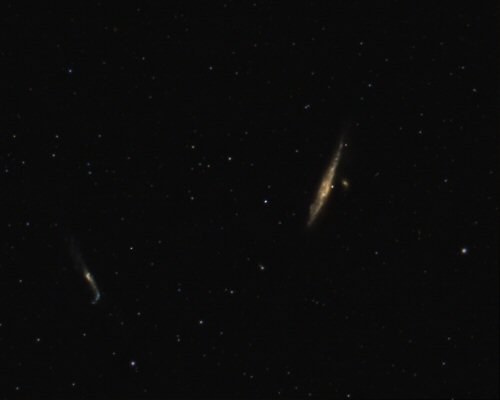
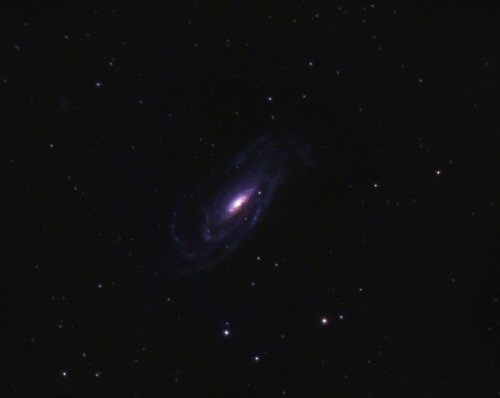
NGC 5033 is around 60 million light years from the Earth, and is a Seyfert galaxy with an active galactic nucleus. This nucleus is thought to contain a super massive black hole, which is displaced from the point around which the stars in this galaxy rotate, causing instabilities which may explain the brightness of the nucleus.
Steve’s other image is a close up detail of IC 1396 the Elephant’s Trunk emission nebula in Cepheus:

Steve used a variety of telescopes and either a Trius 694 mono camera (with red, green, blue and narrow band filters) or an Atik 490 colour camera.
Paul Brierley, observing coordinator for the Macclesfield AS, made a number of visual observations using a Celestron C9.25 SCT. In Ursa Major, Paul found M82 brighter than M81 with a 24mm TV Panoptic eyepiece giving 97x. Moving to Canes Venatici, and changing to an 18mm Altair Ultra Flat eyepiece (130x), M51 and NGC 5195 were clearly seen, and M94 appeared very bright with this eyepiece. Paul finished his session with views of the Cocoon galaxy NGC 4490 and globular cluster M3.
Dave Finnigan