
The weeks just before and just after the summer solstice are generally a lean time for deep sky observers in the UK, so it is pleasing to post these observations by four section members who sent in four images and one drawing. Of particular interest is the supernova SN2023ixf in M101, shown in an image and a sketch below.
David Davies imaged globular cluster NGC 6229 in the constellation of Hercules with a 250mm Richey Chretien telescope plus 0.7x focal reducer and ZWO ASI294 MC Pro colour camera:
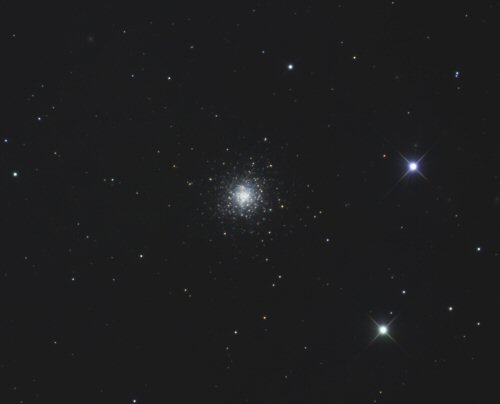
NGC 6229 is at around 100,000 light years from the Earth and contains two separate generations of stars, leading to speculation that it might be all that remains of a dwarf galaxy which was absorbed by our own galaxy in the distant past.
Geoff Elston imaged M101 the Pinwheel galaxy in the constellation of Ursa Major, including the recent supernova, with a Skywatcher Maksutov 125mm telescope and a Canon 550D DSLR camera:

SN 2023ixf is a type II core collapse supernova, which was discovered by Japanese amateur astronomer Koichi Itagaki on the 19th of May 2023. If the core of the galaxy is considered as a clockface, it is the bright spot in a spiral arm approximately at the eight o’clock position.
Ian Papworth used a Skywatcher 150P Newtonian f5 reflector and Altair Astro Hypercam 183C Pro colour camera to image globular cluster NGC 5466 in the constellation of Bootes and the same telescope plus an Atik 314L mono camera to image M57 the Ring nebula in Lyra:
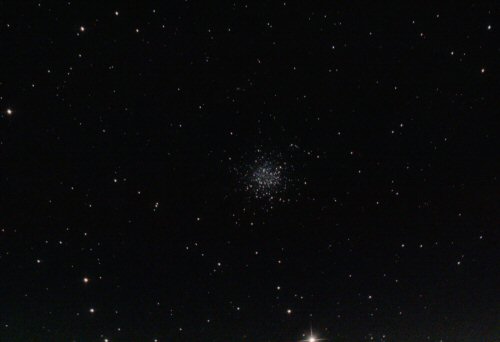
NGC 5466 is around 53,000 light years from the Earth, and is very poor in elements heavier than helium, with an estimated age of 12.88 billion years. It is considered to be the source of a stream of stars extending across the sky from Bootes to Ursa Major which was discovered less than twenty years ago.

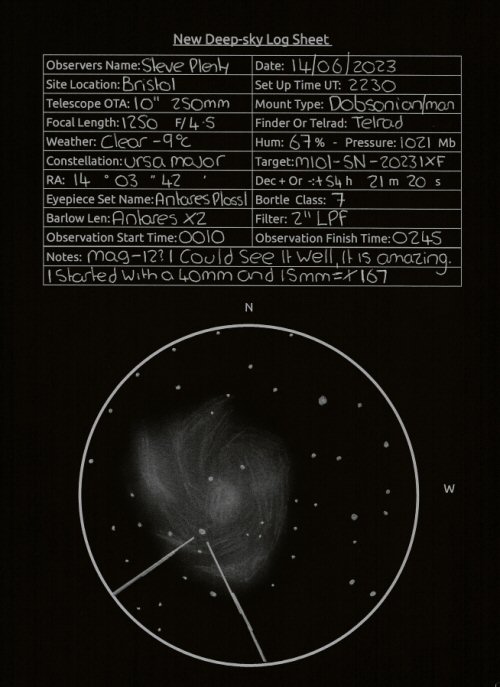
Steve Plenty made a drawing of spiral galaxy M101, indicating the supernova, observing with a 10″ Dobsonian reflector A copy of Steve’s reporting sheet is reproduced below:
Dave Finnigan