
June is always a challenging month for deep sky observers, with hours of astronomical darkness in short supply for those in the South of the UK and pretty much non existent in the far North. Despite this, four section members have produced between them five digital images and one drawing.
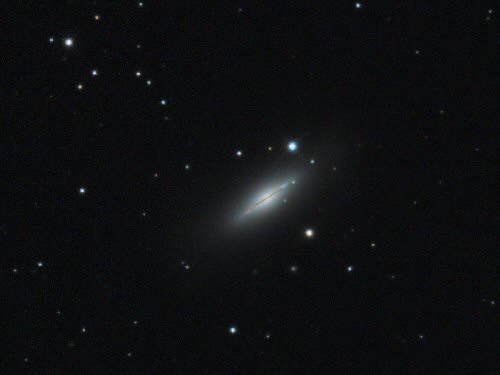
David Davies provided two of these images, galaxy M99 in the constellation of Coma Berenices and a second galaxy M102, the Spindle galaxy; also in Coma Berenices. David used an 8” Richey Chretien telescope and a QSI 583 camera plus red, green and blue filters.

M99 clearly has a distorted shape, with an asymmetric core and one spiral arm extended away from the rest of the galaxy (on the left in this image). A past gravitational encounter with NGC 4262, another galaxy in the Virgo Cluster, is a possible cause. As a result, M99 is forming new stars at a higher rate than might be expected for this type of galaxy.
Steve Plenty, new to this section, sketched globular cluster M13 in the constellation of Hercules. Steve has two Newtonian reflestors: a 10” f5 Dobsonian and a 6” f5 Skywatcher150P.
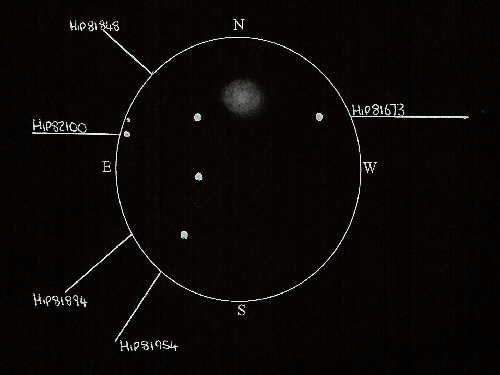
M13 is an easy globular for binocular observers, and is resolvable into countless stars away from the absolute centre in a 150mm telescope. M13 is about 22,000 light years from the Earth, and is around 145 light years across; its stars are ancient, 12 billion or more years old.
Ian Papworth also observed M13 using a Skywatcher 150P Newtonian telescope; taking a digital image with an Altair Hypercam 183 C colour camera:

Mark Beveridge used a Celestron 200mm Edge f10.4 SCT and a SXR – 814 camera plus red, green and blue filters to image globular cluster M5 in the constellation of Serpens and galaxy M94 in Canes Venatici.

As with M13, this globular may be resolved into individual stars with a 150mm telescope.
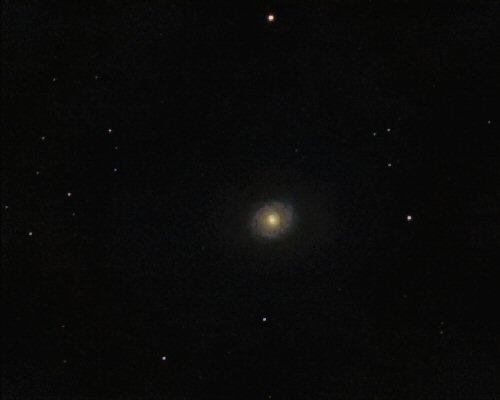
M94 is unusual because studies show that it has very little dark matter present. The outer disk of the galaxy is active; about one – tenth of new stars are forming here. An inner ring is also forming lots of new stars and has been called a starburst ring.
Dave Finnigan