
This month four section members sent in 24 digital images of deep sky objects.
Richard Lewis took these images of emission/reflection nebula M42 and reflection nebula M78, both within the constellation of Orion with a Takahashi 106mm refractor and ZWO ASI 294 MC colour camera:
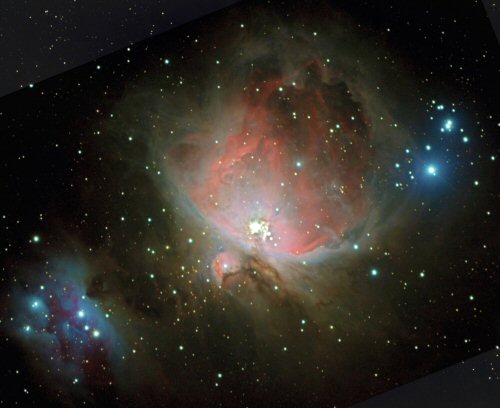
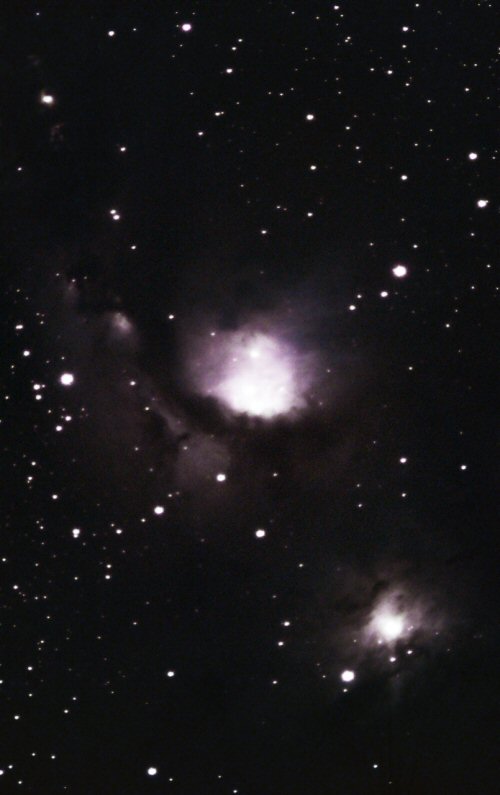
M78 is a part of the Orion B molecular cloud complex, and is reflecting light from two highly luminous class B stars, HD 38563 A and HD 38563 B. M78 contains a cluster of stars which shine in the infra red part of the electromagnetic spectrum; there are Herbig Haro objects here too, indicative of newly created stars and a number of pre-main sequence T Tauri variable stars less than 10 million years old.
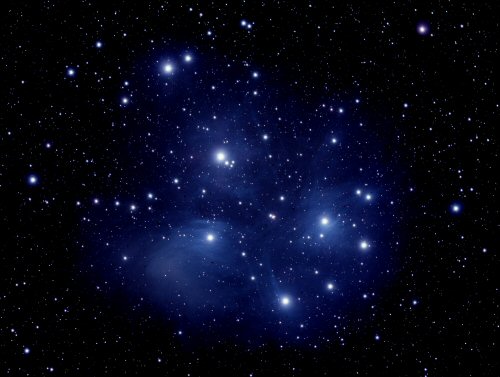
Richard also imaged M45 the Pleiades open cluster in Taurus and IC 1396 the Elephant’s Trunk emission nebula in Cepheus:

Mark Beveridge sent in ten images taken with a Celestron C11 SCT plus 0.63 focal reducer and a ZWO ASI 294 MC Pro colour camera. M81 Bode’s galaxy, NGC 2841 and NGC 3079 are all in the constellation of Ursa Major:


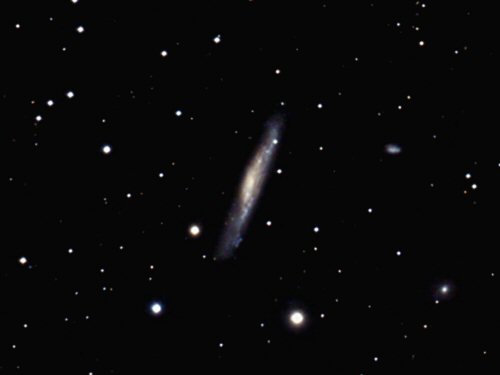
NGC 949 is a spiral galaxy in Triangulum, NGC 972 is in Aries, NGC 660 is in Pisces, NGC 1055 is in Cetus and NGC 7497 is in Pegasus:


NGC 660 is classed as a polar ring galaxy, however the ring of material is tilted at about 45 degrees from the galactic plane. It is thought that a gravitational encounter with another galaxy a billion years ago is a likely explanation. There is an ongoing high rate of new star formation and NGC 660 is also classed as a starburst galaxy.

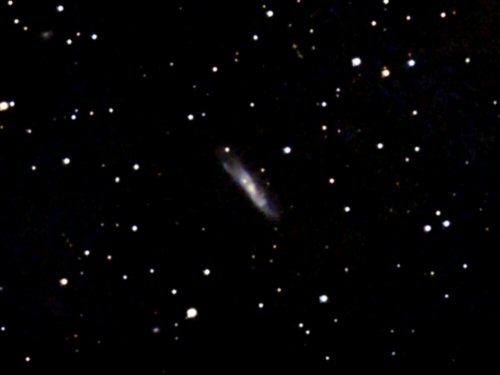
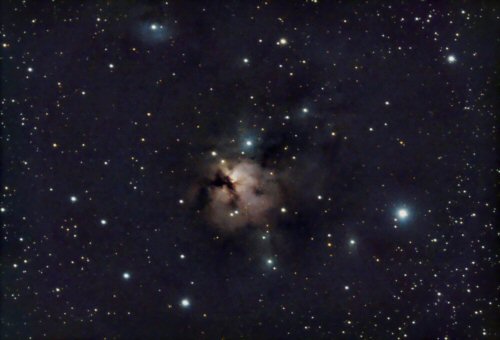
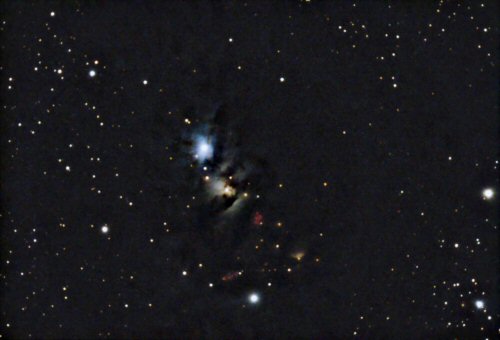
Mark also imaged emission/reflection nebula NGC 1579 in Perseus, known as the Northern Triffid, and reflection nebula NGC 1333 also in Perseus:
Alan Clitherow, director of the SPA Planetary Section, used a WO 71mm refractor and a QHY 268 M mono camera plus H II and OIII filters to image IC 1848 the Soul emission nebula in the constellation of Cassiopeia:
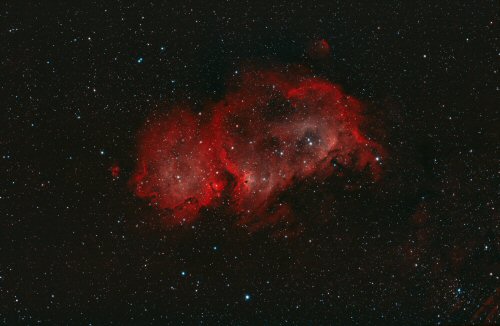
The whole nebula is known as Westerhaut 5 or Sh2-199 and although usually called IC 1848 this is refers to one of four open clusters within it, the others being Cr 34, Cr 632, Cr 634, (Cr short for the Collinder catalogue which contains 471 open clusters). The theory that cavities created by radiation and stellar winds from the most massive stars (as seen in this image) lead to new star creation as matter is concentrated towards cavity edges is known as Triggered Star Formation. Studies have shown that stars are progressively younger with distance from cavity central points.
Steve Norrie imaged IC 443 the Jelly Fish supernova remnant in the constellation of Gemini, IC 1805 the Heart emission nebula in Cassiopeia and NGC 7000 the North America emission nebula in Cygnus with an EDR 72mm refactor and ZWO ASI 294 MC colour camera

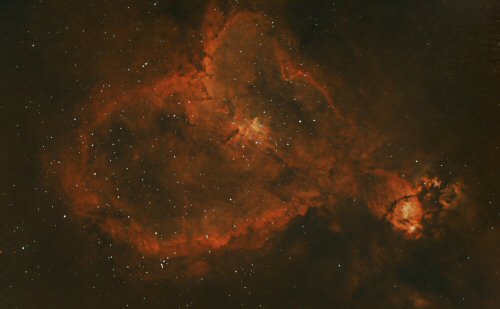
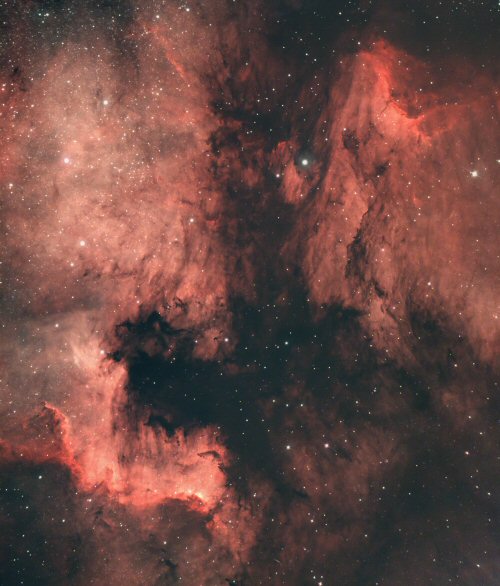
Steve’s next six images were taken with Celestron C8 SCT and Trius 694 mono camera plus narrow band filters for the nebula image and red, green and blue filters for the galaxy images.
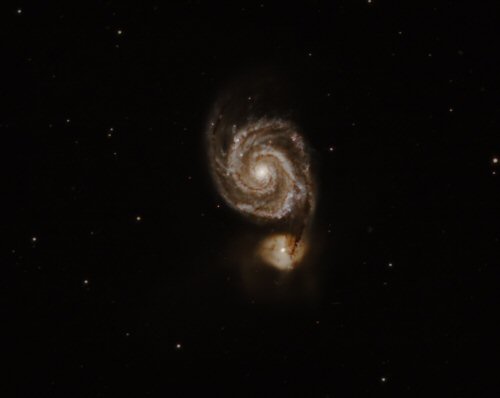
The objects are Sh2 – 112 emission nebula in Cygnus, M51 the Whirlpool galaxy and M106 both in Canes Venatici, M82 the Cigar galaxy and NGC 2841 both in Ursa Major and NGC 2403 in Camelopardalis:


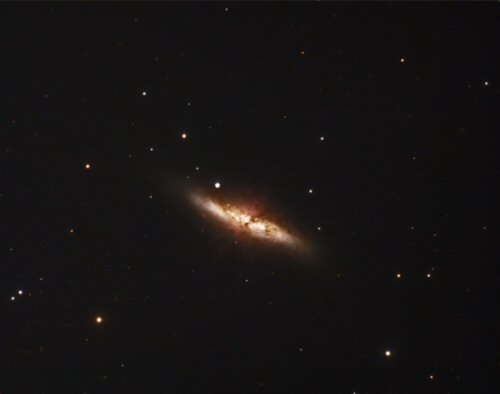
M82 is the closest starburst galaxy to the Earth at a distance of around 12 million light years. The accelerated star formation is understood to have been triggered by gavitaional interaction with M81 (see above). M82 hosts the brightest pulsar known so far, M82 X-2, equivalent to ten million suns in radiation energy. It spins once every 1.37 seconds and orbits a 5 solar mass star every 60 hours.
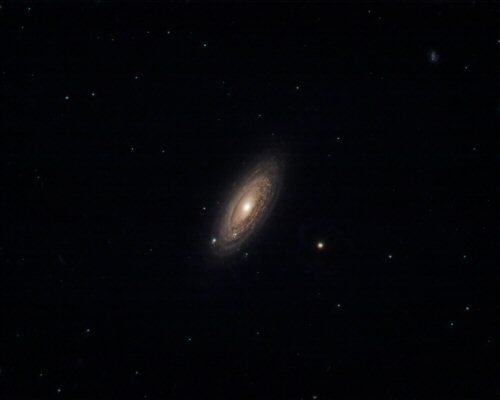

Dave Finnigan