
Despite clear skies being a rarity this month, two section members were able to send in eighteen images of deep sky objects:
Mark Beveridge took images of galaxies M108 and NGC 2985, both in the constellation of Ursa Major, plus NGC 2146 (with NGC 2146A at the bottom right corner) in Camelopardalis, from Aberdeen with a Celestron C11 SCT plus 0.63x focal reducer and ZWO ASI 294 MC Pro colour camera:


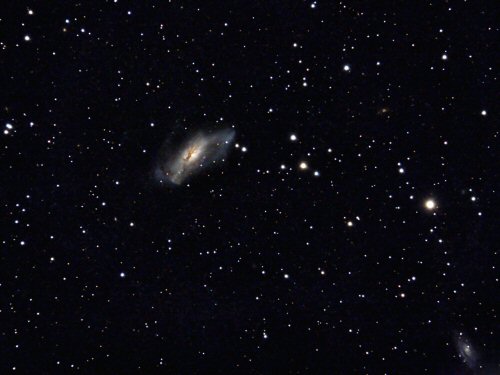
NGC 2146 is a starburst barred spiral galaxy with a high rate of new star formation. It is thought that a gravitational encounter with NGC 2146A around 800 million years ago may be resposible for this, and NGC 2146’s distorted spiral arms.
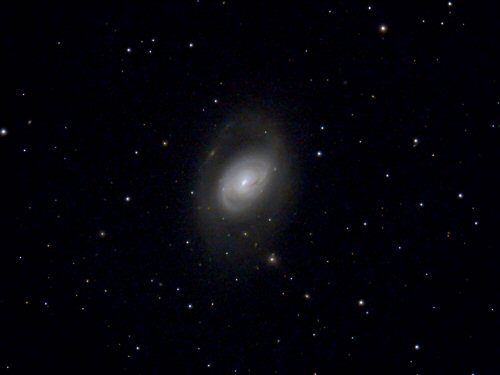
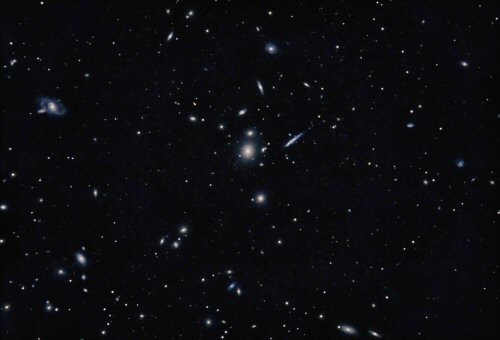
With the same telescope and camera set-up, but from Thainstone, near Inverurie, Mark made further observations. Below are M82 in Ursa Major; also M95, M96, Abell 1367 (the Leo Cluster) and the Hickson 44 group of galaxies which are all in Leo:



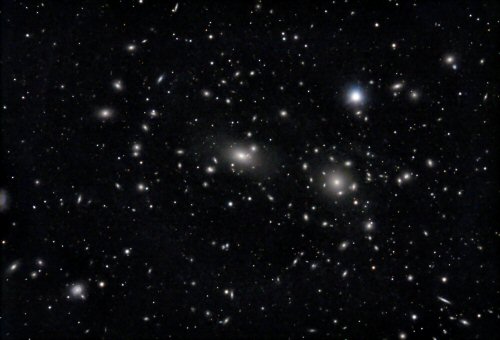
Mark imaged galaxy M99 and Abell 1656 (the Coma Cluster of galaxies) in Coma Berenices, NGC 2445 and NGC 2500 in Lynx, galaxy NGC 2595 (with PGC 23700, a ring galaxy top right) in Cancer and NGC 2392 planetary nebula in Gemini:

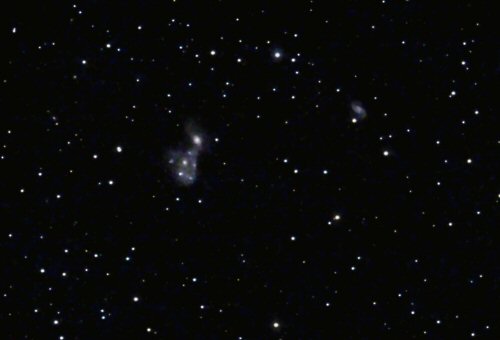
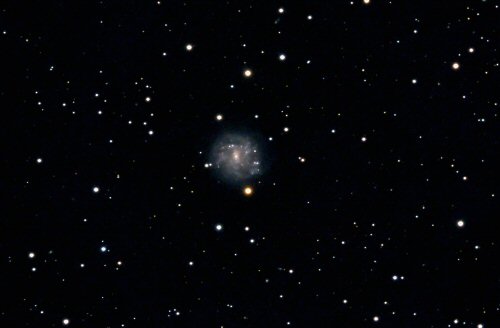
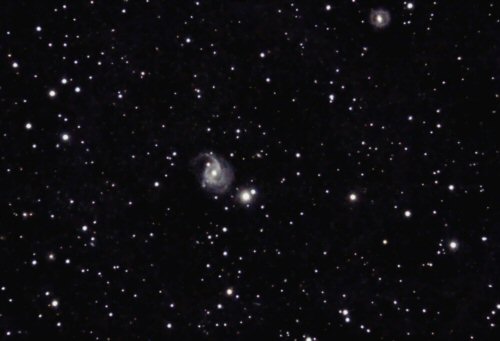

Steve Norrie imaged three emission nebulae: Melotte 15 (the open cluster at the centre of the Heart Nebula) in the constellation of Cassiopeia, NGC 1579 the Northern Triffid in Perseus and NGC 2359 Thor’s Helmet in Canis Major with a Celestron C8 SCT and Starlight Xpress Trius 694 mono camera plus narrow band filters to give the Hubble palette colour effect:

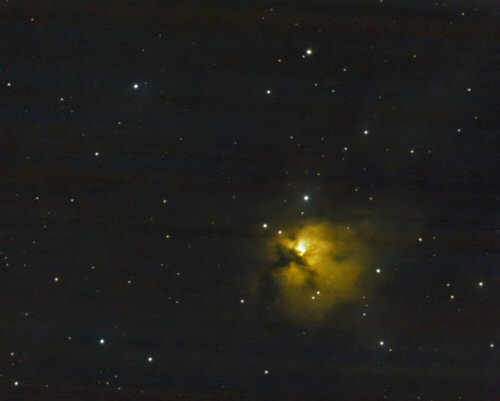

NGC 2359 is similar to NGC 7635 the Bubble emission nebula, in that a hot star (in this case the pre-supernova Wolf Rayet star WR7) is sculpting and ionising the material around it.
Steve switched to a Redcat 71mm refractor and Altair Astro AA26 TEC colour camera plus Optolong L-eXtreme filter for this image of the Spaghetti supernova remnant on the Auriga/Taurus border:

Dave Finnigan