
Six section members made observations in between periods of very stormy weather. In total they sent in two sketches and thirteen digital images.
Michael Kinns sketched open cluster M35 in the constellation of Gemini and the Leo triplet galaxies, M65, M66 and NGC 3628 observing with an Orion Optics SPX 200mm Newtonian reflector at a magnification of 67x:
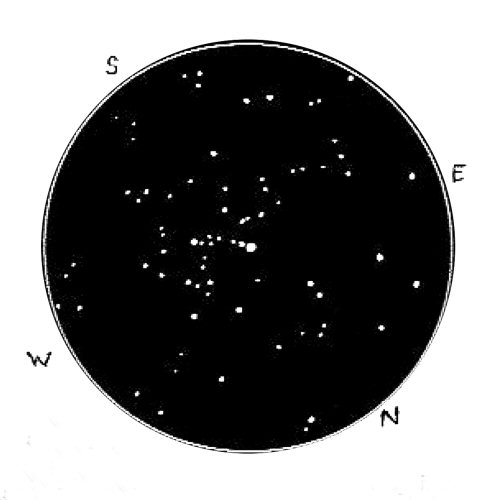
M35 is a naked eye object away from light pollution at a magnitude of 5.2. Appearing similar in diameter to the full moon (approximately 30 arcminutes) the cluster is readily seen in binoculars.

Richard Lewis imaged M33 the pinwheel galaxy in the constellation of Triangulum, NGC 2244 the Rosette nebula in Monoceros, IC 2177 emission nebula on the Monoceros/Canis Major border and IC 405 the Flaming Star emission/reflection nebula in Auriga:

M33 is quoted as having an apparent magnitude of 5.7; it is not easily seen without optical aid however as it has low surface brightness – the light is spread over about 70 x 40 arc minutes (more than two full moons). A small telescope at low power is a good way to attempt to see this object.
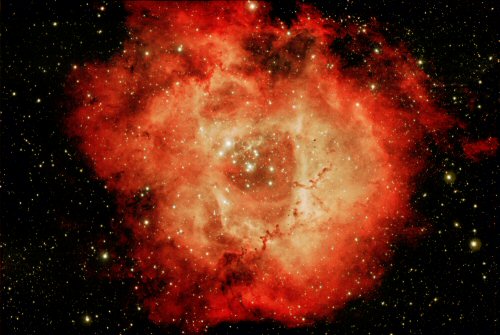

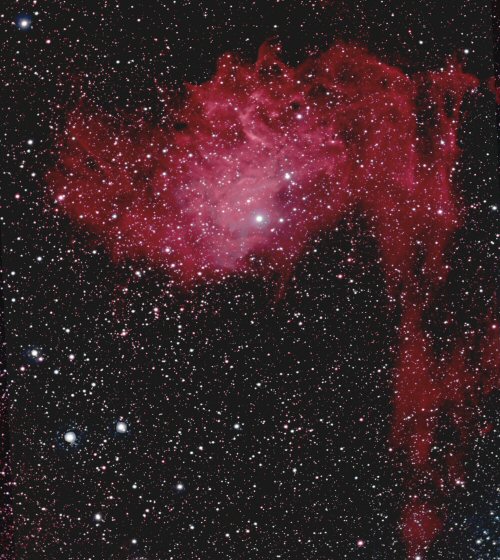
Richard used a Takahashi f5 106mm refractor and ZWO ASI 294 MC colour camera plus an Altair Quadband filter.
John Fathers imaged NGC 2359 Thors Helmet emission nebula in the constellation of Canis Major with a Celestron C11 SCT and ZWO ASI 294 M mono camera plus H II and OIII filters:

NGC2359 is being energised by ionising radiation from a hot Wolf Rayet star WR 7, which may ultimately become a supernova. A powerful stellar wind is sculpting the gas thrown off from the star and interacting with molecular clouds in the vicinity.
With the same telescope and a ZWO ASI 071 MC colour camera plus Optolong L-eNhance filter John also imaged Abell 21 the Medusa planetary nebula in Gemini:

Alan Clitherow, SPA Planetary Section director, imaged IC 1805 the Heart emission nebula in the constellation of Cassiopeia using a Williams Optics 71mm refractor and QHY 268 M mono camera plus HII filter:

IC 1805 contains an open cluster of young, massive, energetic stars responsible for ionising the nebulosity. The cluster is known as Collinder 26 or Melotte 15, and several of these stars are of the order of 50 solar masses.
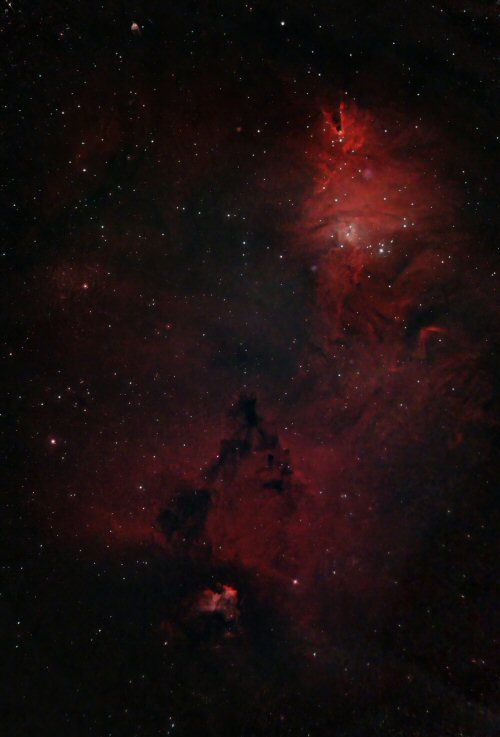
Steve Norrie sent in five images of emission nebulae, all taken with an EDR 72mm refractor and a ZWO ASI 294 MC colour camera. An Optolong L-eNhance filter was used for NGC 281, an Optolong L-eXtreme filter for the others.
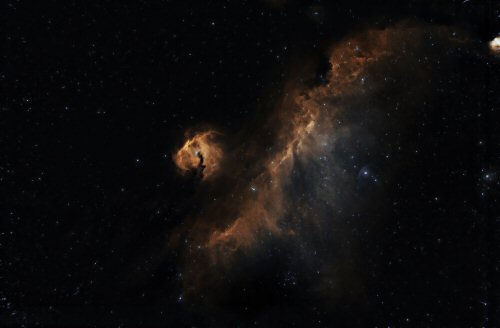
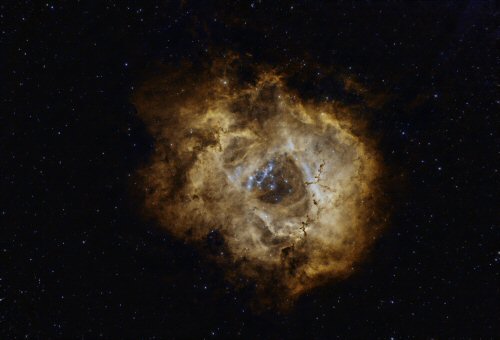
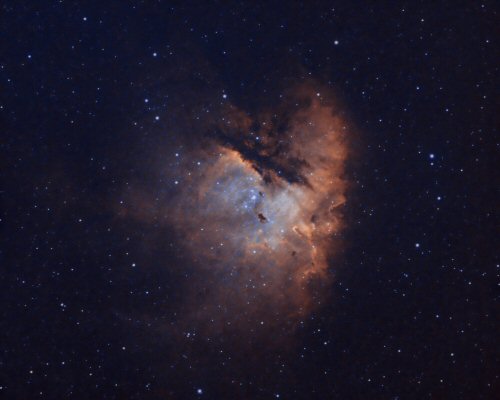
Below are NGC 2264 the Cone nebula, IC 2177 the Seagull’s Head nebula and NGC 2244 the Rosette nebula all in the constellation of Monoceros, then NGC 281 the Pacman nebula in Cassiopeia and Sh2-132 the Lion nebula on the Cepheus/Lacerta border:
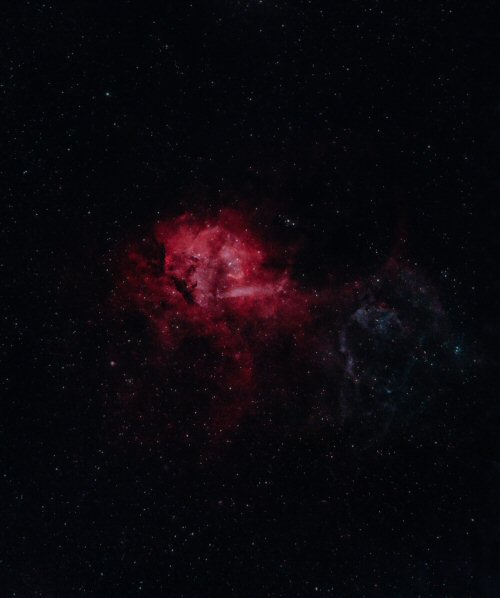
Within Sh2-132 hot, massive stars are ionising the nebulosity; among them are two Wolf Rayet stars, W 152 and W 153.
Lewis Parry used a Skywatcher Evostar 72mm ED f5.8 refractor and Canon 700D camera to image NGC 7023 the Iris reflection nebula in the constellation of Cepheus:
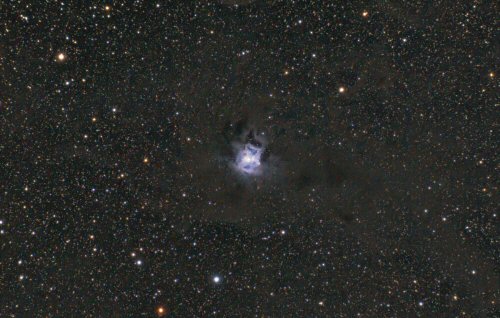
NGC 7023 is technically the associated open cluster just above the reflection nebula LBN 487. A young, hot, blue, ten solar mass star SAO 19158, spectral type B5, is at the centre of the nebula, providing the illumination.
Dave Finnigan