
Another quiet month for the section, with two members sending in images.
Steve Norrie imaged seven emision nebulae, the first being NGC 2244 the Rosette Nebula in the constellation of Monoceros, taken with a Williams Optics Redcat 71mm f4.9 refractor and Starlight Xpress Trius 694 mono camera plus narrow band filters to give the Hubble palette:
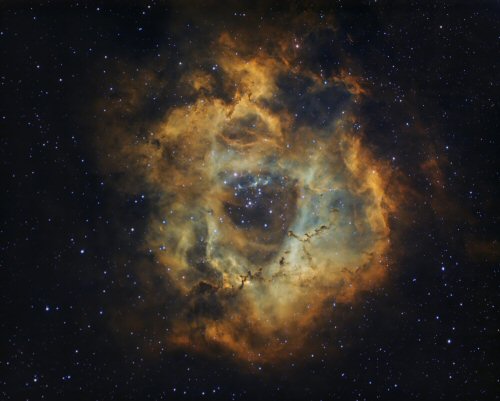
To be accurate, NGC 2244 is the open cluster of stars at the centre of the nebulosity. This open cluster is thought to be no more than 5 million years old, and is about 50 light years across. It contains a number of massive, hot O class stars, whose powerful ultra violet radiation ionises the surrounding gas, while their stellar winds are removing gas and dust from the centre. Two stars worth mentioning are HD 46223 and HD 46150, which have been estimated to be 50 and 60 times the mass of our sun respectively, with luminosities 400,000 and 450,000 times that of the sun. It is possible that the more massive star might actually prove to be a double).
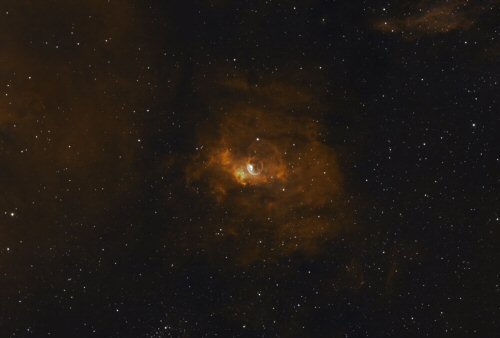
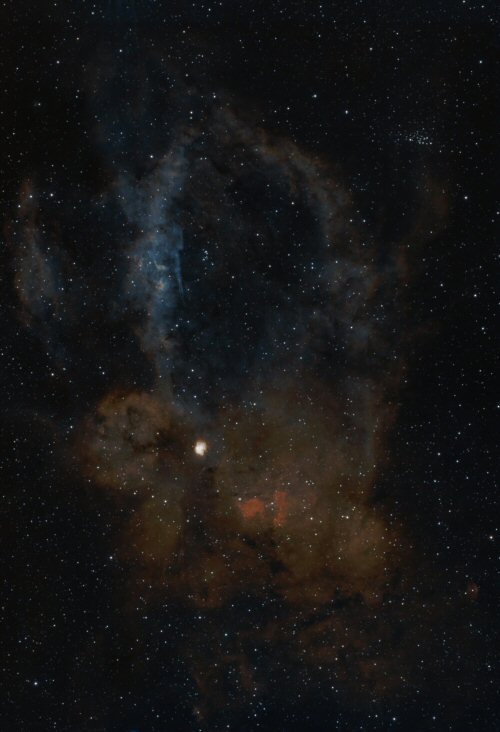
The remaining images were all taken using an Explore Scientific 127mm f7.7 refractor and ZWO ASI 294 MC colour camera plus a Svbony dual band (HII, OIII) filter. NGC 7635 the Bubble Nebula and Sh1-109 the Lobster Claw Nebula are both in Cassiopeia:
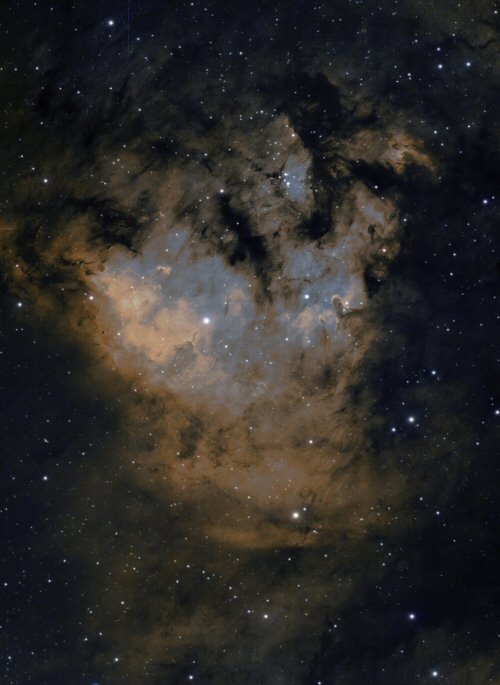
Below are NGC 7822 and Sh2-131 the Elephant’s Trunk Nebula, which are both in Cepheus:
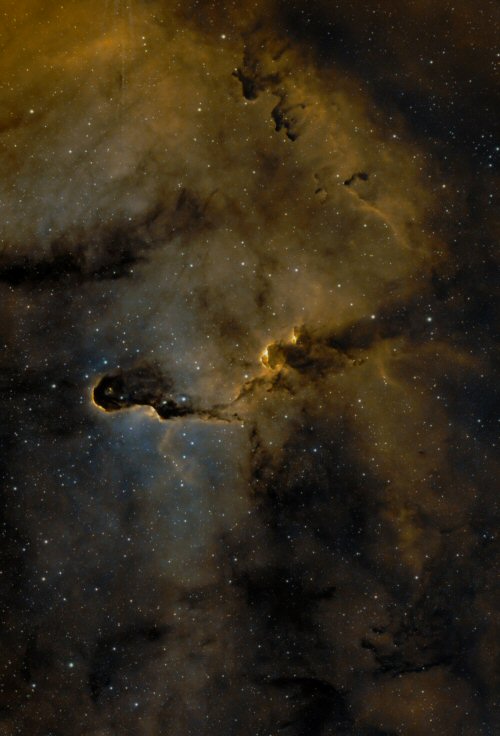
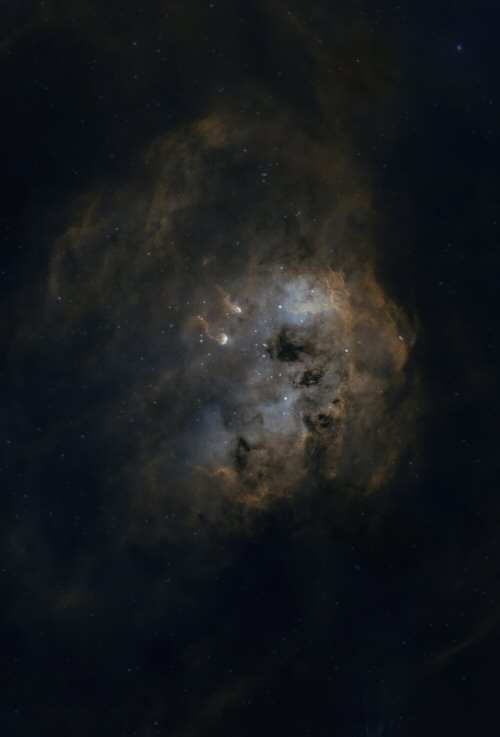
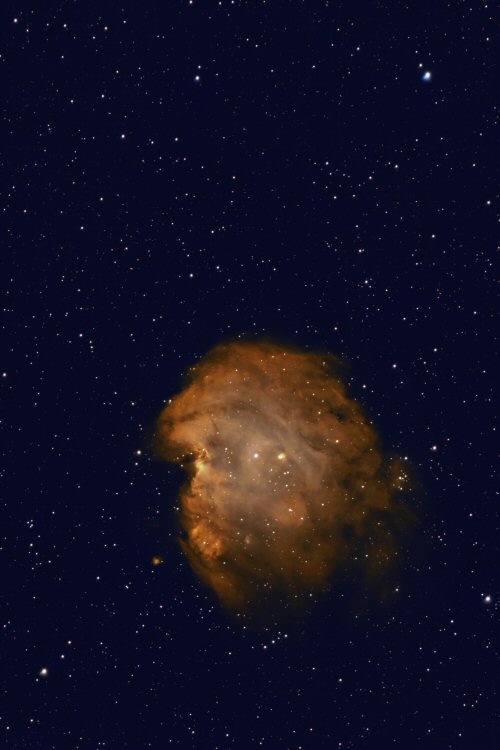
Steve also imaged IC 410 the Tadpoles Nebula in Auriga and NGC 2175 the Monkey Head Nebula in Orion:
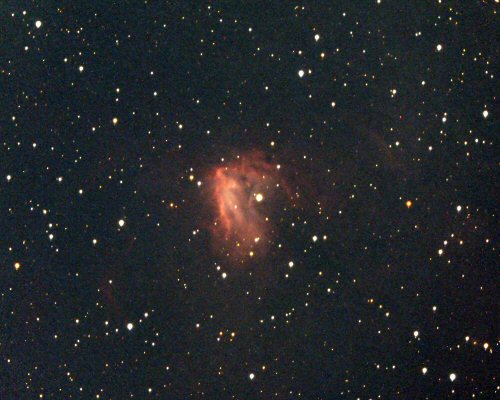
Mark Beveridge imaged galaxy IC 10 in the constellation of Cassiopeia and emission nebula NGC 1491 the Fossil Footprint in Perseus with a Celestron C11 SCT with a 0.63x focal reducer and ZWO ASI 294 MC Pro camera:
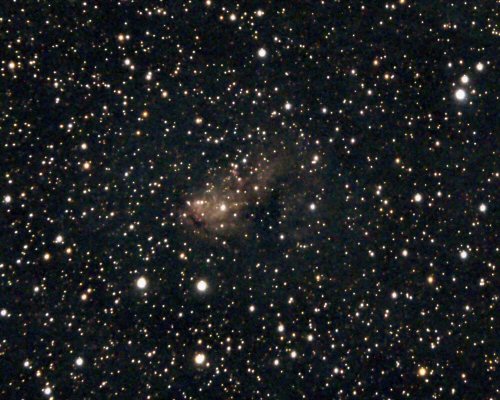
IC 10 is an irregular galaxy, and is the only known star burst galaxy within our Local Group, and the closest one to the Earth. The HII regions in IC 10 are of the order of 10 million years old. Many Wolf-Rayet stars of similar ages to each other have been detected.
Dave Finnigan