
This month, three section members submitted eleven deep sky images.
Paul Brierley captured this image of M45 the Pleiades open cluster in the constellation of Taurus with a Williams Optics ZS 61mm refractor, ZWO ASI 294 MC camera and Optolong L-Pro light pollution broadband filter:

The Pleiades contains hot, blue B type stars of around 100 million years old, and is 444 light years from the Earth The blue reflection nebulosity evident in the above image is thought to be a dust cloud through which the cluster is passing, at a relative velocity of about 18 km per second.
David Davies imaged planetary nebula M76 the Little Dumbbell in the constellation of Perseus with a 250mm Richey Chretien telescope, field flattener and ZWO ASI 071 MC camera plus an Antilia Dual Band filter:

M76 is about 2,500 light years from the Earth, and is 2.7 x 1.6 arcminutes in angular size. With an apparent magnitude of 10.1, it is one of the faintest (and smallest) Messier objects.
Steve Norrie imaged IC 410, the Tadpoles emission nebula in the constellation of Auriga and a part of IC 1805, the Heart nebula in Cassiopeia with a Celestron C8 SCT and a Starlight Xpress Trius 694 mono camera pus narrow band filters:


Steve imaged spiral galaxy M31 in Andromeda, first with a Redcat 51mm refractor and ZWO ASI 294 MC camera, then with a Redcat 71mm refractor plus AA 26 TEC camera:


With the same telescope and camera pairings plus an Optolong L-eXtreme filter, Steve took two images of NGC 2264 the cone emission nebula and Christmas tree open cluster in Monoceros:
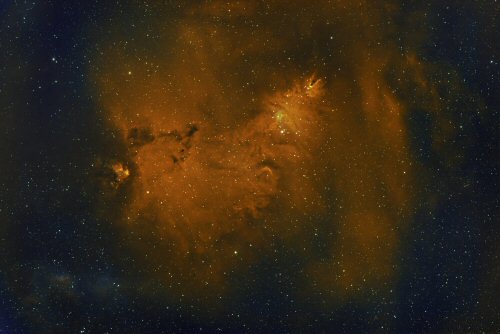
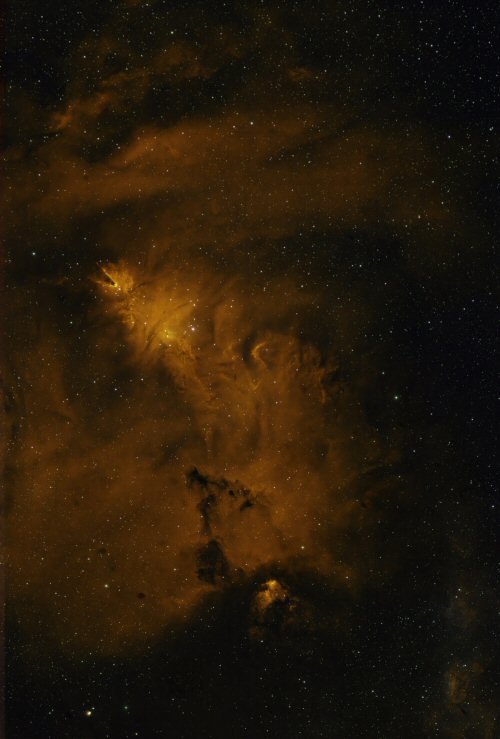
The above nebulous region is around 2,300 light years from the Earth, and incudes the Fox Fur nebula and Snowflake nebula. The brightest star in the Christmas Tree cluster is S Monocerotis, a massive multiple star system.
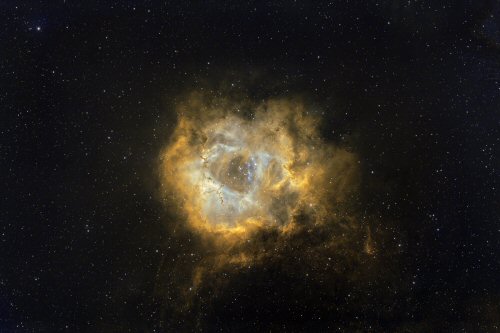
Similarly, NGC 2244 the Rosette emission nebula in Monoceros, imaged with the 51mm setup then the 71mm:

Steve also captured a wide angle view of the Tadpoles emission nebula in Auriga (see IC 410 above) on the left and IC 405 the Flaming Star emission nebula on the right with the Redcat 71/AA26 TEC combination:

Dave Finnigan