
The midwinter month delivered few gaps in the cloud cover; happily five deep sky section members were able to take a total of twelve digital images.
John Fathers imaged emission nebula NGC 1491 in the constellation of Perseus using a 115mm refractor, a ZWO 071 MC colour camera and a TriBand filter:

NGC 1491, also known as Sh2-206, is being energised by the ultra violet radiation emitted by a hot, young star designated BD +50 886, which combined with a powerful stellar wind is creating a cavity in the nebulosity.
Richard Lewis imaged the Pleiades open cluster M45 and supernova remnant M1 both in the constellation of Taurus, also NGC 1499 the California emission nebula in Perseus and NGC 2244 the Rosette emission nebula in Monoceros:


NGC 2244 is estimated to be of the order of 5 million years old or less. A number of spectral type O stars, young, hot and radiating in UV with powerful stellar winds, are ionising the gas in the nebula (which is considerably hotter than most HII regions). The brightest star within the cluster, HD 46150, is type O5V and estimated to be 450,000 times more luminous than the sun.
Richard used a Takahashi FSQ 106mm refractor and a ZWO ASI 294 MC colour camera. Richard also added data using a Triband filter for the last three images.
Ian Papworth took this image of B33 the Horsehead dark nebula in the constellation of Orion with a Skywatcher 150P Newtonian reflector and an Altair Hypercam 183c colour camera:

The gright star in the above image is Alnitak, zeta Orionis, the easternmost of Orion’s belt stars. B33 is a dark cloud of dust and gas, sihouetted against emission nebulosity generated by radiation from Alnitak. The reflection/emission nebula below and to the left of B33 is NGC 2023, illuminated by a pre-main sequence star HD 37903.
David Davies imaged dwarf elliptical galaxy M110 in the constellation of Andromeda:

M110 is a satellite of M31, a small part of which is in the bottom left of the above image. M110 has been found, unlike most dwarf ellipticals, to contain regions of dust, and also contains young blue stars at its core. For this reason M110 is designated a peculiar galaxy.
David used an 8″ Richey Chretien telescope with a 0.7x focal reducer and QSI 683 mono camera plus red, green and blue filters
Steve Norrie imaged emission nebula IC 410 in the constellation of Auriga with an EDR 72mm refractor and StarlightXpress Trius 694 mono camera and narrow band filters:

The open cluster within IC 410 is NGC 1893; the stars here are young (of the order of 4 million years old), energetic sources of UV and stellar winds . Just above top centre in the above image are two vertical streams of nebulosity known as the Tadpoles of IC 410. These are 10 light year long regions of probable new star formation.
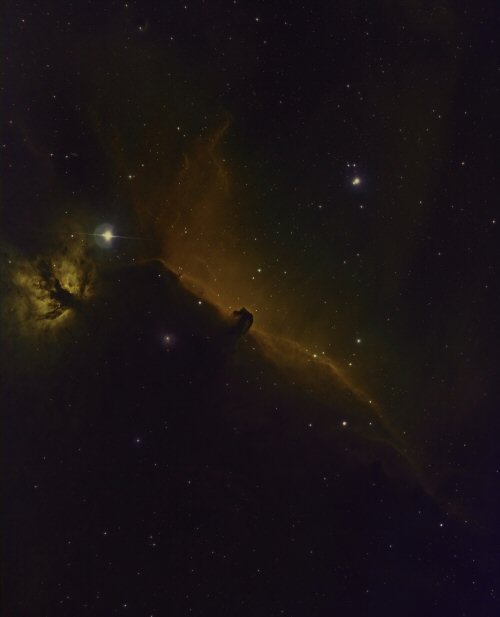
With the same setup Steve imaged B33 the Horsehead dark nebula in Orion and NGC 2264 the Cone emission nebula in Monoceros (which also contains the Christmas Tree open cluster):

With the same camera, but now connected to a Celestron C8 SCT Steve imaged M1 the Crab supernova remnant in Taurus and emission nebula NGC 7538 in Cepheus:


Dave Finnigan