
A return to longer hours of darkness, together with some clear sky periods has enabled three members to take ten images of deep sky objects.
Ian Papworth used a Skywatcher 72mm ED refractor and Altair Hypercam 183C Pro colour camera to image NGC 6888 the Crescent emission nebula in the constellation of Cygnus, NGC 7635 the Bubble emission nebula in Cassiopeia and NGC 869 and NGC 884 the Sword Handle double cluster in Perseus:


The Sword Handle, two open clusters of young, hot stars lying side by side in the sky, is about 7,500 light years from the Earth. their respective magnitudes of 5.3 and 6.1 allow them to be seen with the naked eye from a dark sky site.
Alan Clitherow imaged IC 5146 the Cocoon reflection/emission nebula in the constellation of Cygnus using a Skywatcher MN 190 P Maksutov – Newtonian telescope and QHY 268 MC colour camera:

IC 5146 hosts an open cluster of young, hot stars known as Collinder 470. The dark nebulosity in the image extending from the centre to the top centre is Barnard 168.
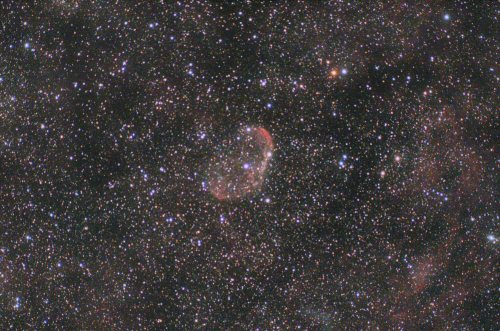
Steve Norrie sent in six images. With a Williams Optics Redcat 51mm f4.9 refractor and Altair Astro AA 26C Tec colour camera Steve imaged Sh2-119 the Clamshell emission nebula and NGC 7000 the North America emission nebula which are both in the constellation of Cygnus:


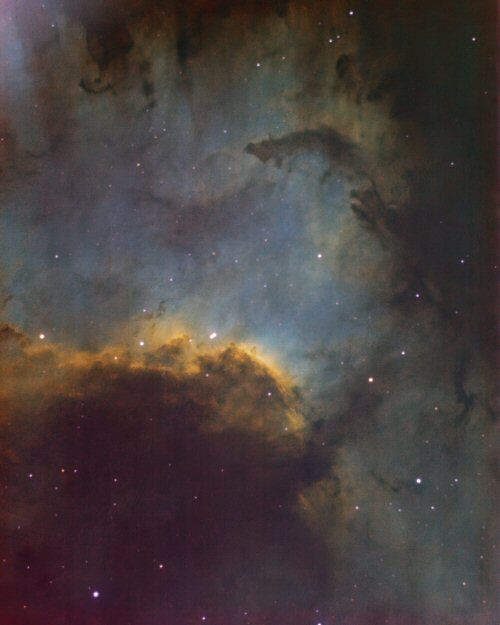
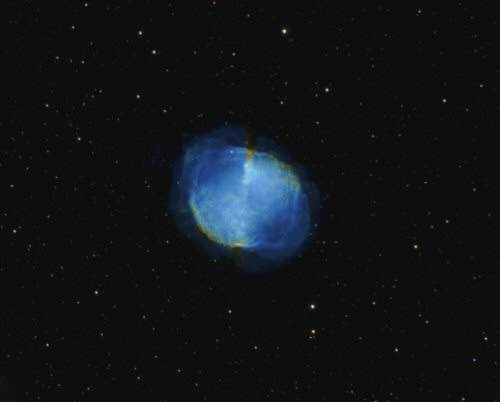
Using a Celestron C8 SCT and Starlight Xpress Trius 694 mono camera plus narrow band filters Steve imaged LBN 359, a part of the North America emission nebula featured above, NGC 7635 the Bubble emission nebula also featured above, and M27, the Dumbbell planetary nebula in Vulpecula:

Steve also imaged NGC 281 the Pacman emission nebula in Cassiopeia with n Explore Scientific ED 127mm refractor together with the Trius 694 camera and narrow band filters:
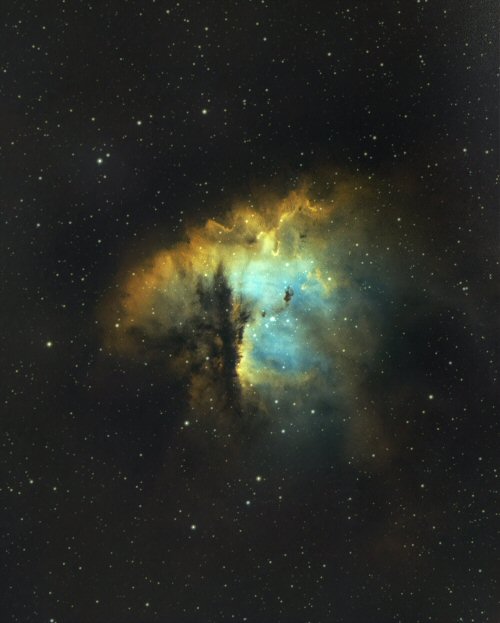
NGC 281 is about 20 x 30 arc minutes in angular size, which translates to about 50 light years across at an estimated distance of around 9,500 light years. The nebulosity is a site of new star formation, and contains Bok Globules, an open cluster of young stars designated IC 1590 and a highly luminous O class star HP3121.
Dave Finnigan