
A welcome return, for deep sky observers, to longer hours of darkness resulted in six section members sending in twenty digital images and one drawing.
Paul Brierley used a Williams Optics Z61 f5.9 refractor coupled with an astro-modified Canon EOS 6000 DSLR plus an Optolong L-eNhance filter to image the North America emission nebula in the constellation of Cygnus:

NGC 7000 is a region of ionised hydrogen, which is being energised by the ultra violet radiation of a binary pair of young massive type O stars. The nebula is 90 light years from top to bottom and 140 light years across, and Gaia gives the distance from Earth to be 2,590 light years. A second image of this nebula, by Steve Norrie, is reproduced below.
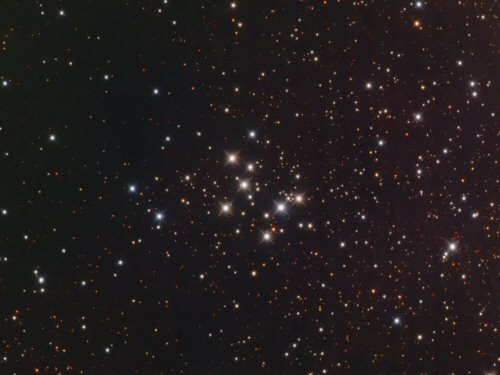
David Davies imaged open cluster M29 in the constellation of Cygnus, globular clusters M75 in Sagittarius and NGC 6229 in Hercules plus galaxy NGC 7331 in Pegasus:
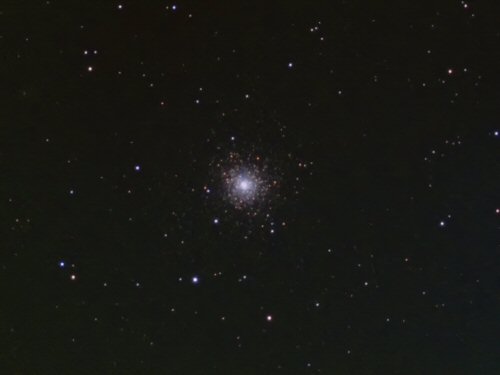
Data from the Gaia space observatory identified the remnants of a dwarf galaxy which merged with our milky way galaxy about 8 – 11 billion years ago, the most recent merger of this kind. Along with 50 billion solar masses of stars, we think at least 8 globular clusters were added to the milky way, and M75 is one of these.

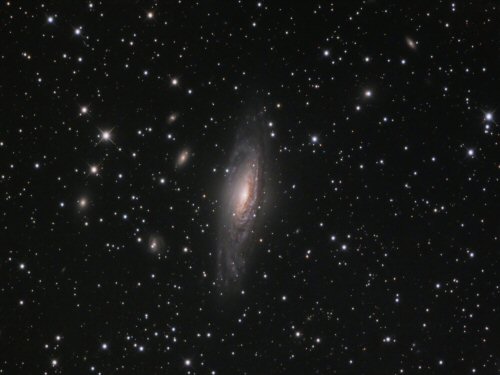
David used a 250mm Richey Chretien telescope and a QSI 683 mono camera plus red, green and blue filters.
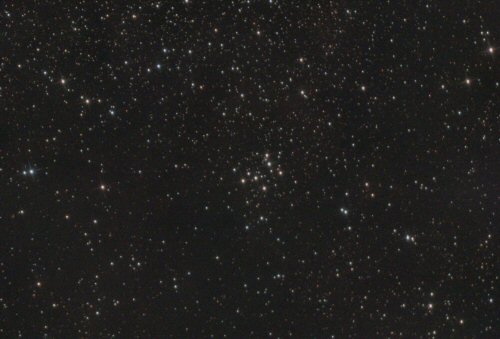
Ian Papworth captured five deep sky objects with a combination of a Skywatcher 150P Newtonian telescope and an Altair Astro 183C colour camera. Open cluster NGC 6910 is in the constellation of Cygnus, open cluster M29 is also in Cygnus, globular cluster M71 is in Sagitta, globular cluster M15 and galaxy NGC 7331 are both in Pegasus:


M71 is a very loosely concentrated globular cluster, indeed until the 1970’s it was thought to be a densely concentrated open cluster. As globulars go, it is relatively young at 9 or 10 billion years, but examination of the H – R (temperature vs luminosity) diagram for the constituent stars settled the matter.

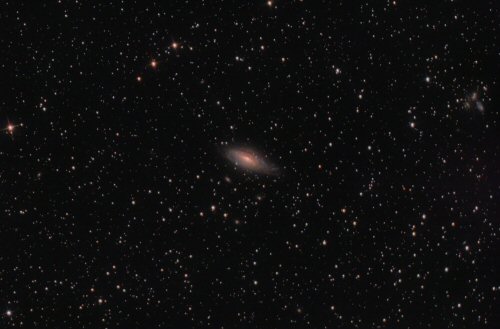
Steve Plenty used a 250mm Newtonian telescope plus a 40mm eyepiece to give a magnification of 31x to sketch the Pleiades open cluster M45 in the constellation of Taurus:

M45 is currently thought to be 444 light years from the Earth, the nearest Messier object and visible to the naked eye from reasonably dark skies. It contains a number of hot blue B type stars and the age of the cluster lies in the range 75 – 150 million years.
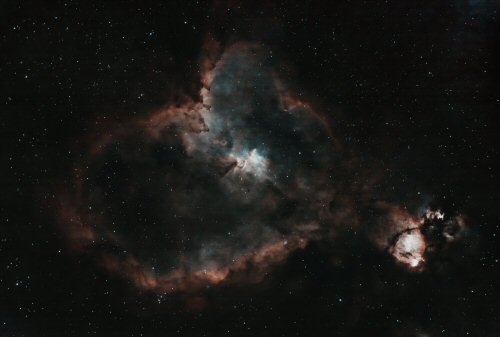
Steve Norrie used an EDR 62mm refractor and ZWO ASI 294 camera plus either Optolong L-eXtreme filter or narrow band fiters to image emission nebulae IC 1396 the Elephant’s Trunk nebula in the constellation of Cepheus, IC 1805 the Heart nebula and NGC 281 the Pacman nebula both in Cassiopeia, also NGC 7000 the North America nebula and IC 5070 the Pelican nebula both in Cygnus:

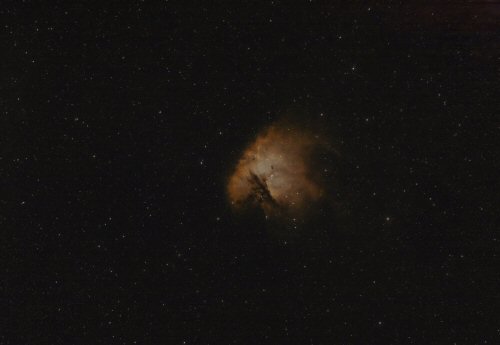
NGC 281 is associated with open cluster IC 1590. Bok globules are present, which are thought to be indicative of new star formation. A highly luminous type O star, designated B1, is also present.


Mark Beveridge sent in five images, two emission nebulae. two planetary nebulae and a pair of galaxies captured with a Celestron C11 SCT with a 0.63 focal reducer and ZWO ASI 294 MC Pro colour camera. Below are IC 4954/5 in the constellation of Vulpecula, M17 the Swan nebula in Sagittarius, M57 the Ring nebula in Lyra, NGC 6894 in Cygnus and NGC2276/NGC2300 in Cepheus:

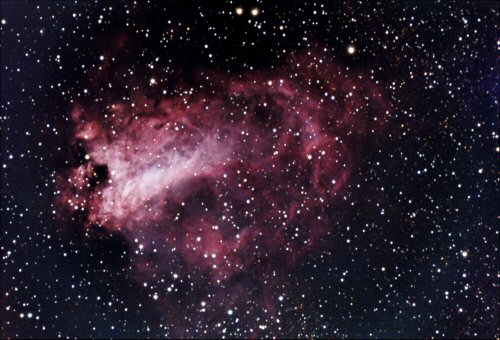


NGC 2276 is an intermediate spiral galaxy, and shows signs of gravitational disturbance, probably with elliptical galaxy NGC 2300, to its upper right in this image. NGC 2276 has starburst activity in its spiral arms, one of which contains an intermediate (50,000 solar mass) black hole.
Dave Finnigan