
Once again, it has been a challenging month with adverse weather conditions severely reducing opportunities for section members to make observations. Five of them were able to take a total of seven digital images:
Richard Lewis took this image of the Ring planetary nebula in the constellation of Lyra with a Takahashi 106N refractor working at f16 and a ZWO ASI 294 colour camera:

M57 has an apparent magnitude of 8.8 but is only around 1 x 1.5 arcminutes across so can be seen as a star-like point of light in binoculars but larger telescopes and higher magnifications are needed to reveal structure and detail. The central white dwarf is magnitude 15, and has a surface temperature of the order of 125,000 K.
Paul Brierley used an astro modified Canon EOS 600D DSLR with an 85mm f1.4 lens to produce this image NGC 7000, the North America emission nebula in the constellation of Cygnus:
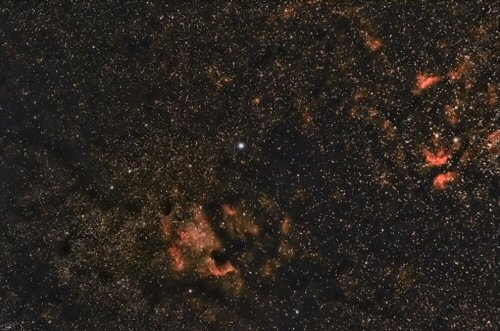
Data from the Gaia astrometry space observatory has measured the distance of 395 stars within the nebulosity, revealing that the North America Nebula and adjacent Pelican nebula are 2,590 light years from the Earth. This means that NGC 7000 is 90 light years across from north to south.
Ian Papworth took this image of NGC 6888, the Crescent emission nebula in the constellation of Cygnus, with a Skywatcher 150P Newtonian reflector and an Altair Hypercam 183C pro colour camera:
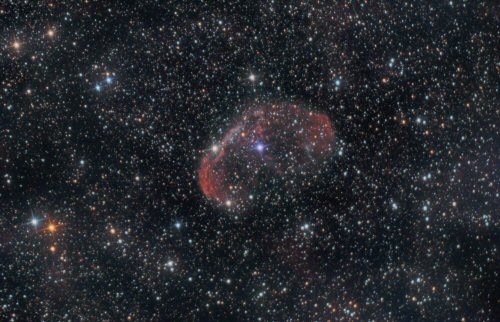
This nebula has been created by the hot central star, a Wolf-Rayet (WR 136), shedding its outer layers which are being ionised by the star’s powerful stellar wind.
David Davies used an 8” Richey Chretien telescope, a 0.7x focal length reducer and a QSI 683 mono camera plus red, green and blue filters to capture an image of globular cluster M15 in the constellation of Pegasus:

M15 is around 33,600 light years from the Earth and at an apparent magnitude of 6.2 may be readily seen with binoculars. It contains a planetary nebula, Pease 1, the first of just four discovered within a globular cluster.
Steve Norrie took three images of deep sky objects with a Celestron C8 SCT and a Trius 694 mono camera plus narrow band filters. The first two are narrow band versions of objects already depicted above, NGC 7000 and NGC 6888:
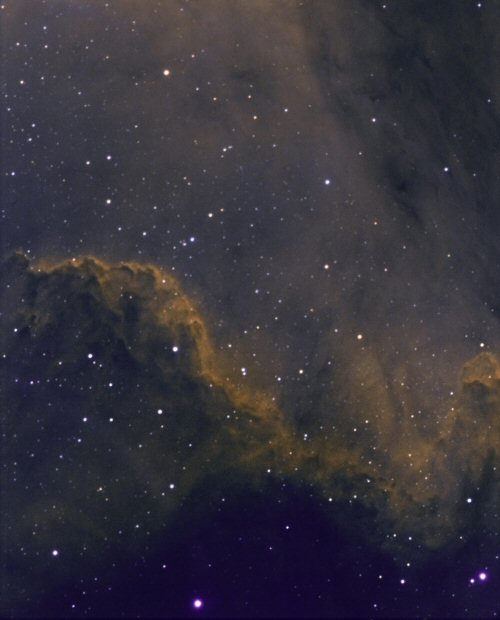
In marked contrast to Paul’s wide angle image of the whole NGC 7000 nebula and its surroundings, Steve’s image is a close up of one bright part of the nebula, known as the Wall.
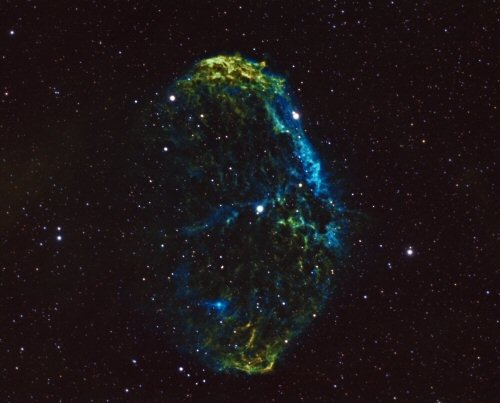
Steve’s third image is the Elephant’s Trunk emission nebula, in the constellation of Cepheus:

The cavity at the head of the nebula, at the top left, has been created by powerful stellar winds from a young, massive, hot star HD 206267. Material in the rim of the nebula is being compressed and is leading to new stars being created. Some of these protostars, reckoned to be only about 100,000 years old, were imaged in the infra red in 2003 by the Spitzer space telescope.
Dave Finnigan