
This month seven section members sent in their observations. Fifteen images of deep sky objects in total are featured in the report: a number of galaxies were imaged more than once, inviting comparisons between different telescope and camera combinations:
David Davies used a 250mm Richey Chretien f8 telescope and ZWO ASI 071 MC Pro colour camera to image M51, the Whirlpool spiral galaxy in the constellation of Canes Venatici:
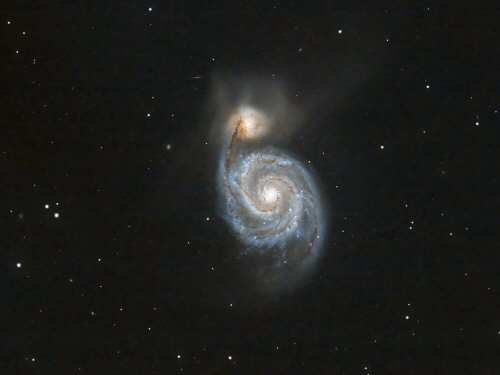
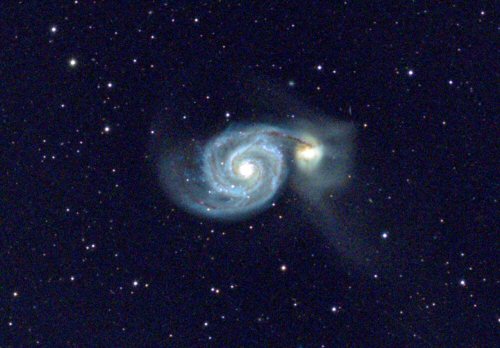
The object commonly referred to as M51 is actually a pair of interactng galaxies, the larger M51a or NGC 5194 and the smaller M51b or NGC 5195. The James Webb space telescope’s Near Infra Red Camera imaged M51 in August 2023 as part of a study of new star formation beyond our own galaxy. See also an image of M51 taken by Richard Lewis near the end of this report.
Paul Brierley imaged M67, an open cluster in the constellation of Cancer and M101 the Pinwheel spiral galaxy in Ursa Major with a ZWO SeeStar S50 smart telescope, which is a 50mm f5 optical system combined with a 1,920 x 1,080 2.9μm pixel sensor:
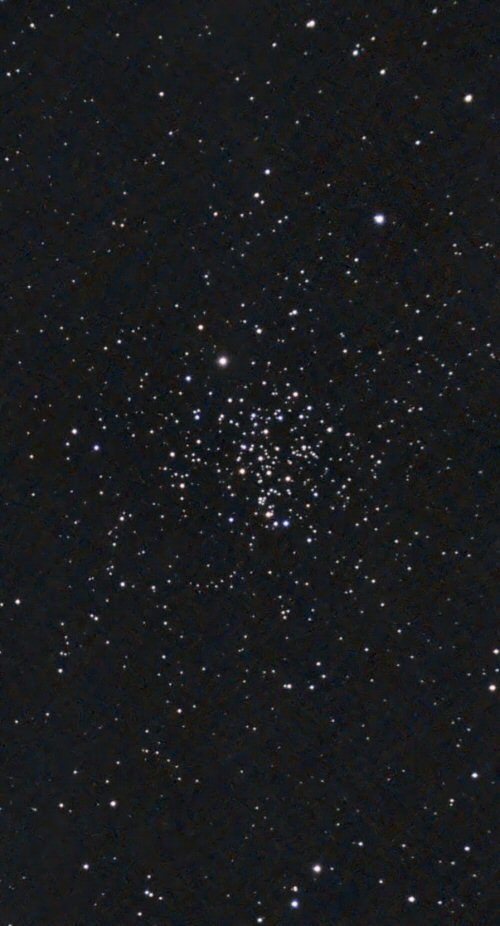
M67 is of great interest to professional astronomers, who study the evolution of the stars within it, because it is estimated to be about 4 billion years old. Some stars have already left the main sequence of the Hertsprung-Russell diagram, ultimately to become red giants
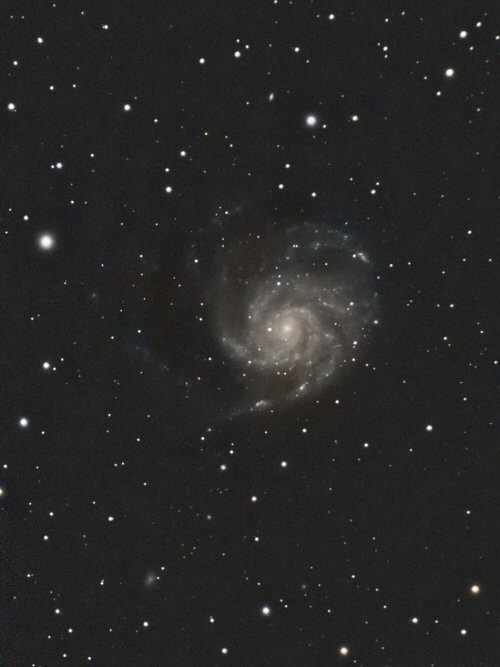
Steve Norrie and Alan Clitherow also imaged M101 this month.
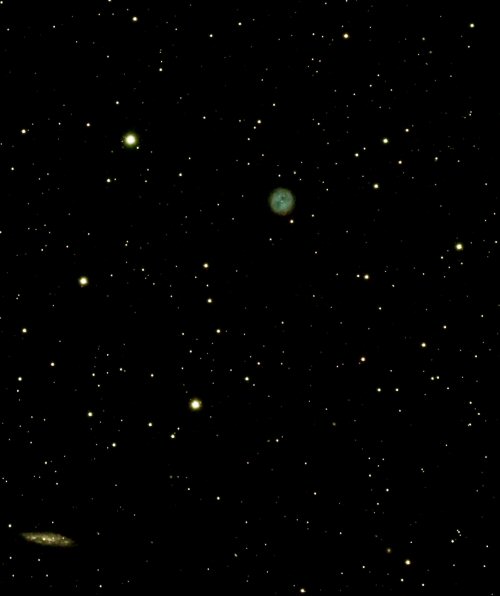
Cath Adams, SPA council member and merchandise manager, sent in her first contributions to the section: four images taken using a Vaonis Vespera II smart telescope, which is a 50mm f5 optical system plus a 3,840 x 2,160 2.9μm pixel sensor. Below are M65, M66, and NGC 3628 the Leo triplet of galaxies, M81 (Bode’s Galaxy) and M82 interacting galaxies in Ursa Major, M97 the Owl planetary nebula also in Ursa Major and M42 emission/reflection nebula in Orion:

See also Steve Norries’s image of the Leo Triplet.
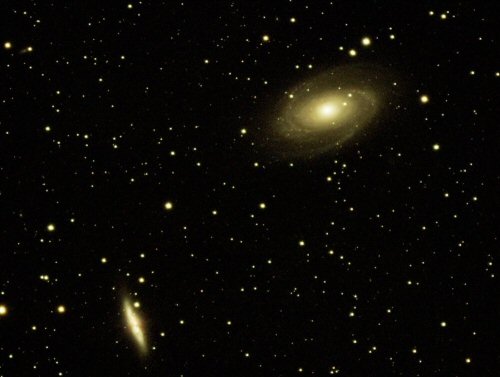
M82, at the bottom left in the above image, is designated a Starburst Galaxy, the closest one to the Earth. The accelerated new star formation is likely to have been triggered by gravitational interaction with M81. Steve Norrie also imaged M81 (Bode’s Galaxy) this month.

Ian Papworth imaged globular cluster M13 in the constellation of Hercules using a Skywatcher 72mm ED f5.8 refractor and an Altair Astro Hypercam 183C Pro colour camera:
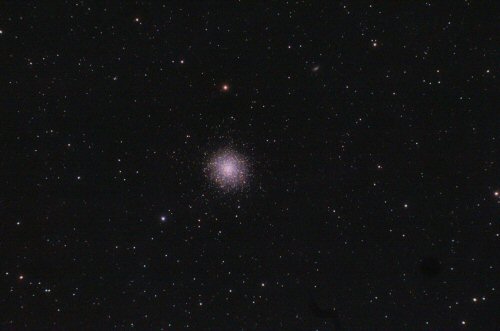
M13 is technically a naked eye object with a magnitude of 5.8, and may be observed using binoculars and small telescopes. It is around 22,000 light years from the Earth and is estimated to contain about half a million stars.
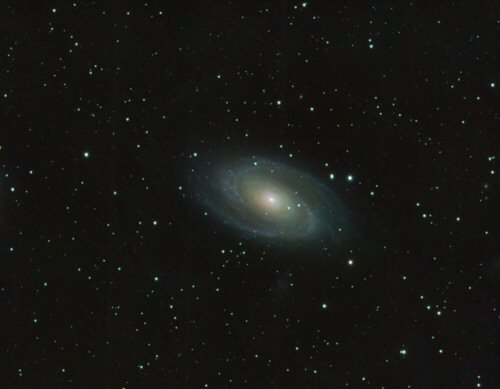
Steve Norrie sent in four images this month, the first three taken via an Explore Scientific ED 127mm refractor and Atik 490 MC colour camera combination and the fourth with a Askar FMA F180 Pro 40mm aperture f4.5 astrograph and Altair Astro 26 TEC camera. Below are M65. M66 and NGC 3628 the Leo triplet, M81 (Bodes Galaxy) in Ursa Major, M101 the Pinwheel spiral galaxy also in Ursa Major and Sh2-240 the Spaghetti supernova remnant on the Auriga/Taurus border:


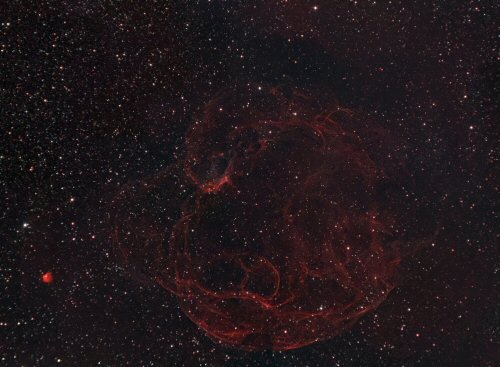
Sh2-240 has an angular size of roughly three degrees, so a very wide angle photogaphic arrangement is required to capture the whole of it in a single frame. It is estimated to be about 160 light years across, around 3,000 light years from the Earth and of the order of 40,000 years old.
Alan Clitherow, SPA Planetary Director, imaged M101 the Pinwheel spiral galaxy in the constellation of Ursa Major and M106 galaxy in Canes Venatici using a Skywatcher MN 190 Pro Maksutov-Newtonian telescope plus QHY 268 C colour camera:

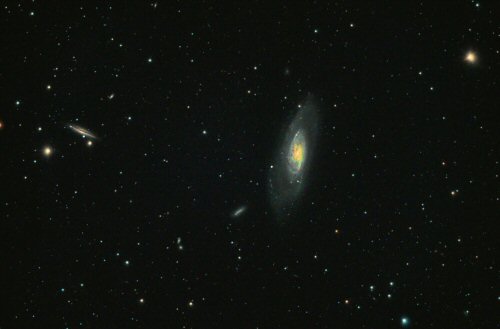
M106 is a type 2 Seyfert galaxy, having an active supermassive black hole. It has an apparent magnitude of 8.4, and is around 24 million light years from the Earth.
Richard Lewis also imaged M51 the Whirlpool galaxy in the constellation of Canes Venatici with a Takahashi FSQ 106mm refractor and ZWO ASI 2600 MC Duo colour camera:
Dave Finnigan