
This month, four section members sent in a total of sixteen images:
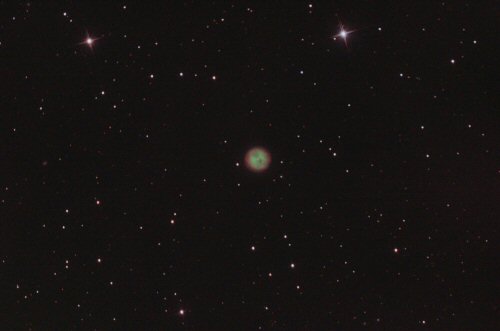
Ian Papworth used a Skywatcher 150P Newtonian reflector and an Altair Astro Hypercam 183C colour camera to capture M97 the Owl planetary nebula in the constellation of Ursa Major and M92 globular cluster in Hercules:

M92 is an old, metal-poor cluster of mostly population II stars and is around 27,000 light years from the Earth. Estimates for the age of this cluster give 11 billion years, plus or minus 1.5 billion.
David Davies imaged supernova SN2022hrs in galaxy NGC 4647 in the constellation of Virgo. M60 is the more prominent galaxy in the image:
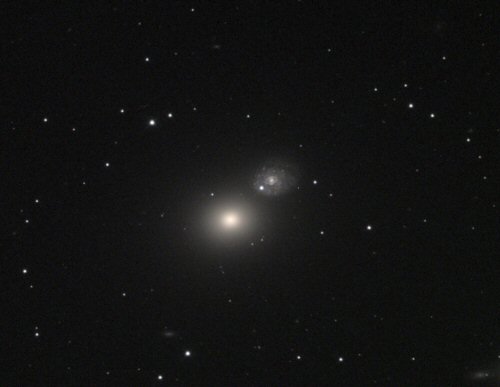
Type 1a supernova SN2022hrs was dicovered by Japanese amateur astronomer Koichi Itagaki on the 16th of April 2022. The light from this supernova took around 63 million years to reach us.
David used an 8″ Richey Chretien telescope and a QSI 683 mono camera plus red green and blue filters.
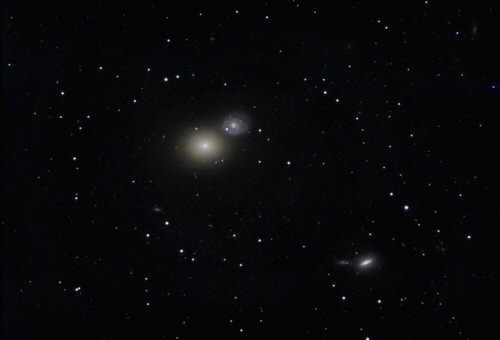
Mark Beveridge submitted four images of galaxies, M60 with NGC 4647 (also supernova SN2022hrs), M58 and NGC 4535 all in the constellation of Virgo and M85 with NGC 4394 in Coma Berenices:

M58, in common with other spiral galaxies in the Virgo cluster, has lost hydrogen gas through interactions with the intracluster medium, leading to low levels of new star formation in the galactic disc. It does however have regions of new star formation in a small ring around the centre of the galaxy, which contains a supermassive black hole.

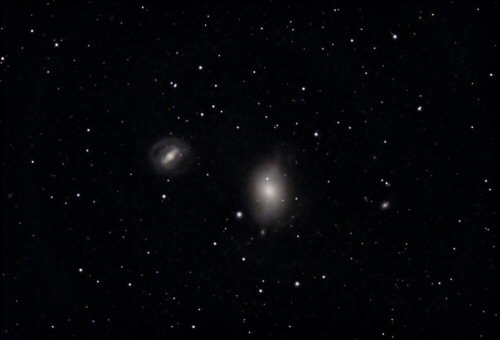
Mark used a Celestron C11 SCT with a 0.63 focal reducer and ZWO ASI294MC Pro camera.
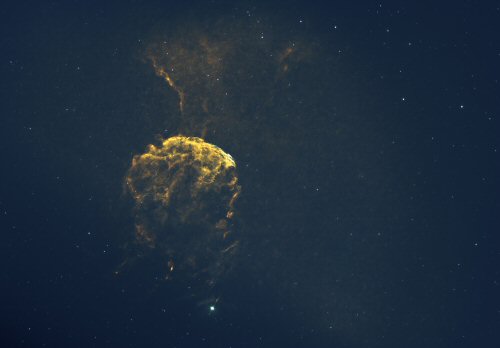
Steve Norrie sent in nine images. Below is IC 443 the Jellyfish emission nebula in the constellation of Gemini. For this image, Steve used an EDR 72mm refractor and ZWO ASI294 camera and Optolong L-eXteme filter:
Steve imaged NGC 2174 the Monkey Head emission nebula in Orion and NGC 2244 the Rosette emission nebula in Monoceros with an ES 127mm refractor and Atik 490 mono camera and narrow band filters:


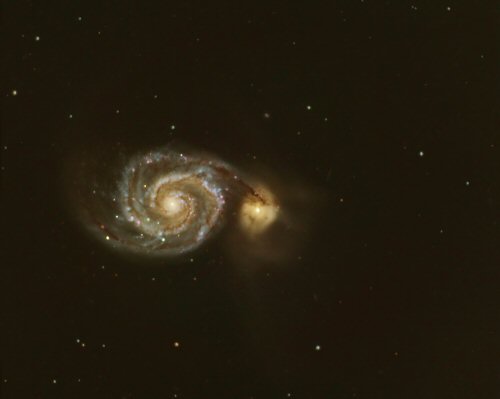
Steve also imaged four galaxies with a Celestron C8 SCT and Trius 694 mono camera plus red, green and blue filters; M81 Bode’s galaxy and NGC 3184 the Little Pinwheel both in Ursa Major, M58 in Virgo and M51 the whirlpool galaxy in Canes Venatici:


Steve also imaged two globular clusters using the C8 and Trius combination, M3 in Canes Venatici and M53 in Coma Berenices:
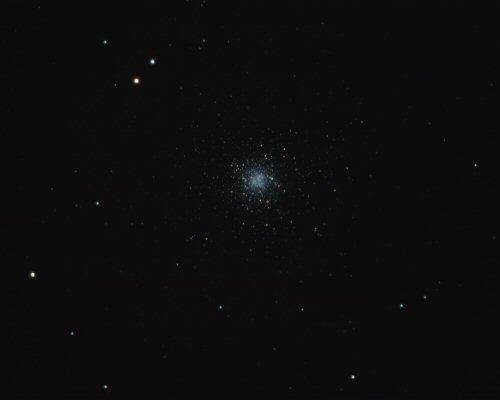
M3 is a large globular cluster containing around half a million metal-poor stars; having said that it has a higher abundance of metals than most globulars. It is about 34,000 light years from the Earth, and more variable stars have been observed in it than in any other globular cluster.
Dave Finnigan