
A lean month for Deep Sky Section as cloudy skies shrouded the UK for much of the time. I received observations from three section members; a total of eight images in all.
Geoff Elston, SPA Solar Section director, imaged three open clusters: M34 in the constellation of Perseus, M35 in Gemini and M37 in Auriga.

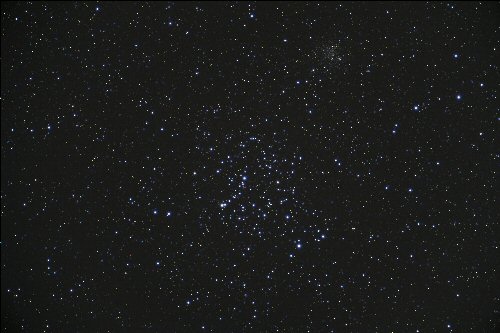
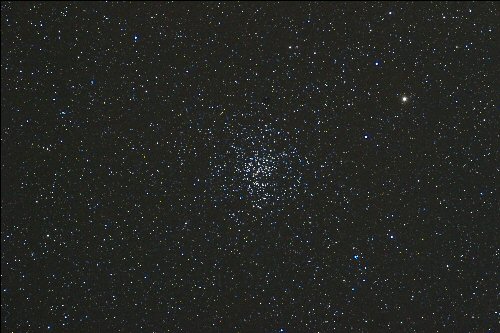
Of these three open clusters, M37 is reckoned to be the oldest at around 400 – 500 million years; M34 is around 200 million years old and M35 the youngest at about 175 million years.
Geoff also imaged M42, the unmistakable emission/reflection nebula in Orion:

Geoff used a 127mm Maksutov Cassegrain and an 80mm achromatic refractor for these images, together with a Canon D550 DSLR.
Ian Papworth imaged globular cluster M13 in the constellation of Hercules with a Skywatcher 150p Newtonian reflector and an Altair Hypercam 183c pro camera:

At magnitude 5.7 M13 is easy to see using binoculars or a small telescope, and is a splendid sight in a 150mm diameter or larger. It is around 21,000 light years from the Earth, and almost 12 billion years old.
Steve Norrie produced two images of emission nebula IC 1396, the Elephant’s Trunk nebula, in the constellation of Cepheus. The first, below, via a Celestron C9.25 SCT and the second via an EDR 80 refractor:

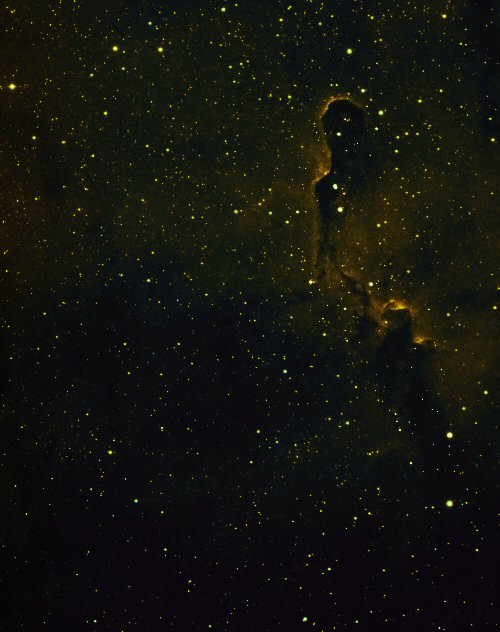
Steve created the Hubble palette with narrow band filters and a Trius 694 mono camera.
Using the C9.25 and the Trius camera, this time with red, green and blue filters, Steve made an LRGB image of galaxy M82 in Ursa major:
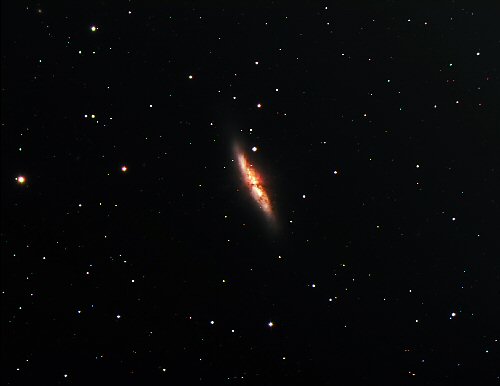
M82 is the closest starburst galaxy to the Earth. It is about five times more luminous than our own galaxy, with around 200 clusters of young stars at its core, each cluster of around 200,000 solar masses. The centre of this galaxy hosts a supermassive (30 million solar masses) black hole; data from the Chandra X -ray telescope suggests that M82 contains an intermediate mass (200 – 5000 solar masses) black hole as well.
Dave Finnigan