
As should be expected in late autumn, section activity has increased despite the vagaries of UK weather. Four section members sent in a total of thirty images:
Richard Lewis made observations with a Takahashi FSQ 106mm f5 refractor and ZWO ASI 2600 MC Pro colour camera and quadband filter. Below are the Veil Nebula supernova remnant in the constellation of Cygnus (a two image composite), IC 1396 the Elephant’s Trunk emission nebula in Cepheus and two images of IC 5070 the Pelican emission nebula in Cygnus:

The Veil Nebula components are the remains of a massive star (possibly 20 times the mass of the sun) which ended its life violently some 10 – 20,000 years ago. The three main parts are designated individually: The Western Veil (NGC 6960), the Eastern Veil (NGC 6992 and NGC 6995) and Pickering’s Triangle, top centre. NGC 6974 and NGC 6979 are smaller bright areas between the Eastern Veil and Pickering’s Triangle.


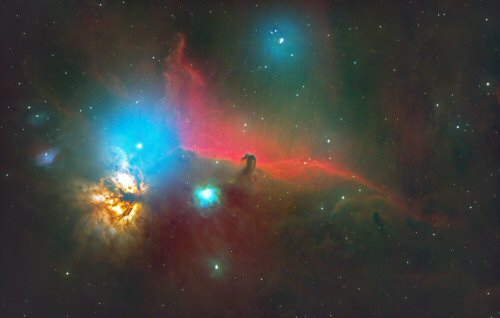
Richard also imaged B33 the Horsehead dark nebula in Orion and M1 the Crab supernova remnant in Taurus:

Emma Bowron used her ZWO SeeStar S50 smart telescope to capture eleven deep sky targets. In the constellation of Cepheus are NGC 40 the Bow Tie planetary nebula, Barnard 175 (aka Vdb 152) dark nebula and open cluster NGC 188:


Next are NGC’s 869 and 884, the Sword Handle pair of open clusters in Perseus (aka the Double Cluster) and galaxy NGC 891 in Andromeda:

NGC 869 and NGC 884 are visible to the naked eye from a reasonably dark sky location (magnitude 5.3 and 6.1 respectively) and readily seen as two areas of faint stars using binoculars or small telescopes. They are both around 7,500 light years from the Earth, and are considered to be 4,700 and 3,700 solar masses respectively.

Emma also imaged six open clusters (M52, M103, NGC 457, NGC 559, NGC 668 and NGC 7789) in Cassiopeia – collating them onto a single image:

Paul Brierley also used a ZWO SeeStar S50 smart telescope for his images. Below are the Orion Nebula M42, galaxy NGC 1272 in Pisces and NGC 7640 in Andromeda:


NGC 7640 is a magnitude 11 object, and is about 30 million light years from the Earth (some sources quote 18 million light years). A barred spiral galaxy, it is about half the diameter of the milky way at 60.000 light years across.
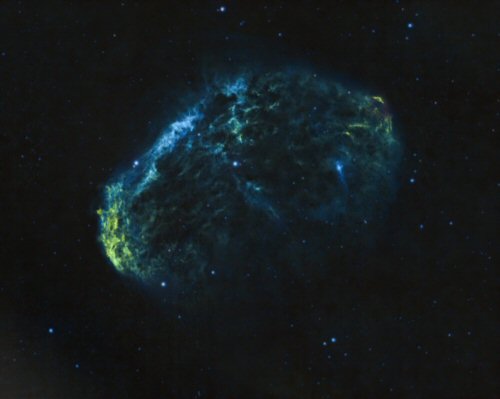
Steve Norrie used a variety of telescope, camera and filter combinations to produce ten images. With a Celestron C8 SCT and Starlight Xpress Trius 694 mono camera plus SII, HII, and OIII filters to give the Hubble palette, Steve imaged Sh2-142 the Wizard emission nebula and IC 1396 the Elephant’s Trunk emission nebula which are both in the constellation of Cepheus, also NGC 6888 the Crescent emission nebula in Cygnus:


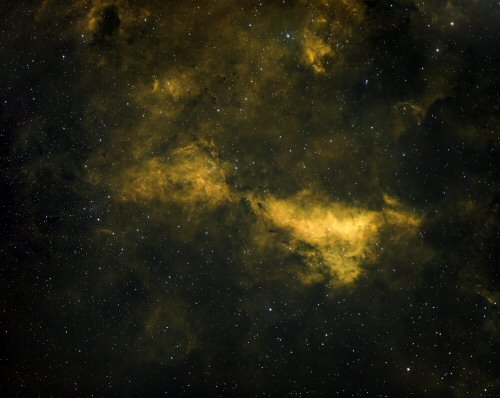
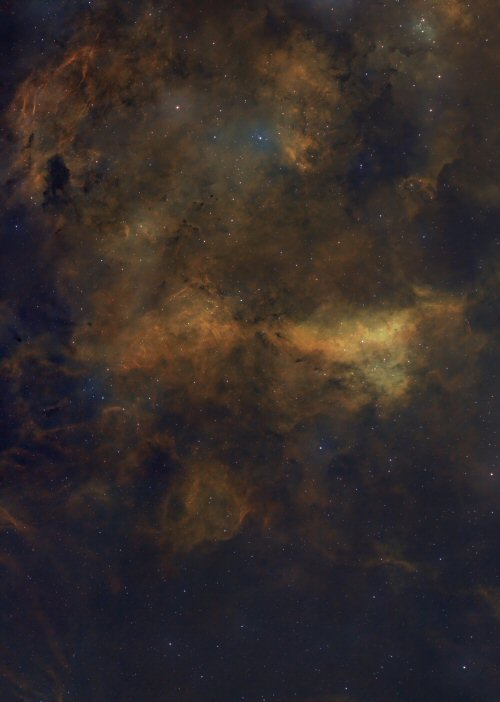
With a Williams Optics Redcat 51mm refractor and Starlight Xpress Trius 694 mono camera plus SII, HII, and OIII filters to give the Hubble palette Steve imaged Sh2-157 the Lobster Claw emission nebula and IC 1805 the Heart emission nebula (both in Cassiopeia) plus IC 1318, the Sadr region of emission nebulosity in Cygnus:

Sh2-157, is a typical emission nebula: interstellar gas is being ionised by the ultra violet radiation emitted by the hot, massive young stars formed within it. In this instance, one of the stars is Wolf-Rayet star W157, which will eventually progress to the last phase (supernova) of its short energetic life.

With a Williams Optics Redcat 71mm refractor and an Altair Astro 26 TEC camera Steve imaged our nearest large galactic neighbour M31 in Andromeda:

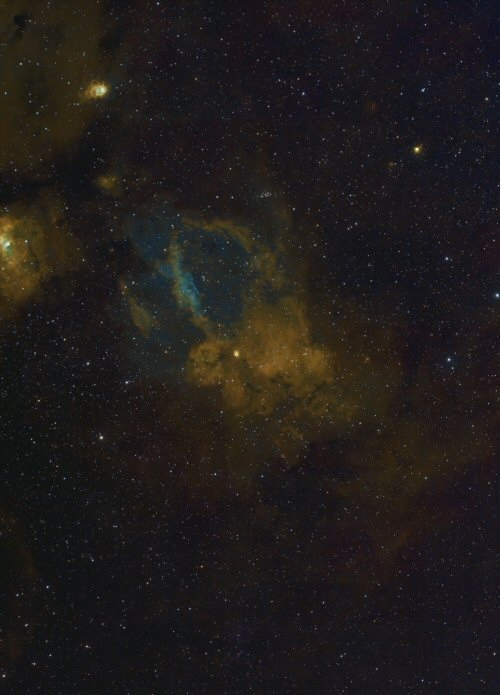
Steve also imaged IC 1396, Sh2-157 and IC 1318 again with the R71 and AA26 combination plus the addition of an Svbony dual band (HII, OIII) filter:

Dave Finnigan