
This month saw six section members send in eighteen digital images.
Paul Brierley used an Altair 115mm EDT refractor and a Canon 600D DSLR to image M27 the Dumbbell planetary nebula in the constellation of Vulpecula:
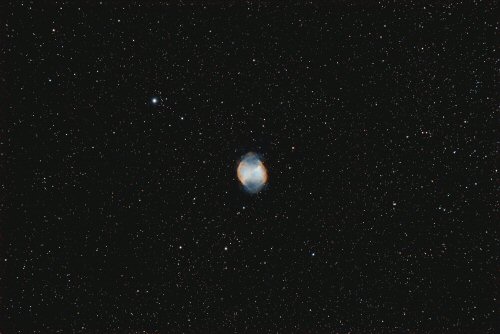
M27 may be seen using binoculars, and is readily observed with a small telescope: it has a magnitude of 7.4 and angular size 8 x 5.6 arcminutes. Planetary nebulae form when stars of intermediate mass, around 1 to 8 solar masses, reach the end of their life cycle. Ultra violet radiation from the hot core remnant of the original star ionises shells of expelled material, making them visible for a few tens of thousands of years.
David Davies sent in three images. IC 1613 is an irregular dwarf galaxy in the constellation of Cetus, NGC 6712 is a globular cluster in Cepheus and NGC 6946 is the Fireworks galaxy on the Cepheus/Cygnus border:

IC 1613 is a member of our local group of galaxies and is about 2.4 million light years from the Earth. It was the study of Cepheid and RR Lyrae variable stars within this galaxy (the intrinsic brightness of these stars is is linked to their period of variability) which added to our knowledge of galactic distances and the true scale of the universe.
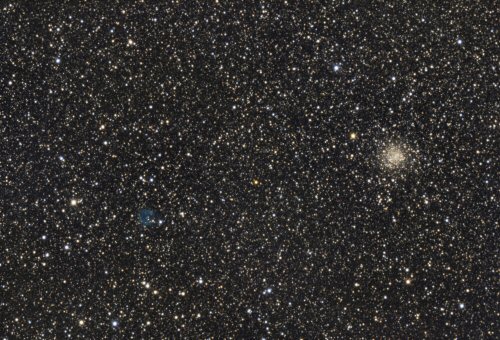

David captured the above images with a 250mm Richey Chretien telescope with a 0.7x focal reducer and ZWO ASI294 MC Pro colour camera.
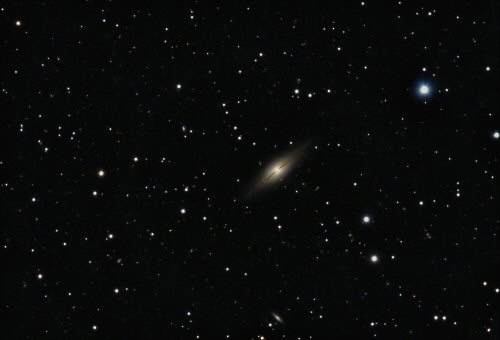
Mark Beveridge used a Celestron C11 Edge SCT plus 0.63x focal reducer and ZWO ASI 294 MC Pro colour camera to image a variety of deep sky objects. Two of these are galaxies in the constellation of Pegasus, NGC 7742 the Fried Egg galaxy and NGC 7814 the Little Sombrero galaxy:

NGC 7742 is unusual looking – it has a ring which researchers think may have been created when the galaxy merged with a smaller one: gas rotates outside the ring in the opposite direction to the stars within the ring, also a central disc of gas is inclined at 6 degrees to the outer disc. NGC 7742 is a Seyfert type 2 galaxy, an active core indicating the presence of a supermassive black hole.
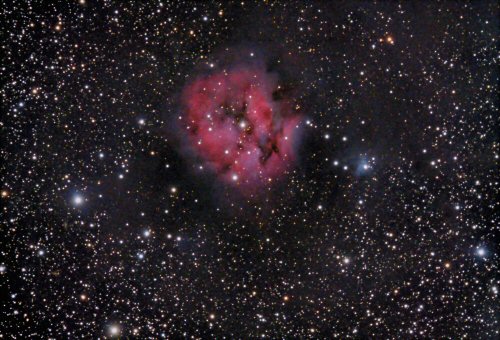
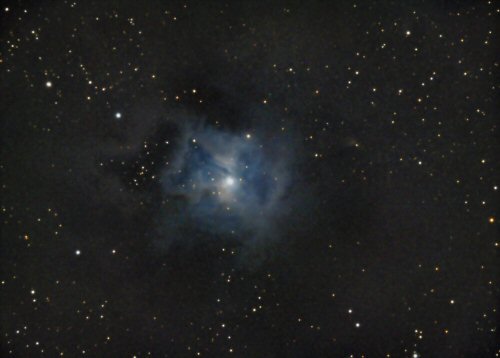
Mark also imaged Abell 82 a planetary nebula in Cassiopeia, IC 5146 the Cocoon reflection/emission nebula in Cygnus and NGC 7023 the Iris reflection nebula in Cepheus:

John Fathers used an f2 Celestron RASA 8″ astrograph and ZWO ASI553 MC Pro camera to image IC 5070 the Pelican emission nebula in the constellation of Cygnus, IC 1396 the Elephant’s Trunk emission nebula and LDN 1235 the Shark dark/reflection nebula, both in Cepheus. A dual narrow band filter was also used for the emission nebulae.

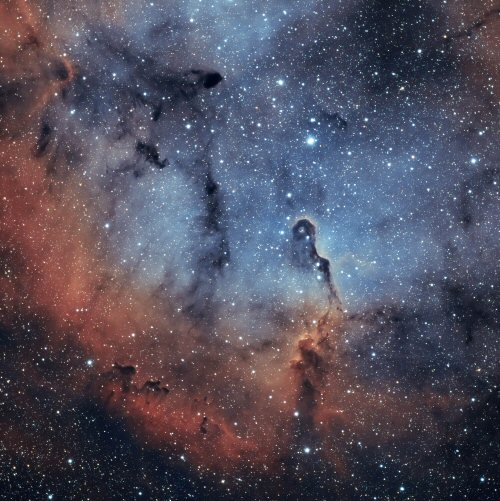

LDN 1235 is the dark nebula to the lower right of centre in this image. The two blue reflection nebulae to the upper left and right of centre are designated Vdb 149 and Vdb 150: these shine due to the presence of two class B stars.
Richard Lewis used a Takahashi FSQ 106mm refractor and ZWO ASI 294 MC Pro colour camera plus Quadband filter to capture NGC 6960, the Witch’s Broom (a part of the Veil Nebula supernova remnant) in the constellation of Cygnus and NGC 7635 the Bubble emission nebula in Cassiopeia:

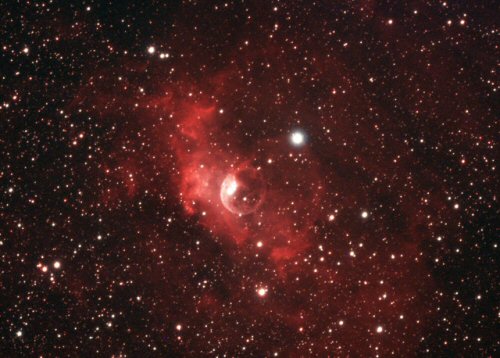
The distinctive appearance of the Bubble nebula is due to the powerful stellar wind from a young, massive, hot class O star SAO 20575. This star is around 44 times the mass of the sun and about 400,000 times more luminous, with an absolute magnitude of -5.5. The UV radiation from the star is ionising the gas in the nebula, predominantly hydrogen, giving it the familiar red hue seen in RGB images of emission nebulae (quite different to the narrow band image of NGC 7635 below).
Steve Norrie sent in four images. NGC 7000 is the North America nebula in the constellation of Cygnus and Steve used two quite different telescope and camera combinations to image it. Below is the wide angle view with an EDR 72mm refractor and ZWO ASI294 MC camera, then a detail of NGC 7000 known as the Wall using a Celestron C8 SCT and Trius 694 mono camera plus narrow band filters:
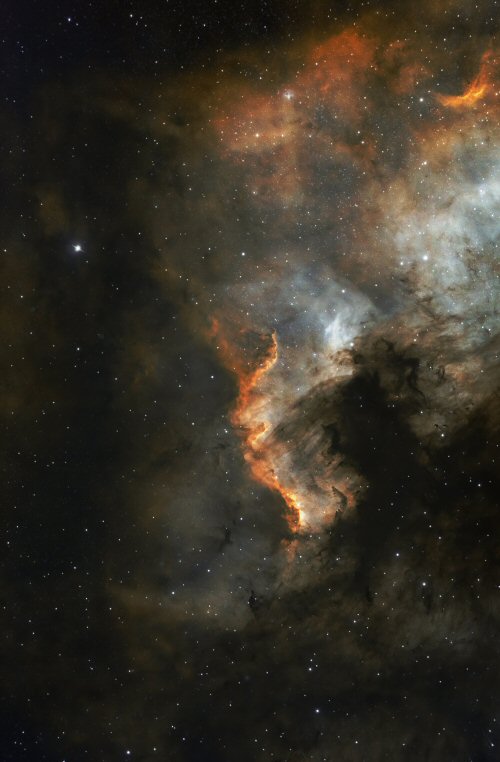
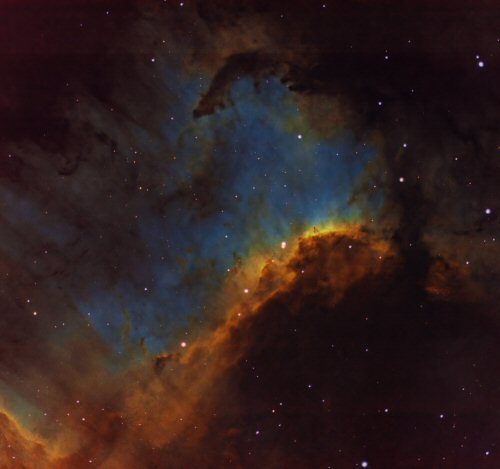
The Cygnus Wall is the part of NGC 7000 corresponding to Central America. It is in this region that copious new star birth is occuring. The new stars, many hidden behind clouds of dust, are illuminating and sculpting their surroundings.
Steve also imaged NGC 7635 the Bubble emission nebula with the C8/Trius/narrow band setup and IC 1805 the Heart emission nebula with a WO 51mm refractor and an Altair Astro 26C colour camera and an Optolong L-eXtreme dual band filter, both of which are in Cassiopeia:


Dave Finnigan