
A relatively busy month for the section: nine members sent in thirty – four digital images and one drawing.
Ian Papworth used a Skywatcher 150P Newtonian reflector and an Altair Hypercam 183c colour camera to image four open clusters and an emission nebula. The open clusters are M103 and NGC654 which are both in the constellation of Cassiopeia, NGC’s 869 and 884 the Sword Handle in Perseus and M38 in Auriga:

M103 is around 9,000 light years from the Earth so quite remote, and is thought to be about 25 million years old. It is worth mentioning that the bright star in at the top left of the cluster is not a member of M103 but a foreground triple star designated Struve 131, whose main component is a blue supergiant.


The emission nebula is NGC 7635 the Bubble nebula in Cassiopeia:

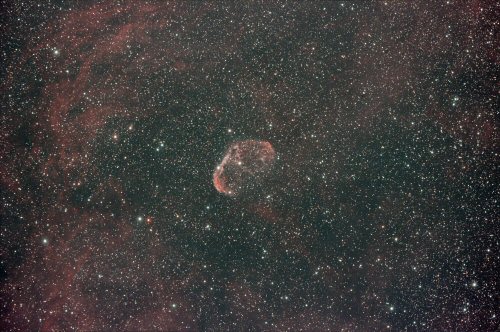
John Fathers imaged NGC 6888 the Crescent emission nebula in the constellation of Cygnus and M1 the Crab nebula, a supernova remnant in Taurus:

M1 has been identified as the remnant of a supernova which occured in the year 1054 and was recorded by astronomers in China. A pulsar lies at the heart of the Crab nebula, a neutron star rotating at around 30 times per second, emitting pulses of radiation across the electromagnetic spectrum from radio frequencies to gamma rays.
John used a 70mm APO refractor and ZWO ASI 071 MC Pro camera plus a TriBand filter for the NGC 6888 image and a 115mm refractor with the same camera and filter for M1.
Paul Brierley used a WO ZenithStar 61mm APO refractor and astro modified Canon EOS 600D DSLR camera to capture M33 the Pinwheel galaxy in the constellation of Triangulum:

M33 is about 2.7 million light years from the Earth, and the third largest in our local group of galaxies, after our own galaxy and M31. Technically a naked eye object, you will need very good eyesight and a very clear dark sky to see it. Dark adaptation and averted vision help too of course.
Richard Lewis focussed his attention on the Veil supernova remnant in the constellation of Cygnus, with two images featuring the Western Veil NGC 6960 and one of the Eastern Veil NGC 6992:
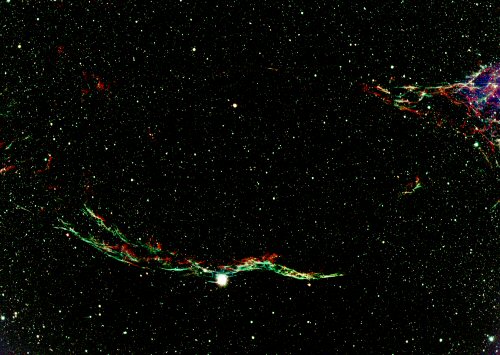
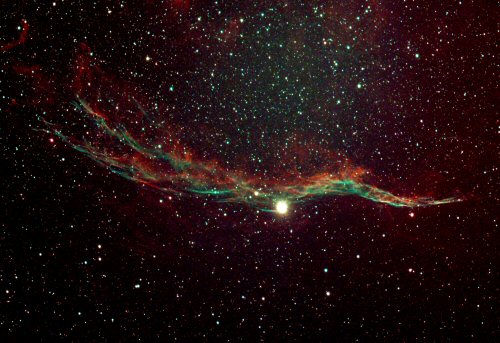

It is thought that the star which exploded between 10 and 20 thousand years ago to produce the Veil was 20 times the mass of the sun and the supernova would initially have been so bright that it would have been visible during daylight hours.
Richard used a Takahashi FSQ 106N refractor with a ZWO ASI 294 colour camera plus a TriBand filter.
Lewis Parry imaged emission nebulae IC 1805 and IC 1848 the Heart nebula and Soul nebula in the constellation of Cassiopeia with a guided Canon 700D DSLR camera with added data from a HII filter:
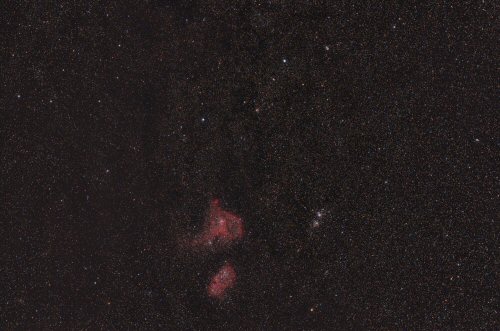
This region of new star formation lies about 7,000 light years from the Earth in the Perseus spiral arm of our galaxy.
Michael Kinns drew open cluster NGC 129 in the constellation of Cassiopeia at the eyepice of an Orion Optics SPX 200mm f6 Newtonian telescope at a magnification of 67x:
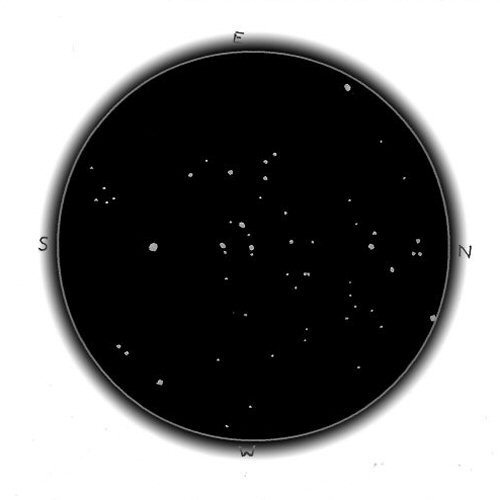
NGC 129 may be seen using binoculars and is reckoned to be about 80 million years old. The brightest star present is a double, DL Cassiopeiae, one component of which is a Cepheid variable.
David Davies imaged NGC 281 the Pacman emission nebula in the constellation of Cassiopeia and IC 1590, the open cluster within the same nebula, processed specifically to enhance the Bok globules and dust lane:
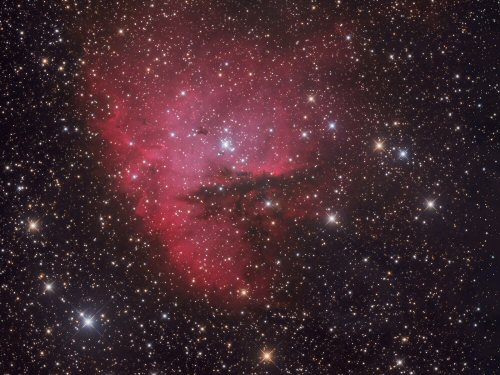

NGC 281 is another star forming region in the Perseus spiral arm. The open cluster within it, IC 1590, contains a massive, hot, luminous class O star (HD 5005) which is a component of multple star B1. This produces much of the radiation ionising the gas present, and is bright within the nebulosity in both of the above images.
Mark Beveridge used a Celestron Edge 200mm f10.4 SCT and SXR-H814 mono camera plus red, green and blue filters to image galaxy NGC 864 in the constellation of Cetus:

With the same telescope and camera but with the addition of a 0.7x focal reducer, Mark imaged four more galaxies NGC 524, NGC 660 and NGC 7714/5 (a pair of interacting galaxies aka Arp 284) all in Pisces and NGC 772 in Aries and emission nebula The Northern Trifid NGC 1579 in Perseus:


NGC 660 is clearly distorted and there is a theory that it is the result of an ancient encounter between two galaxies. There is a ring of material around the galaxy, inclined at 45 degrees, which contains a great number of star forming regions; possibly related to the gravitational disturbancies of such a collision maybe a billion years ago.


Steve Norrie submitted a total of fourteen images to the section. Ten are of emission nebulae, the first four below were taken with an EDR 72mm refractor and Starlight Xpress Trius 694 mono camera and narrow band filters to give the Hubble palette and are NGC 7822 in the constellation of Cepheus, NGC 2244 in Monoceros, IC 405 in Auriga and IC 1318 in Cygnus:


The next four are IC 410 the Tadpoles nebula in Auriga, NGC1491 in Perseus, NGC 7635 in Cassiopeia and NGC 281 the Pacman nebula also in Perseus taken with a Celestron C8 SCT, again the Hubble palette:
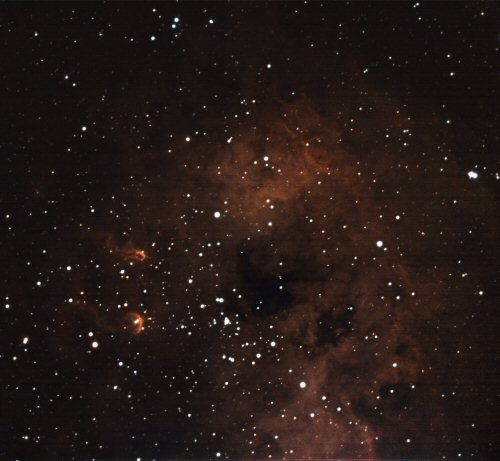
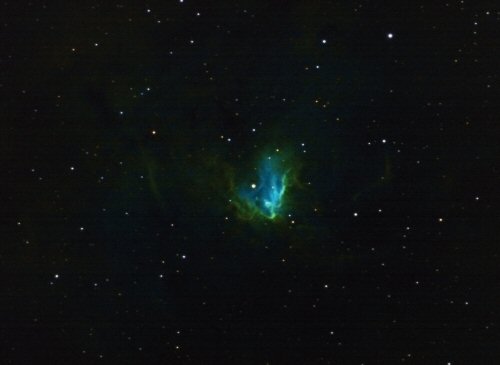
NGC 1491, another bright emission nebula in the Perseus galactic arm, is being illuminated by the intense ultra violet radiation from a massive young blue star BD +50 886 just to the upper left of the nebulosity, hollowing and shaping the gas cloud.


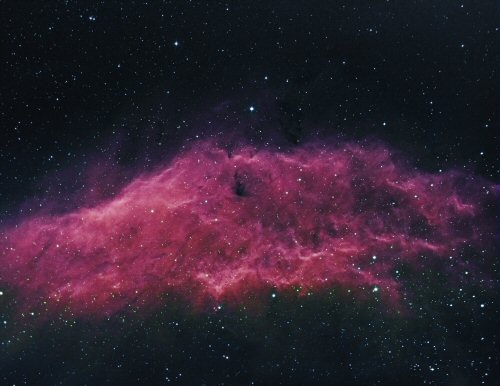
The remaining two emission nebulae are M42 in Orion and NGC 1499 the California nebula in Perseus:

Steve also imaged M33 the Pinwheel galaxy in Trangulum, NGC 7023 the Iris reflection nebula in Cepheus and two supernova remnants: IC 443 the Jellyfish nebula in Gemini and NGC 6992, the Eastern Veil nebula in Cygnus:


Dave Finnigan