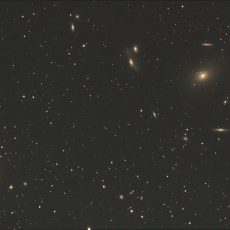
May is a great time of year for finding galaxies – and all you need is ordinary binoculars! As long as your skies are reasonably dark – which means waiting up until around midnight – you can even find some galaxies in the Virgo Cluster, about 50 million light years away!
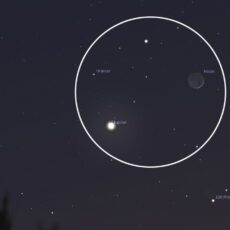
Ever seen Uranus? No, be serious, have you ever seen the planet Uranus? April 2024 is a good time to look for it, because it’s right next to Jupiter, the brightest planet in the sky at the moment. And on 10 April there’s a spectacular line-up of Jupiter, Uranus, a thin crescent Moon and even a comet, all close together in the sky. Read more
The major total eclipse of Monday 8 April 2024 is only visible in Mexico and North America as a total event. But while most people in the UK won’t see any eclipse at all, whatever the weather, some places in the north and west of the country have the chance of seeing a small partial event at sunset.
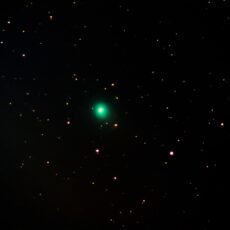
There’s a comet in the evening sky at the moment! But don’t go out and hope to see something whizzing across the sky, like in some movies. Although it is huge, and is indeed whizzing, it’s actually about 240 million km away from us, so right now it’s actually quite faint and can only be seen to move very, very slowly against the starry background. But it’s getting brighter and should be visible with binoculars so it is worth a look.
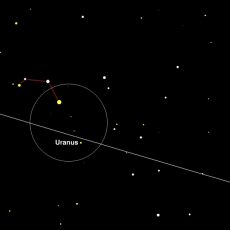
During early 2024, Jupiter appears to be heading for Uranus. This gives a great opportunity to find the elusive Uranus in the evening sky, even from city locations, using just binoculars. And don’t worry – there’s no risk of a collision!
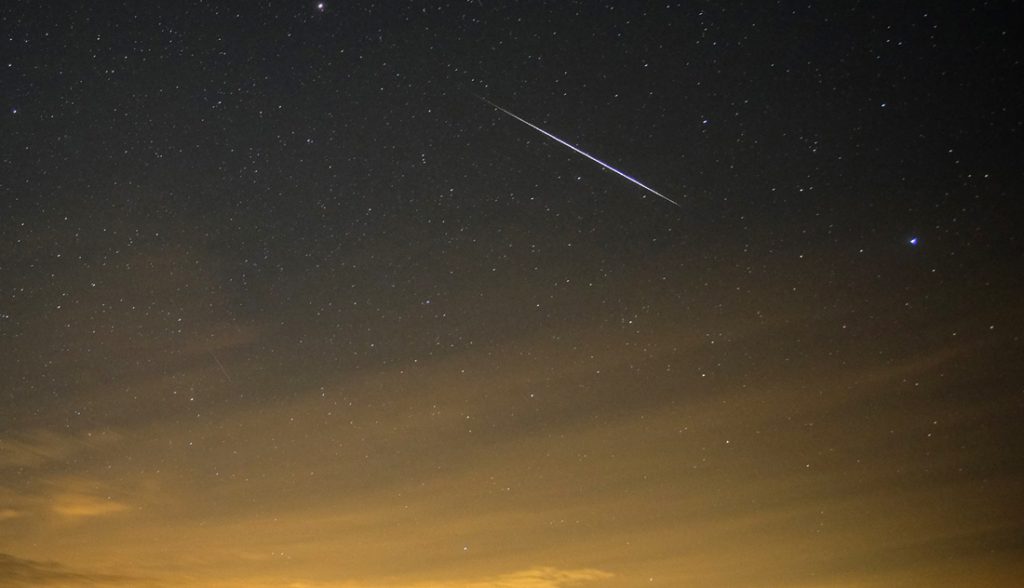
For astronomers, New Year fireworks come in the form of the Quadrantid meteors. Each year around 3–4 January one of the best meteor showers of the year occurs, and 2024 promises to be a good year, weather permitting.
A Quadrantid meteor photographed in January 2020 by Paul Sutherland from Walmer, Kent
How many?
You may hear that ‘up to’ 120 meteors an hour are expected, and that is the official ‘zenithal hourly rate’. But hold on – that’s the technical maximum that you might see under ideal conditions. Although the 2024 appearance is likely to be good, as the Moon won’t be too troublesome, very rarely do you get perfect conditions. A bit of light pollution will wipe out many of the fainter ones, and the rates increase after midnight as the radiant – the point in the sky from which the meteors appear to radiate – rises higher in the sky. With clear skies and in a country area you could see 50–60 an hour at this time.
The Quadrantid meteors have a quite narrow peak of activity, which may occur about 9 am UK time on 4 January, during daylight as seen from the UK, but the exact timing is uncertain. From the UK, peak rates are therefore likely to be in the early morning of the 4th. At this time the last-quarter Moon will be in the sky. Even so, meteor observers will be out in force, given clear skies.
The radiant of the Quadrantid meteors lies in the northern sky not far from the well-known pattern of The Plough or Big Dipper. The last-quarter Moon is off to the right of the view.
Where to look
Although the radiant is in the north-eastern sky, meteor observers find that the best place to look is in mid sky about 45 degrees away from the radiant itself. So look towards the north around Polaris, and well away from the Moon, for the best chance of seeing meteors, although any direction will do if this direction is not available to you. There is no particular area of the UK that will see more meteors, but try to get away from city and suburban areas if you can.
Look at the SPA’s Meteor Section website for more information about the Quadrantids and how to observe them.
The Geminid meteors (shooting stars) are at their best this December, and with no Moon around in 2023 to spoil the display, all you have to worry about is the clouds! Here’s how to get the best view of this spectacular event. Read more
The planet Uranus is currently at its brightest for the year – but it still takes some finding! Here’s how to spot the elusive seventh planet from the Sun with just a pair of binoculars. Read more
The annual Orionid meteors (shooting stars), which are caused by dust from the tail of Halley’s Comet, are upon us. These appear in good numbers between 20 and 23 October, which in 2023 coincides with a weekend. What’s more, the Moon will be pretty well out of the way, so all we need are clear skies for a great observing opportunity! Read more
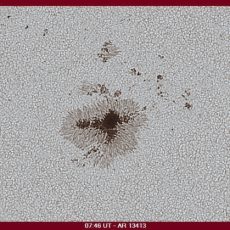
Activity on the Sun continues to rise, as the maximum of the 11-year solar cycle approaches. Large sunspots are now a regular sight, and displays of the northern lights are likely to become increasingly common.