
May is a great time of year for finding galaxies – and all you need is ordinary binoculars! As long as your skies are reasonably dark – which means waiting up until around midnight – you can even find some galaxies in the Virgo Cluster, about 50 million light years away!
Most amateur astronomers can find the Andromeda Galaxy, even with the naked eye, but this is too low in the sky to be seen in May. Instead, try for some much more distant galaxies. They are smaller and fainter, but you can find them with a bit of care. Let’s start with a couple of easy ones – M81 and M82 in Ursa Major.
You start by finding one of the most recognisable star patterns, The Plough, also known as the Big Dipper. This seven-star pattern is made up from the brightest stars in Ursa Major, and it’s so well known that the SPA use it for our logo. But if you’re accustomed to finding it low down in the north, at this time of year you’ll have to look much higher in the sky – almost overhead, as seen from the UK.
Once you’ve found it, use the map below to choose the stars Phecda and Dubhe, and take a line through them, as shown.

Extend the line by about the same distance as between the two stars and aim your binoculars at that spot. Ideally, use binoculars with a magnification of at least 10, such as 10 × 50s. Look for the pair of stars shown on the map. If you find a small triangle of stars, you’re in the wrong spot, as shown by the little cross on the map.
Having found the correct pair of stars, now look slightly away from them and you should see two tiny smudges of light. That’s it – you’ve found the galaxies M81 and M82! Even with binoculars you might see a that they aren’t just round blobs, but slightly elliptical and in the case of M82, spindle-shaped.
OK, so you can’t see great whirling spirals, but bear in mind that you’re looking around 12 million light years away, compared with the 2.5 million light years of the Andromeda Galaxy. Here’s what they look like in large binoculars:

Once you’ve found those, you can try for something much more distant, the giant galaxy M87 in Virgo. Virgo is towards the south, but the problem is that there are no bright stars near to M87 as there are with M81 and M82. So you need to use a signpost, and the best one is the neighbouring constellation of Leo. Here’s a whole-sky map of the sky during May:
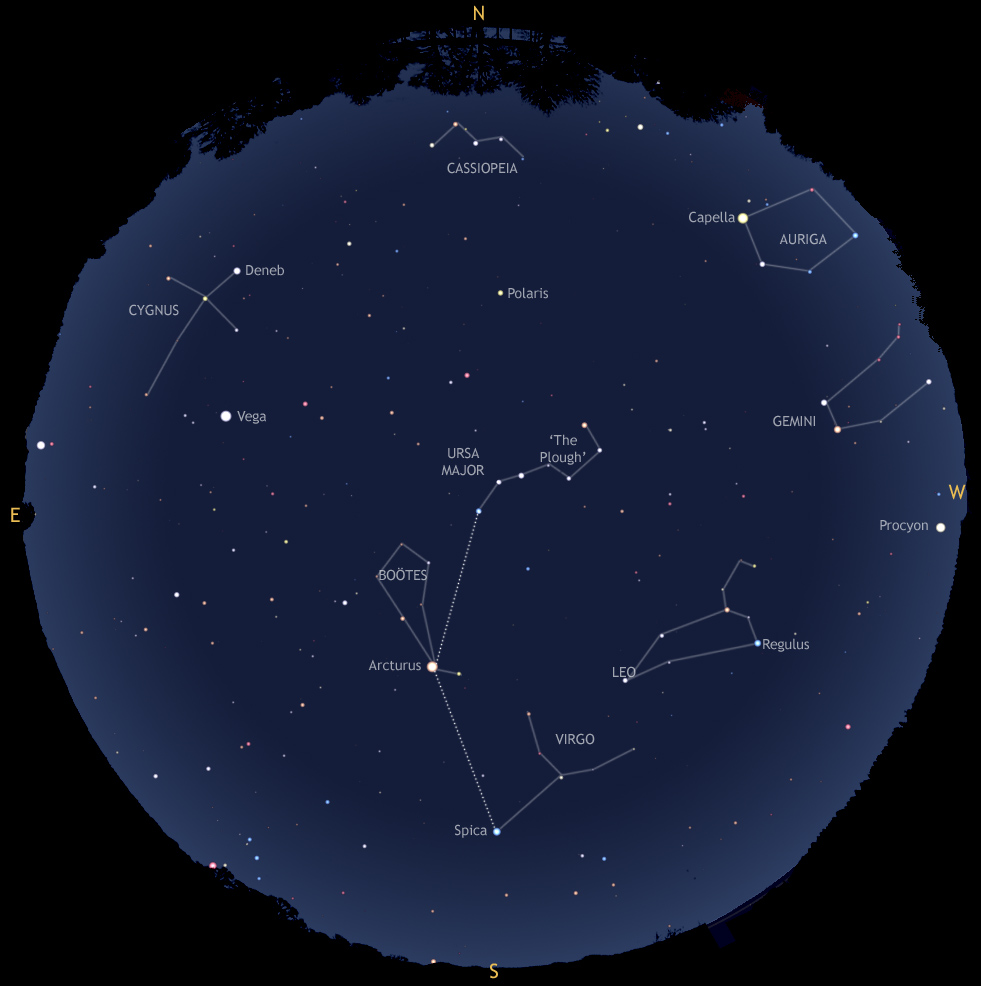
Leo is high up in the south-west, and the lines joining its stars show that it really does look like a crouching lion. Start your journey with the star right by the label saying LEO. This star is called Denebola.
Move east from this and you come to a faintish star, 6 Comae. Now look to the south-east for a pair of stars, 27 and 30 Virginis. The enlarged view below shows 6 Comae and 30 Virginis at opposite corners of the map. They are about 8º apart, which is about 1½ binocular fields of view.
About midway between the stars 6 and 30 you should find a small triangle of stars, as shown on the map below. If you can’t see these stars, give up and try again on a darker night or get away from the city lights.
The giant galaxy M87 is just below a faint star above and to the left of the triangle, while M84 and M86 are above it and to the right. Don’t expect anything bright or large.

Below is a photo of the central part of the map, at a larger scale and showing fainter stars. See if you can spot the triangle, then look for the galaxies. Hint – they are smaller and fainter then the map above suggests.
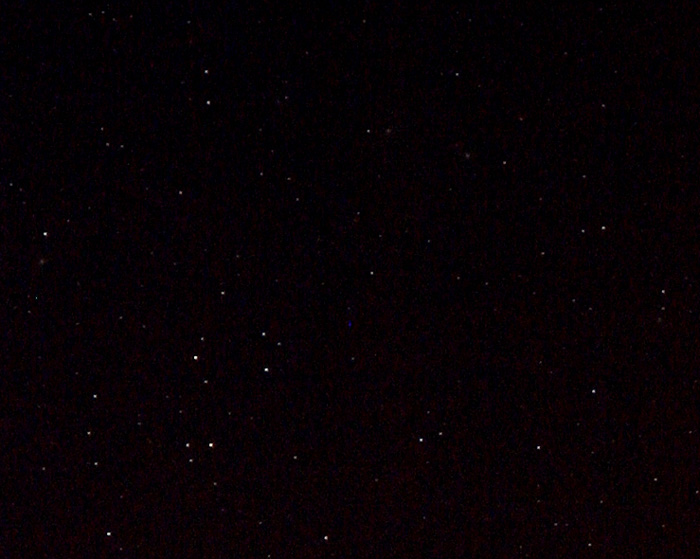
If you can find these galaxies you really are looking at objects 50 million light years away. Not bad for a pair of binoculars! Here’s how they look in a long-exposure photo made with a telescope:

Credit Robin Scagell.
The photo makes the galaxies look brighter than the stars, but through binoculars or a telescope they look much fainter and paler on the sky.