
The Geminid meteors (shooting stars) are at their best this December, and with no Moon around in 2023 to spoil the display, all you have to worry about is the clouds! Here’s how to get the best view of this spectacular event.
Each year around 14 December the Geminid meteors put on a display, and we reckon they are the best meteor shower of the year. You may have heard that there will be rates up to 120 an hour, which is impressive – but the downside is this only applies under ideal conditions, which for most people doesn’t apply. Even so, with typical UK skies you could see one every few minutes – a great free spectacle.
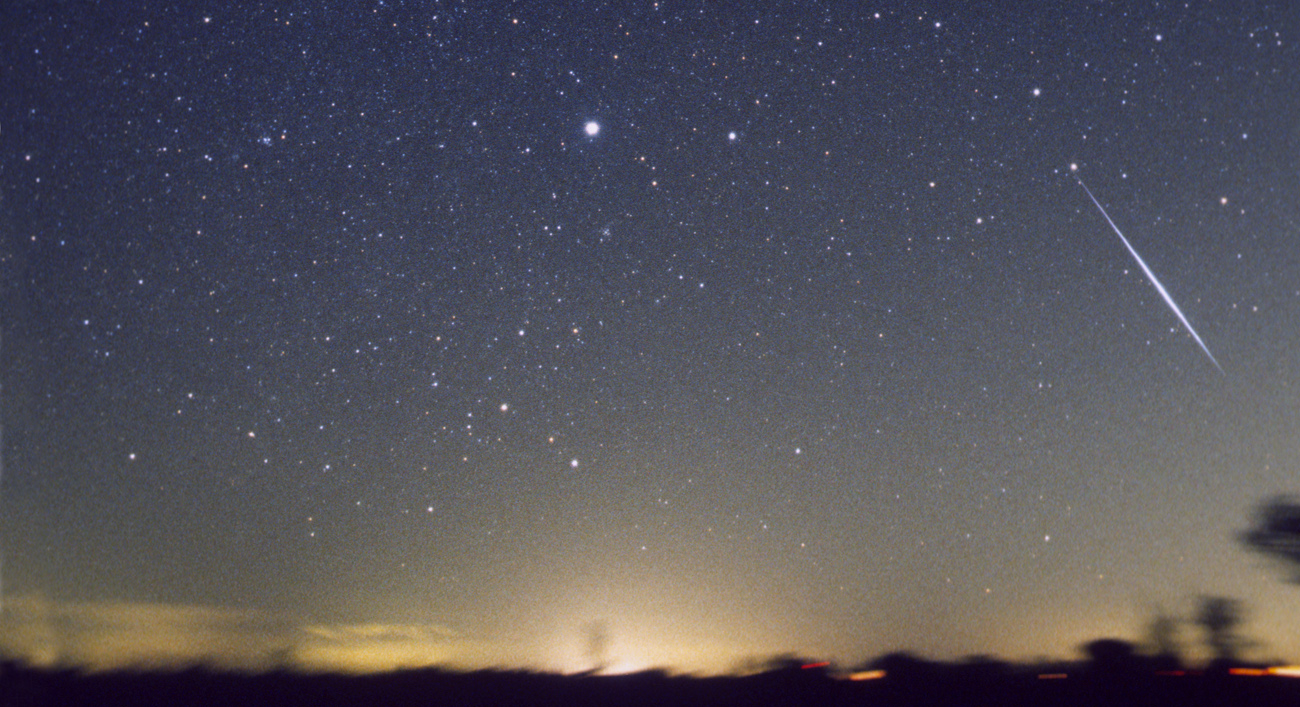
When and where to watch for Geminids
You can see the Geminid meteors throughout the night, but the later in the night you observe, the more you’re likely to see. This is because the meteors come from a point in the constellation of Gemini close to the bright star Castor, which is just rising as it gets dark. As the night progresses, this point, known as the radiant, gets higher in the sky so more meteors are visible. It reaches its peak about 3 am on Thursday 14 December – which for most people means starting to observe on the night of Wednesday 13 December.
You can see the Geminids from anywhere in the UK, but it’s best to get away from city lights. The meteors will be equally visible all over the country and indeed Europe, given clear skies.
Bear in mind that meteors appear at random, and that some may be faint, so if after a few minutes of observing you haven’t seen any, don’t give up! Sometimes there can be a gap of ten minutes or more between seeing any. Dedicated meteor observers reckon that you need an observing time of at least an hour to get a good chance of seeing a fair number. So drag out the sun lounger that you put away for the winter, get yourself comfy with a few blankets and settle down for an evening of stargazing with some shooting stars thrown in.
Meteors are caused by tiny particles of space dust that collide at high speed with Earth’s upper atmosphere. In the early hours of the morning the Earth is moving directly towards the meteors, so they hit the upper atmosphere at higher speed and glow more brightly. So if you want the best display, be prepared for the long haul!
Gemini meteors will also be seen for several days before and after the night of maximum, so if there’s a chance of clear skies beforehand don’t pass up on it. However, because the numbers tend to drop quite rapidly after maximum make the most of early opportunities.
When observing, choose a site with as large a view of the sky as possible, and try to exclude any lights from your field of vision. Although the radiant is in the constellation of Gemini, it’s best not to look directly at that part of the sky, which in the evening is rising in the east. The optimum direction is about 40 degrees away from the radiant, and in mid sky.

There are also likely to be meteors occurring with no particular source, known as sporadics. These can occur at all times of the night, adding to the numbers visible. Another meteor shower, known as the Ursids, will be active from 17 to 25 December, with its peak around 22–23 December. These meteors have a radiant near the star Kochab, which is below the Pole Star during December evenings.
The next opportunity to view a meteor shower is in early January, with the annual Quadrantid meteors on January 3–4.
Photographing the meteors
Because meteors appear at random, the only way to photograph them is to open the camera shutter for a time exposure and hope that one passes through the field of view in that time. Fix the camera on a tripod if possible and do some test exposures with the ISO rating (sensitivity) at a high figure, such as 3200 or greater. Focus the camera on infinity (which usually requires manual focus, or a scene setting for night photography) with the lens at its widest aperture (smallest number, such as f/2.8) and give an exposure time of 30 seconds. If the result is too washed out because of light pollution you will need to give shorter exposures. You may also be able to download a phone app for meteor photography.
You’ll need to repeat the exposures many times to stand a chance of recording a meteor. Good luck!
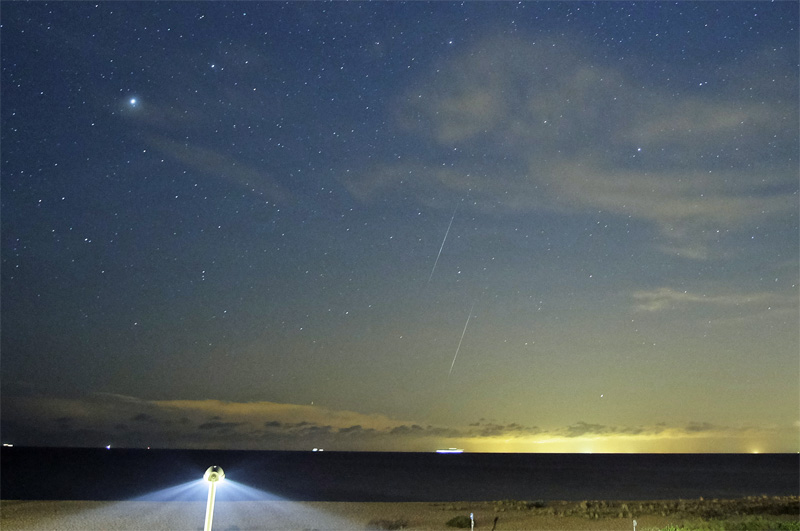
For more information about the Geminids, and about meteors and how to observe them, go to our meteor section web page about this shower.