The planet Neptune can be tricky to find in the sky, but right now Mars is providing an excellent signpost to locating it. At around magnitude 8, Neptune is within the reach of good binoculars in a dark sky, but you need accurate positions for the planet. And not least, you need to know which part of the sky to aim for because it’s just another faint object among many. On 7 December 2018, Mars will pass very close to Neptune as seen in the sky, so if you can find Mars you know where to look for Neptune. Even so, it’ll be more than a matter of just lifting your binoculars and gazing at Neptune.
Mars is now in the south-western sky, and is the brightest thing in that part of the sky. Once you’ve found it, use the photo below to help you locate Neptune through binoculars.
The field of view is similar to that of binoculars. You may see only the brighter stars at first glance, so keep on looking and if the sky is dark enough you should be able to pick out the fainter ones, and also Neptune. A line of stars points to it, but only the two brighter ones are likely to be easily visible.
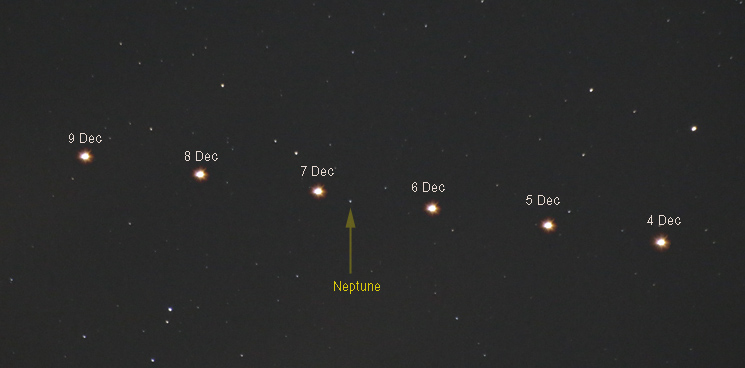
As the photo shows, Mars is some 250 times brighter than Neptune. This means that it is one of the fainter stars visible with typical binoculars, such as 10 x 50s, though it may be invisible if you are observing from light-polluted skies. In that case, you’ll need a telescope and a magnification of 20 or more.
This is only a line-of sight effect. Mars is comparatively close at about 163 million miles, while Neptune is currently 4,489 million km away. You won’t see the actual discs of the two planets unless you use quite a high magnification, and only on 7 December will you be able to get them in the same field of view of a telescope.
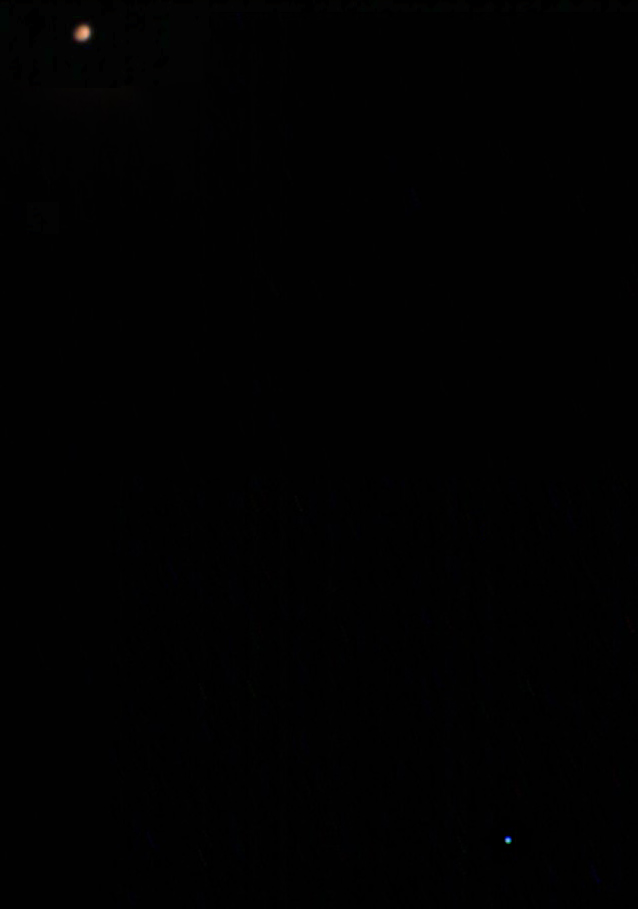
Here’s a combination of two exposures made on 7 December using an 80 mm refractor. Mars is top left and Neptune is bottom right.