
There’s a partial eclipse of the Sun from the UK on Saturday, 29 March 2025 – and it’s at a really convenient time of day, mid-morning, so if skies are clear it offers a great spectacle. The big question is how to view it safely – you shouldn’t use makeshift filters or sunglasses. Many of the suggestions, such as using a pinhole in a cereal packet, aren’t very useful. But we have some great alternatives.
The eclipse occurs when the Moon passes right in front of the Sun, taking a couple of hours to do so. Around 10 am it will appear as if a bite has been taken out of the Sun, enlarging until about 11 am when the bite slowly decreases in size. By around midday the Sun has its usual appearance again.

Because the Sun is so bright, it’s very dangerous to try and look at it directly. You are at real risk of permanently damaging your eyesight if you try to overcome the natural reflex to look away. Of course, we often glimpse the Sun when clouds partially obscure it, but when the clouds suddenly part you get a full eyeful of the light so you need to find a better way of viewing the progress of the eclipse.
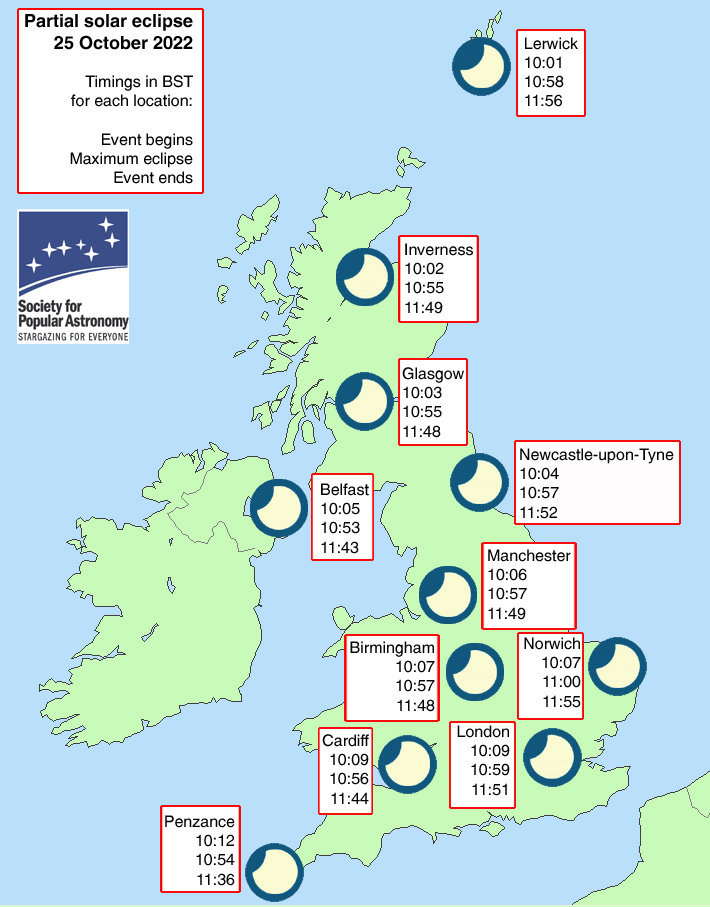
The eclipse will be visible from the whole of the UK, weather permitting of course, although those in the north and west of the country will see a bit more of the Sun covered than those in the south. The appearance of the Sun at maximum eclipse and eclipse timings are shown below.

Because only about a third of the disc of the Sun is covered the sky won’t go dark, and even if it is sunny you probably wouldn’t notice anything unless you were aware of it, unless you glimpse the Sun through cloud. Imagine the alarm of people in ancient times who happened to glance up and saw the Sun progressively being eaten!
Eclipse FAQs
How can I view it?
The Sun is so bright that looking at it directly will blind you. Even at mid eclipse, the remaining bright part of the Sun is far too bright to view. You need to cut its brightness down by about 100,000 times. Ordinary sunglasses are useless, and you should never use household materials such as bin liners, food wrappers or the like (see below). So either use an authorised eclipse viewer, or project the Sun’s image using a small mirror or a telescope or binoculars. A welder’s No 14 glass is also OK for viewing directly.
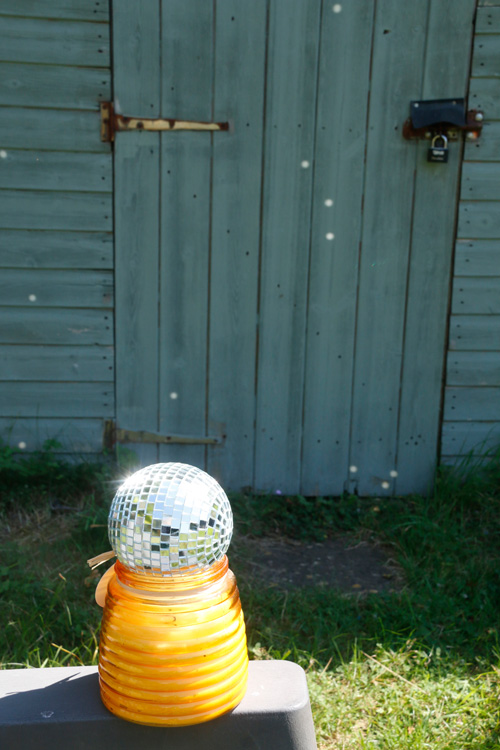
If you have a glitter ball (disco ball) decoration for your Christmas tree you can use that to project lots of small images of the eclipsed Sun. Search your loft now!
Where can I get an eclipse viewer or material from?
Only specialist astronomy suppliers may have stocks. For this eclipse you can get a stock of them from Go Stargazing (minimum order of 50) or you can buy individual glasses from First Light Optics. The most commonly used material for making filters is Baader AstroSolar, available from a number of suppliers, but other materials are available. Just search for ‘solar eclipse viewer’ or ‘Baader Astrosolar’.
I’ve often had to look into a low sun when driving – what’s the problem?
Under those circumstances your eye will not fix on the Sun itself but will dart around and a reflex action prevents you from gazing at the actual Sun. But when trying to see the eclipse you may try to force yourself to overcome this reflex, which is dangerous.
Can I view it through thin cloud?
Quite often we do see the Sun’s disc through cloud with no problems. The problem is that when viewing an eclipse we tend to stare at it for longer than we would usually do so, which could cause a buildup of heat. This must be your own decision – if the Sun is so much dimmed by cloud that it’s hardly brighter than the cloud itself, it may be OK for you to look at it briefly, but eyesight sensitivity varies from person to person and this is not based on medical advice. Look away the instant that the cloud thins.
Will I see sunspots?
If you are viewing the eclipse using binoculars or a telescope you may see sunspots, as there are a few on the Sun at the moment.
What about looking at a reflection in water?
This cuts the brightness down to only about a few per cent of the original brightness – not nearly enough for safety, no matter how dirty the water!
Why can’t I look through a photographic negative like I did when I was young?
Years ago, most photos were taken on black and white film, and the black areas of the negatives were made of silver particles. A couple of layers of these could cut down all wavelengths of light quite well. But colour negatives use dyes rather than silver, and these don’t absorb all wavelengths of light equally. The worst thing is that even though they cut down the visible light, so the Sun looks dim, they may allow through other wavelengths, such as infrared (heat) which will quietly fry your eyeball without your realising it until it’s too late. The same applies to many other dense materials, such as bin liners, smoked glass, food packaging and CDs. So don’t take the risk!
Where will the eclipse be total?
It won’t. On this occasion the central part of the Moon’s shadow, where a total eclipse takes place, misses the Earth completely. The maximum amount that the Moon covers the Sun from anywhere on Earth is from northern Canada where the Sun will be about 93% obscured.