
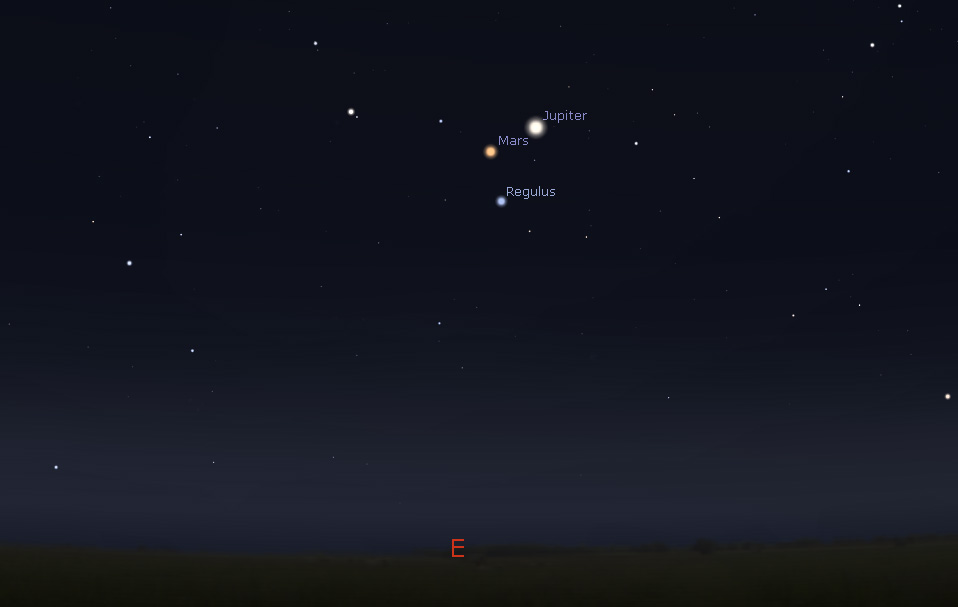
Mars and Jupiter are now an enticing sight in the sky – for those who stay up after midnight UK time. During early November 2026 they draw closer together until by mid-month they make an extraordinary pair just over a degree apart. Then they separate again, giving us a chance to see planetary movements in action.
Most of the time when we see a planet in the sky it seems to remain hanging in the same spot, week after week. It’s only when it’s close to another object that we get to see its true movement around the Sun. This year we can watch each planet moving night by night in its orbit, as they are both close to the bright star Regulus, in the constellation of Leo.
You can see the planets in the eastern sky. At the start of the month they are low down and you might need to wait until about 1 am before they clear the nearby rooftops. At this time, Mars is above Jupiter – you can recognise it by its more red colour. Notice the star Regulus below them.

The planets and Regulus are not really close in space. Jupiter is over 800 million km away, while Mars is about a quarter of that distance. The light from Jupiter has taken 45 minutes to reach us – but the light from Regulus has taken 77 years!

By mid November, the two stars have moved closer to Regulus, but Mars has moved more quickly and now the two planets are neck and neck. It’s quite unusual to see two planets this close in the sky – the event is called a conjunction. They are close enough that you can see both planets in the same field of view of a telescope. The reason Mars moves quicker is that it’s closer to the Sun, and the basic law that governs the orbits of the planets is that the closer they are to the Sun, the faster they move.
Then by the third week in November, Mars has moved past Regulus, but Jupiter is lagging behind. By now you can see the planets well before midnight – no need to lose sleep!
Keep an eye on the two planets throughout the winter and into next year. Our viewpoint from Earth makes them appear to reverse their course, and Jupiter doesn’t get to pass Regulus until July – by which time it’s the other side of the Sun so we can’t see it!
