
Comet Iwamoto is still high in the evening sky, but if you’re hoping to see a blazing object with a fine tail, you will be disappointed. As our previous story points out, this is an object best treated as a visitor to our skies, on a par with many deep-sky objects but more suited to those with a good working knowledge of the sky.
It remains fainter than magnitude 7, and is fading slowly as it draws away from the Sun and Earth. It is currently leaving Gemini and entering Auriga, but the bright Moon is making observations less satisfying than one would like. For those who know the sky, here is a chart of its positions during the last week of February and the first week of March. You’ll need to click on the map to enlarge it so that the labels can be seen.
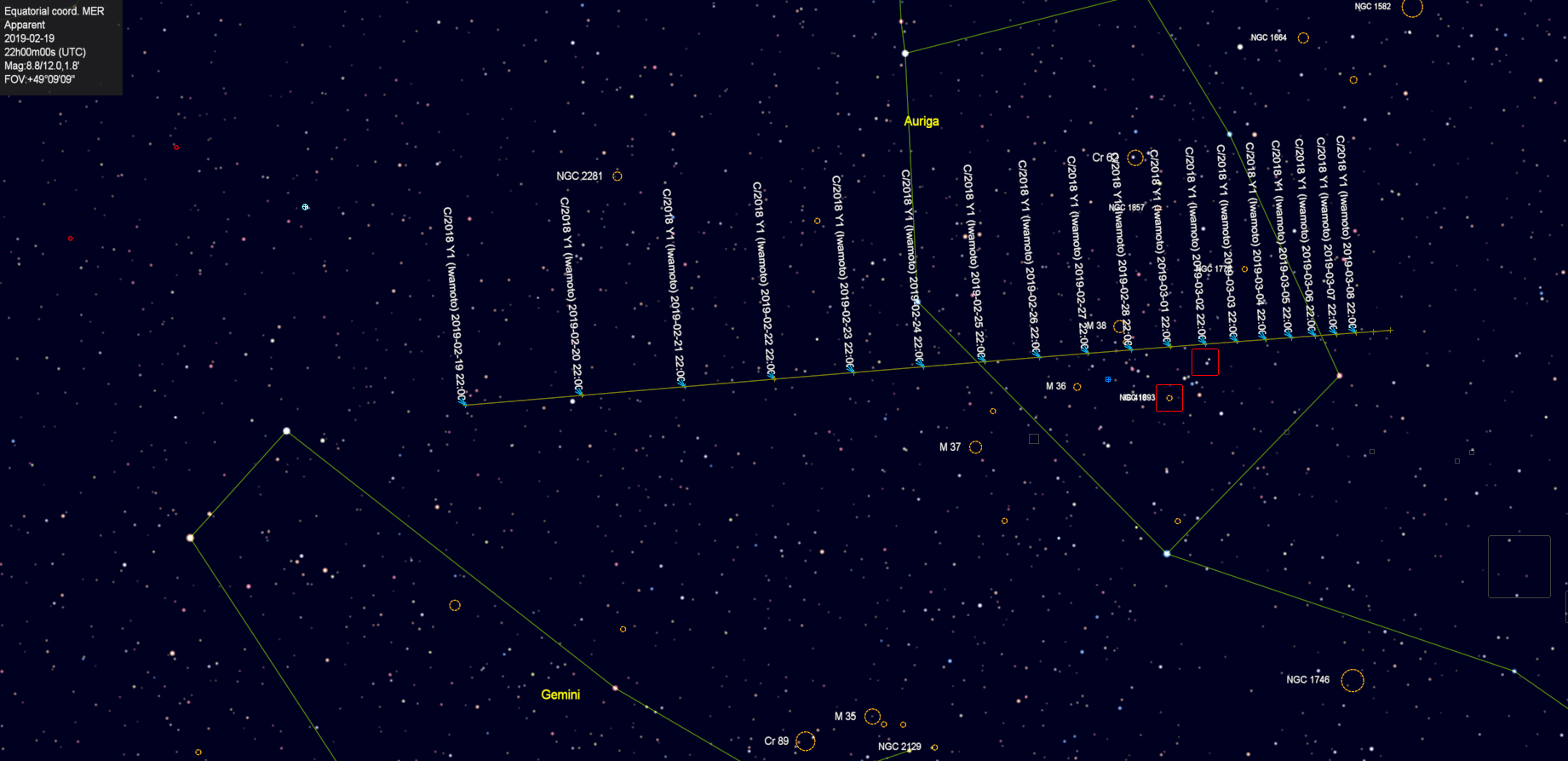
At the end of February and beginning of March the comet passes close to the well-known open clusters M36, M37 and M38. Here’s a more detailed chart showing its positions relative to those objects.
