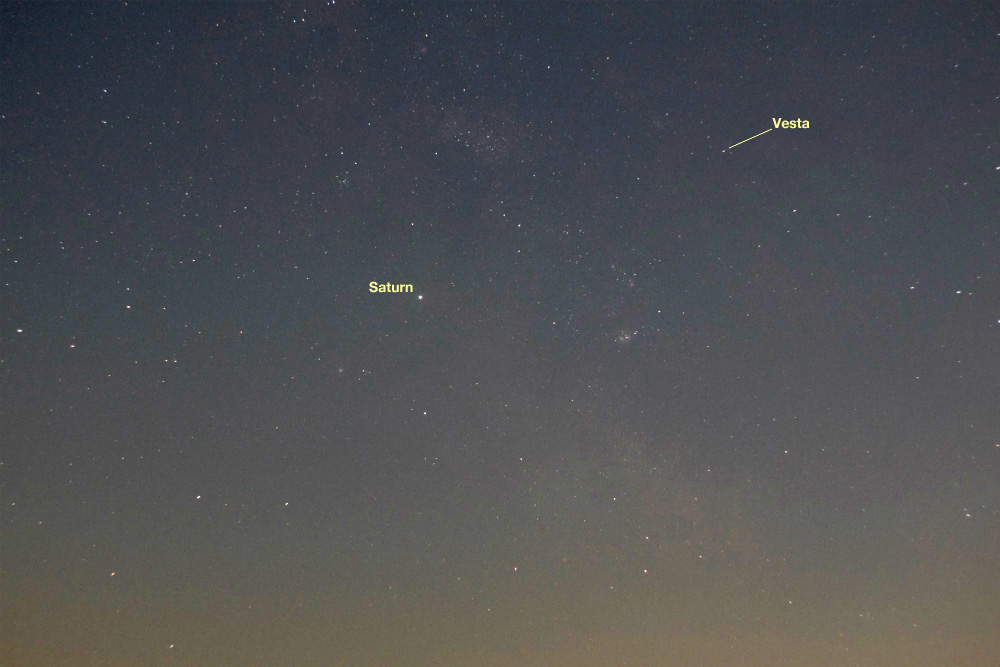
The minor planet (asteroid) Vesta is currently bright enough just to be seen with the naked eye – and won’t be quite as bright again for 11 years.

On the downside, it’s quite low in the sky as seen from the UK, in the constellation of Sagittarius. But fortunately, the bright planet Saturn is nearby, making it easier to spot. It is an easy object using any binoculars.
Vesta is not the largest of the asteroids, with an average diameter of just 525 km, but its unusually bright surface means that it’s the brightest. Despite being just visible to the naked eye from time to time, it was not spotted until 1807.
Occasionally its orbit brings it slightly closer to Earth than usual, and this is one of those times. It won’t be until July 2029 that it again gets as bright as this. So don’t hang around! But this year’s event isn’t Vesta’s brightest ever: it reached magnitude 5.2 on 5 July 1960, for example.
To find Vesta, first locate Saturn by looking to the southern part of the sky in the late evening. It is the brightest object in that part of the sky, fairly low down – literally skimming the rooftops in many cases. It is due south about 1:30 am BST. Now use the map below to locate Vesta for the date you are observing compared with the position of Saturn. It won’t stand out with the naked eye, so use binoculars. In this case, small or low-magnification binoculars are better than large high-power ones, as they will show you more of the sky at a time.

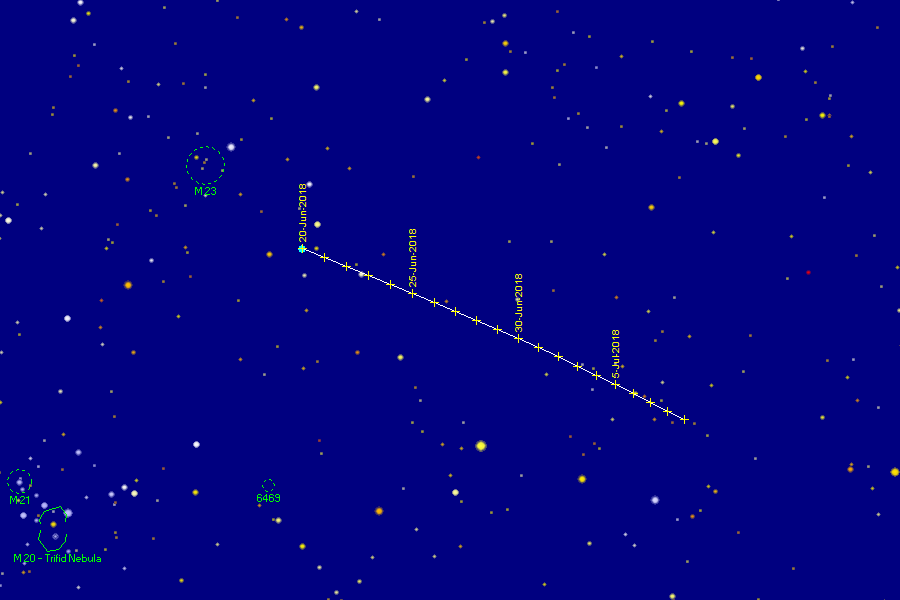
Vesta is moving quite rapidly, so remember that the tick marks on its path are for midnight on the date in question – if you’re observing on the 24th, say, before midnight, it will be close to the next date’s position. If you are using sky mapping software to locate it, make sure you are using the very latest update, as predictions made with software updated even a few months ago are slightly in error.
Taking photographs just a night apart will show its change in position clearly. You don’t need a camera driven to follow the stars – with good modern cameras, just a few seconds’ exposure on a tripod-mounted camera at a high ISO setting and standard lens focal length will be sufficient to show it, though longer exposures on driven cameras will reveal the Milky Way and some deep-sky objects nearby.