Venus is displaying her beauty in the evening sky this spring – but don’t leave it too late to glimpse her, as she retires by the time it gets properly dark!
You can find Venus over in the north-west after sunset, shining brilliantly. The planet is first visible about 45 minutes after sunset, and is easily visible, though quite low down, by 10 pm.
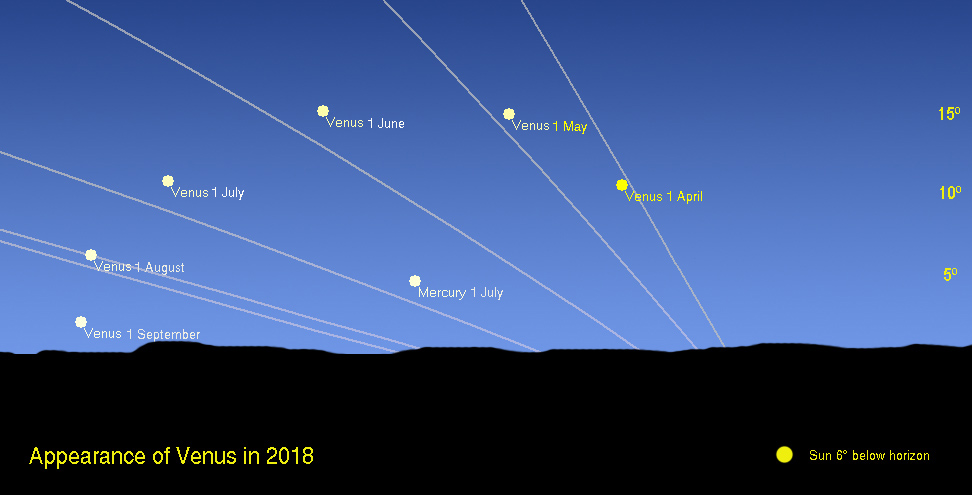
Although Venus is moving closer to Earth, and moves farther away from the Sun as seen in the sky, this year the planet will never get very high above the horizon as seen from the UK. As Venus moves outward, the angle of the ecliptic to the horizon lessens, as you can see from the diagrams below. So although its greatest distance from the Sun is in August, at that time it will be very low as seen from the UK, though down in the southern hemisphere they’ll get a great view. And by September it gets progressively south of the ecliptic, making it virtually unobservable in the bright twilight. This means that the best time to see Venus is this spring, with the optimum time being in May and June.
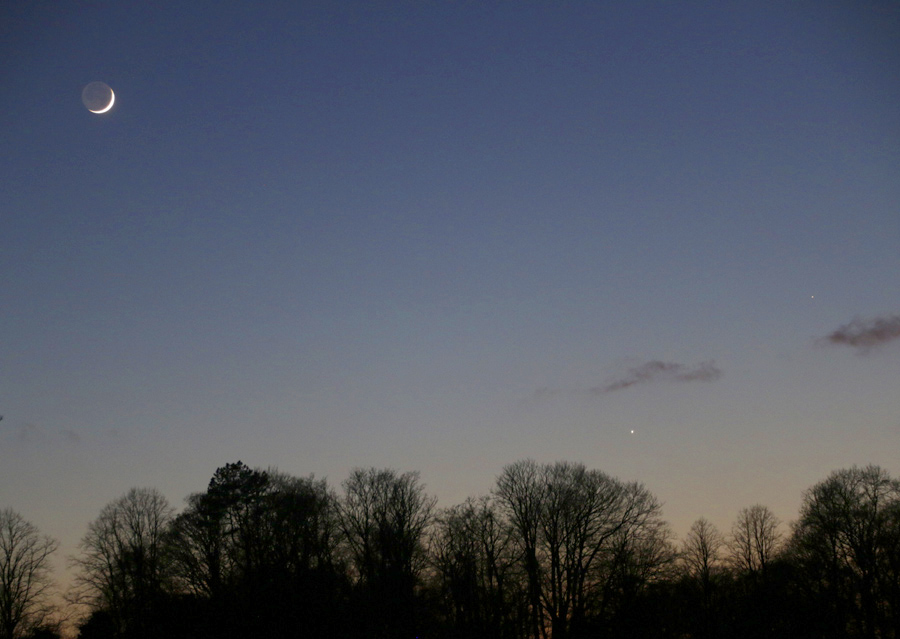
If you want a photo-opportunity with the crescent Moon, the best dates will be 17 May, 16 June, 15 July and 14 August.
Using a telescope
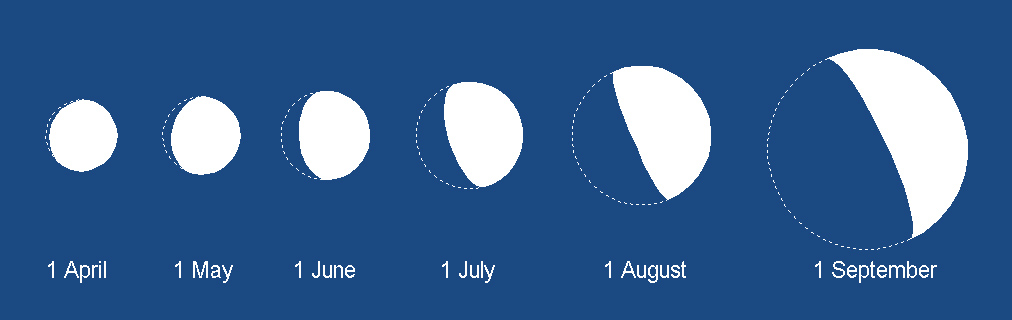
To the naked eye or even binoculars Venus appears just as a brilliant starlike point of light. But if you have a reasonable telescope, capable of magnifying 50 times or more, take a look at it. In April Venus is currently on the far side of the Sun, and is almost fully illuminated so it appears as a disc. As the months progress, Venus gets closer and larger, and its phase decreases. Its diameter increases from 11½ arc seconds in April to 16 arc seconds in July – not particularly large (see the diagram below). By September it will be 30 arc seconds across, but so low as to be virtually unobservable in twilight from the UK. Bear in mind, too, that with the planet so low the turbulence of our atmosphere will make its image very unsteady, so unless you are lucky enough to get very calm conditions you won’t get a sharp view.