
 |
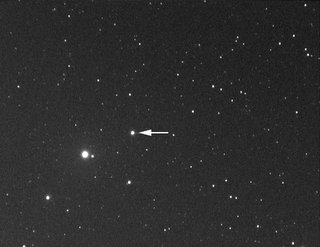
| Vesta, arrowed, on the evening of 23 November. |
|
|
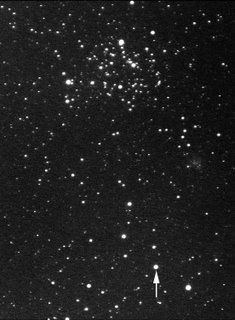
| Ceres, on the same evening, close to M35 (top of picture). Both pictures from Robin Scagell, using 60 mm refractor and Lodestar CCD |
Two bright asteroids, Ceres and Vesta, are currently well-placed for observation in the evening sky in Gemini and Taurus. They both reach opposition – when they are at their brightest and best placed for observation – in December. And this year Ceres is brighter than it will be for many years to come, so this is your best chance to see it using small instruments such as binoculars.
Vesta is the brighter of the two, and is the brightest asteroid. It is currently in Taurus, and reaches its brightest for the year, magnitude 6.4, on 9 December. However, this is not the brightest that it can get, which is magnitude 5.5. For the rather complicated explanation of this, see below.
Ceres is larger than Vesta, and is now designated as a dwarf planet, for reasons which are too tedious to go into here! But its surface is not as bright, so it appears fainter. It was the first minor planet to be discovered, on 1 January 1801. It is currently quite close to Vesta in the sky, and moves from Gemini into Taurus at the beginning of December.
The map below shows the tracks of the two minor planets during December as seen in the sky, with stars shown down to magnitude 5.5. Beneath those are enlarged versions showing the tracks, with ticks every two days and stars to magnitude 11. Click on these maps to enlarge them.
What will I see?
Asteroids are so distant and comparatively small that they appear as points of light in a telescope. So all you will see is a starlike object, looking no different from a star. The only ways to be sure are to compare your view of the area with the star map, and to look again on another night to check that the object you saw is no longer in the same place. So you might need to make a drawing of the area where you think the asteroid is, and do the same again on another occasion.
The brightness of Ceres and Vesta
A minor planet is brightest for the year when it is near opposition, which this year for. However, some years it will be closer than others, as the orbits of these objects are not circular. Vesta is closest when its opposition occurs in June, so this year it is particularly distant. At a June opposition, it can be magnitude 5.5, and just visible to the naked eye.
In the case of Ceres, it is closest in February. But oddly enough, these oppositions (as happened in 2009) are not the brightest, because they take place when Ceres is some way above the ecliptic as well, so the asteroid is not fully illuminated by the Sun. But this year, Ceres is on the ecliptic, and it will be at its very brightest. It will not be as bright until December 2035, so take your chance to observe and photograph it now.
Both objects are visible with binoculars, but you will need a fairly good sky and a steady hand to be able to pick them out. Use the charts below to help you. There are many other stars or similar brightness, so the trick is to look for patterns of stars and see which one is extra.
These maps were created using SkyMap 11. However, we found that the asteroid catalogue provided with the software gave an incorrect position for Ceres, so you will need to download the latest catalogue when producing maps.
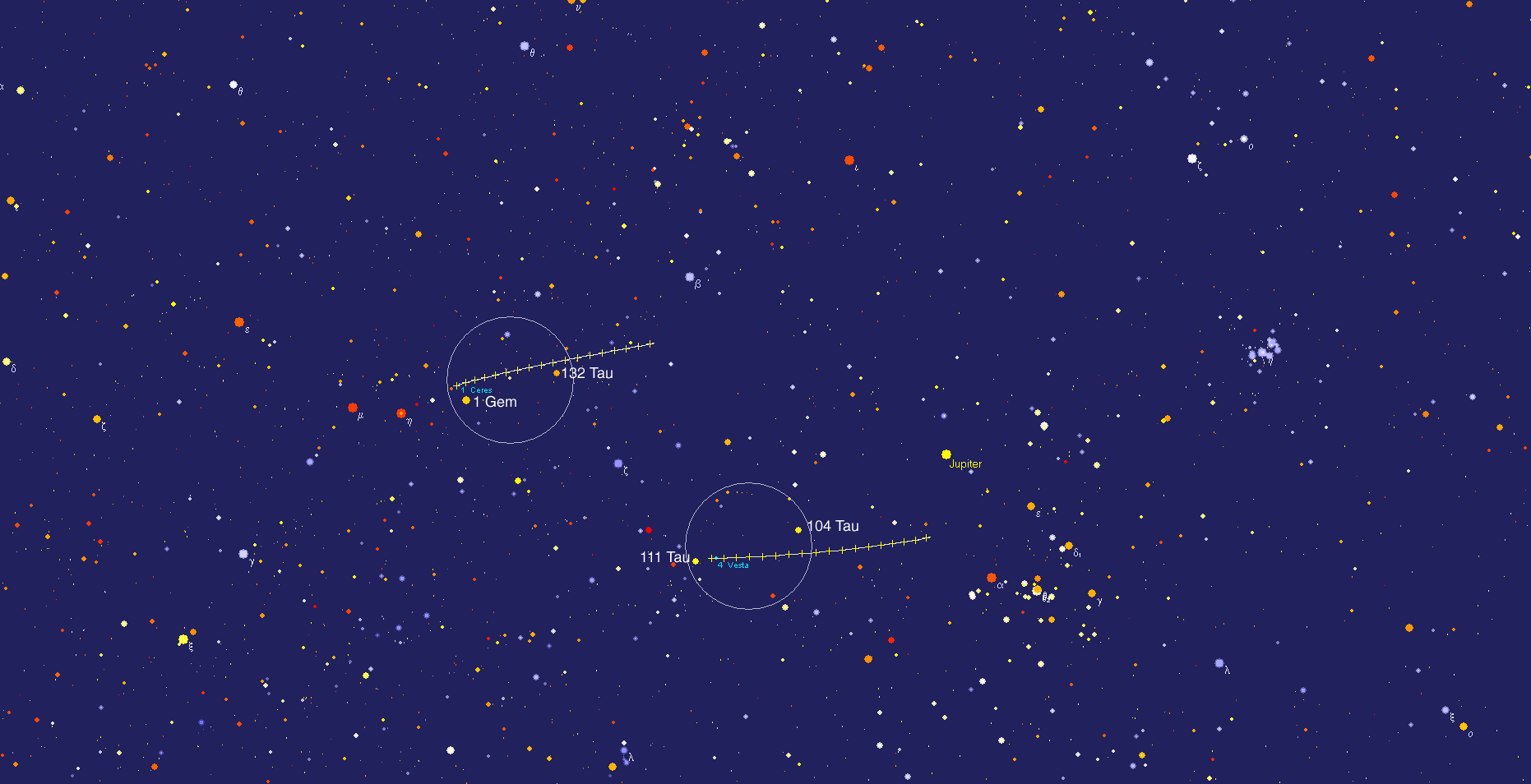 |
| Tracks of Ceres and Vesta November–December 2012. Click to see an enlarged version with reference stars labelled, and typical 5º binocular fields of view |
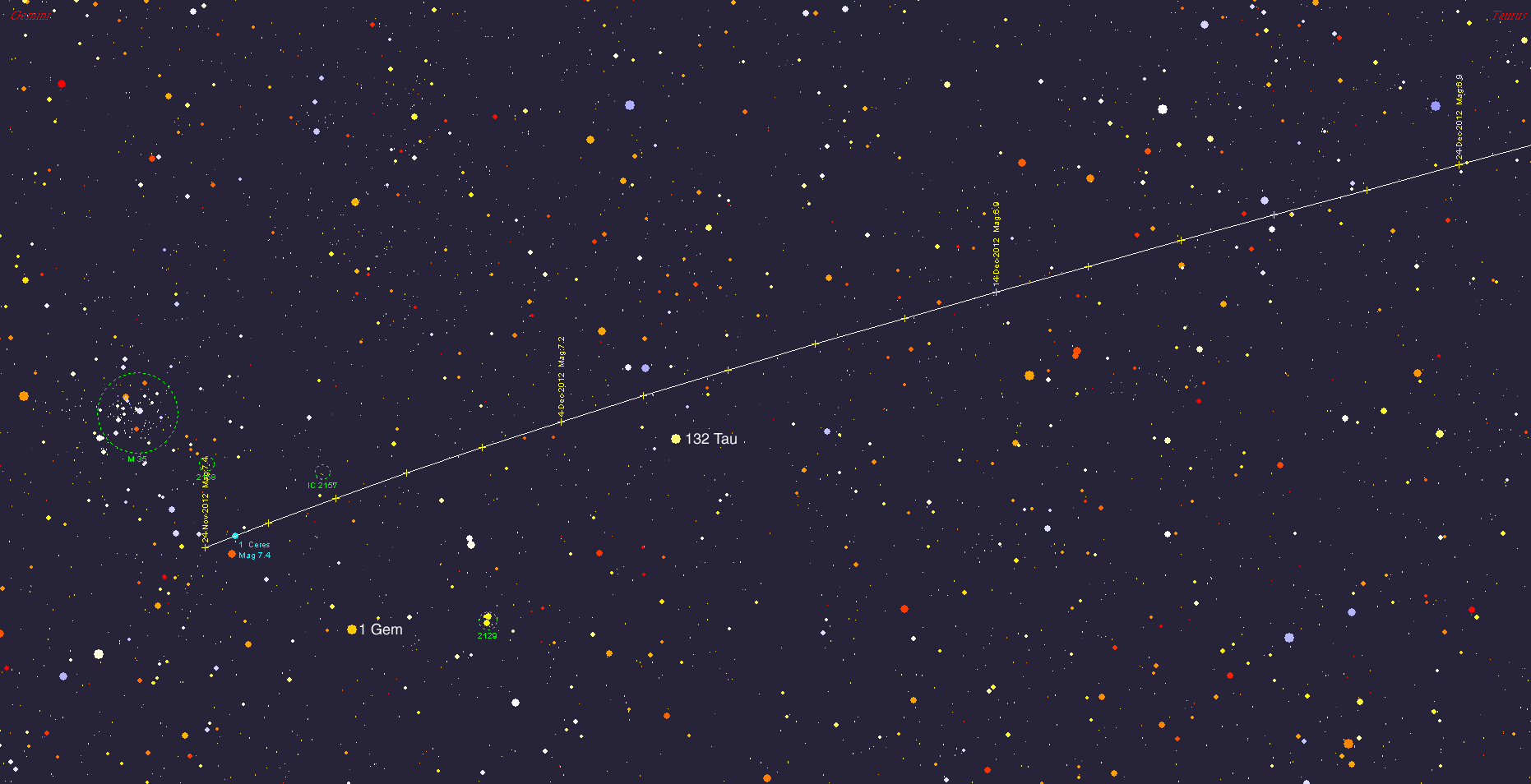 |
| Track of Ceres November–December 2012. Ticks are shown for midnight every two days, so on the evening of that day the asteroid will have moved and will be near the position for the next midnight. The object moves left–right. Click for full-screen view |
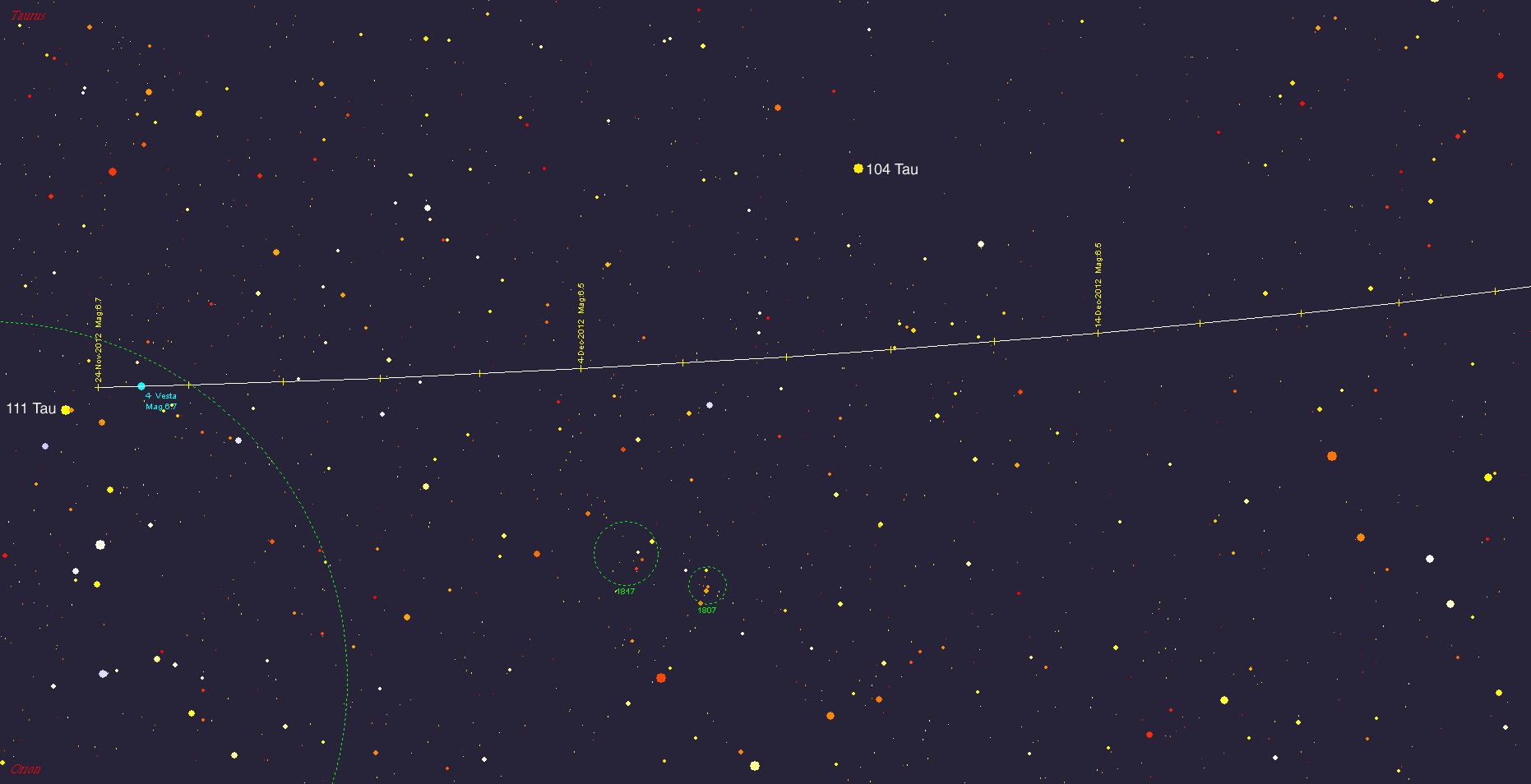 |
| Track of Vesta November–December 2012. Ticks are shown for every two days. The object moves left–right. Click for full-screen view |