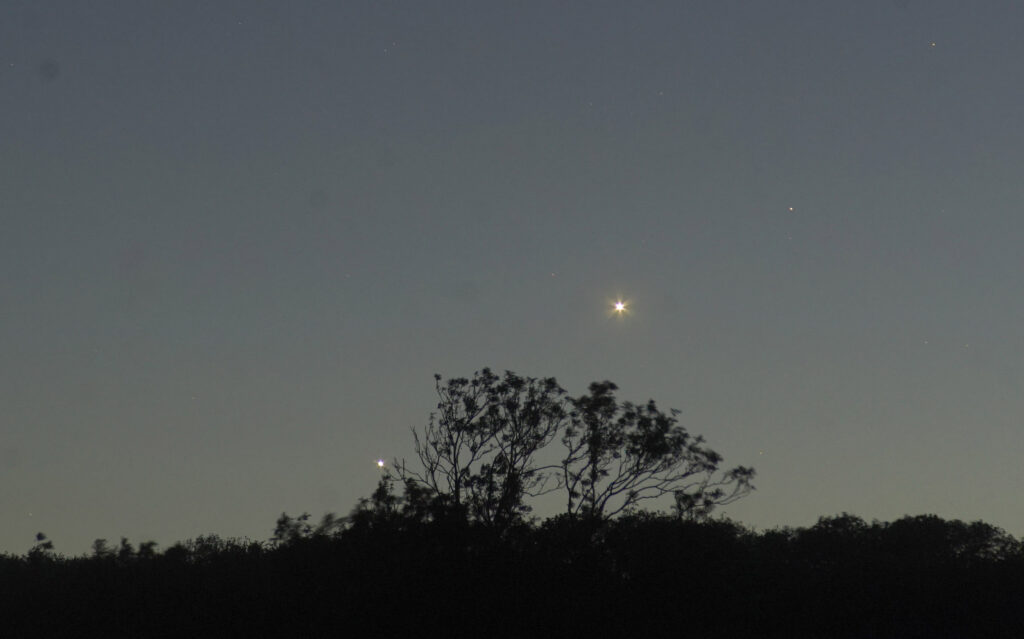
Two bright planets are attracting attention in the western sky after sunset during June 2026 – Venus and Jupiter. But which is which? Actually, they swap places during the month. And we show you how to catch a glimpse of Mercury in the middle of the month.
At the beginning of June, Jupiter is the higher of the two, and is considerably to the left of much brighter Venus. This photo shows how they looked on 28 May:
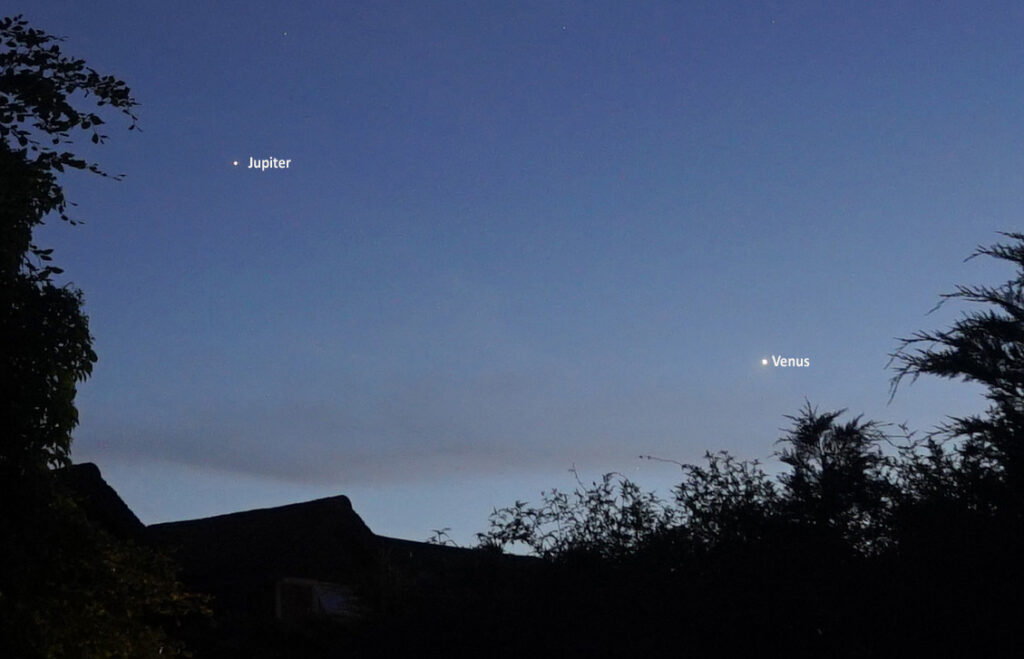
But as the month progresses, Jupiter gets lower night by night, and moves to the right, while Venus gets higher and moves to the left. The two are very close together on 9 June and a day or two on either side. After that, Jupiter is lower. Although the two planets look close together, there’s a vast distance between them. You need to be able to see the orbits, as shown here:
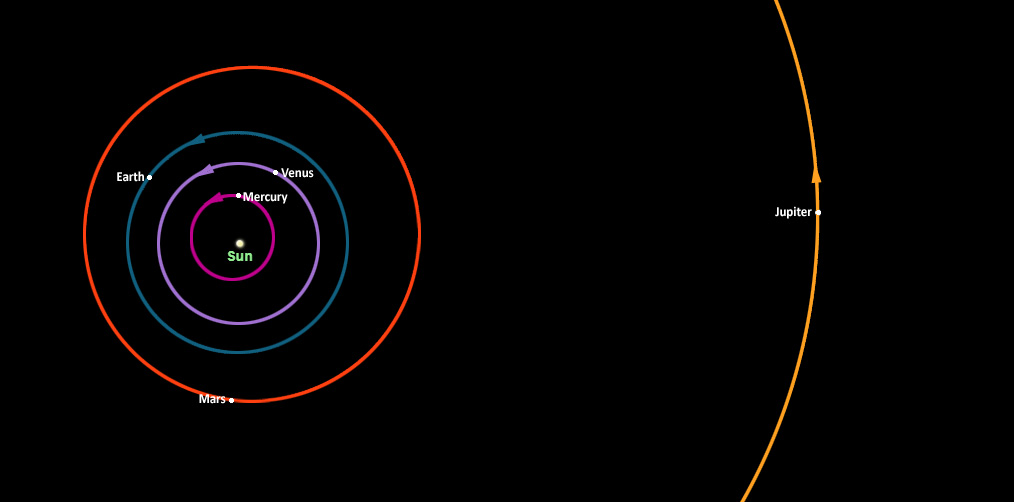
Put yourself looking from Earth, on the left of the view, towards Venus. You can see that Jupiter is in the same line of sight but much farther away. On 9 June, Venus is 179 million km away but Jupiter is 904 million km away.
The closer a planet is to the Sun, the faster it moves in its orbit. So Venus is doing most of the moving, and in the sky you can see it passing Jupiter night by night. But Earth itself is also moving and during June we start to put the Sun between us and Jupiter, so Jupiter sinks into the twilight. Menawhile, all the time, Venus is getting closer. You can watch this happening in the sky by looking each night about 45 minutes after sunset.
Mercury also gets into the picture, moving around its orbit even faster than Venus. It will be at its greatest separation from the Sun on 15 June, so that’s the best time to look for it. It will be more or less in a line from Venus through Jupiter towards the place where the Sun has set. You might find that a sky app on your mobile phone will help you spot it compared with Venus and Jupiter.
Here’s a photo taken with a telephoto lens at 23:13 on 8 June showing Jupiter (lower left) and Venus. Jupiter’s satellites are visible on either side of it.
Update 9 June