
There will be an eclipse of the Moon on the evening of this coming Sunday, 7 September. For observers to the east of the UK this will be a total eclipse, with the Moon going completely dark as it passes through Earth’s shadow. But for most of the UK the total phase ends about the same time that the Moon rises, or even before moonrise, so all we’ll see is the later stages as the shadow moves off the Moon. Even so, it could be a spectacular sight – and you need to prepare in advance if you want to get the best view.
Eclipse gallery
Clouds covered much for the UK during the event, but clearings in southern England allowed views of the partial event.
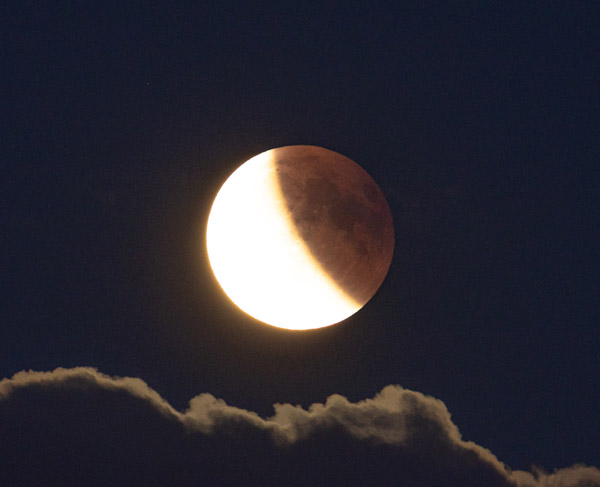

The timings of the eclipse are the same wherever you are, but the crucial factors affecting its visibility are the time of moonrise and the height of the Moon above your eastern horizon from your observing site at 19:52 BST, which is when the total phase of the eclipse ends.
The eclipse begins long before the Moon rises as seen from the UK, at 16:26 BST. Totality begins at 18:30, with mid-eclipse at 19:11, and ends at 19:52. The totally eclipsed Moon is always exactly opposite the Sun, so the time of sunset from your location is critical.
The time of sunset varies from 19:27 from Dover and Lowestoft to 20:00 from Belfast. Anywhere east of a line from roughly Land’s End to John o’Groats totality ends after sunset, but anywhere west of that line you will see only the ending partial stages as the Moon rises higher in the sky.
During these phases the Moon will change from a thin sliver of brightness, with most of its disc eclipsed, to the Moon being fully visible at the end of the umbral phase at 20:56. Following that, the remaining penumbral shadow will clear the Moon by 21:56. The graphic below shows the stages of the total and partial eclipse and where they will be visible from. Click or tap the image to see it larger.

To see the early stages during or just after totality you will need as low an eastern horizon as possible, so it’s worth seeking out a spot where you can view this. The Moon rises slightly to the south of due east on this date.
Sunset eclipses offer good photographic opportunities even if you miss the total phase, when the Moon appears deep red in colour. Find interesting foreground objects to add to the composition.
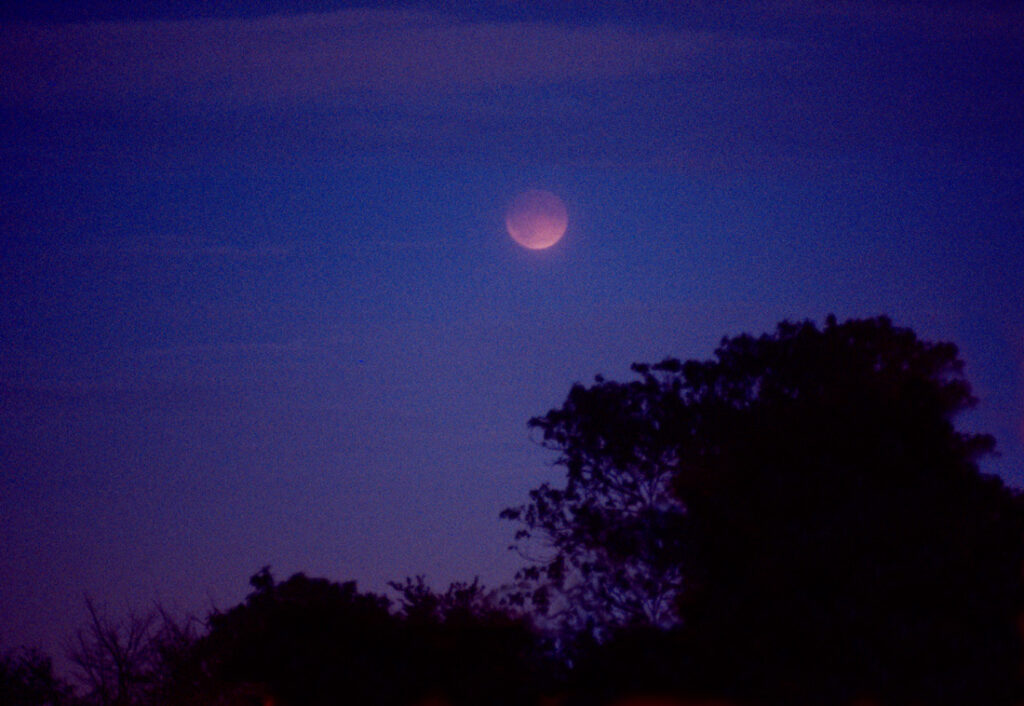
How to photograph the eclipse
Most modern cameras, whether phone or standard digital, will take a photo of the eclipse. But for the best results you really need to zoom in so as to get the disc of the Moon large in the field of view. At standard lens settings, the Moon appears very small in the field of view.
Some high-end phone cameras have genuine telephoto lenses that will give sharp results (optical zoom), but others have digital zooms that simply enlarge the image from a single lens, which is no better than taking a standard snap and enlarging it on screen. You need around a 10x zoom for the best images. This may be a case of digging out your old digital compact camera that has a genuine optical zoom, or a DSLR camera with a 200 mm lens fitted.
By the time the sky is getting dark the exposure time for good results may be a second or more, so you’ll need to put the camera on a tripod, or hold it very steady as you take the shot. One useful tip, even with a tripod, is to use the camera’s delay, usually either 2 or 10 seconds, so you can press the button without jogging the camera. This is particularly useful with phone cameras.
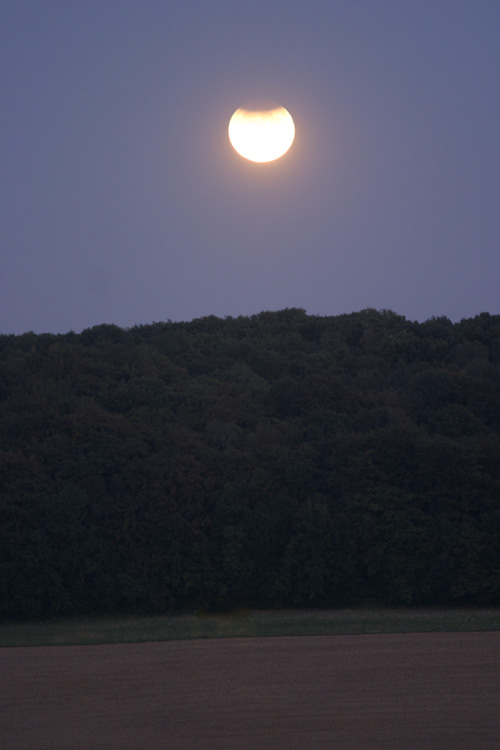
During the later stages of the eclipse, when the sky is fairly dark, the Moon is quite bright compared with the dark shadowed area. The automatic exposure on your camera will try to balance out the brightness and could overexpose the Moon, so the eclipsed part can’t be seen. In this case you’ll have to reduce the exposure by using manual control, so on a digital camera check the instructions beforehand so you know how to do this (and take it off manual exposure afterwards!).
On a phone camera, tapping the screen may give you an exposure control which will help to give the correct exposure for the shot.