

It’s August and holiday time. With luck you’ll be able to stay up a bit to make the most of darker skies than you’re used to. It gets dark a bit earlier than in July, as well. And for once you won’t get frostbite. But how do you make sense of all those stars?
That’s where we come in. Use our easy-to-follow sky guide and you’ll be out there stargazing in no time. You will need a star map, and you will need to know how it works. This may seem obvious, but there is a knack to understanding these things. Here’s our map for this month:
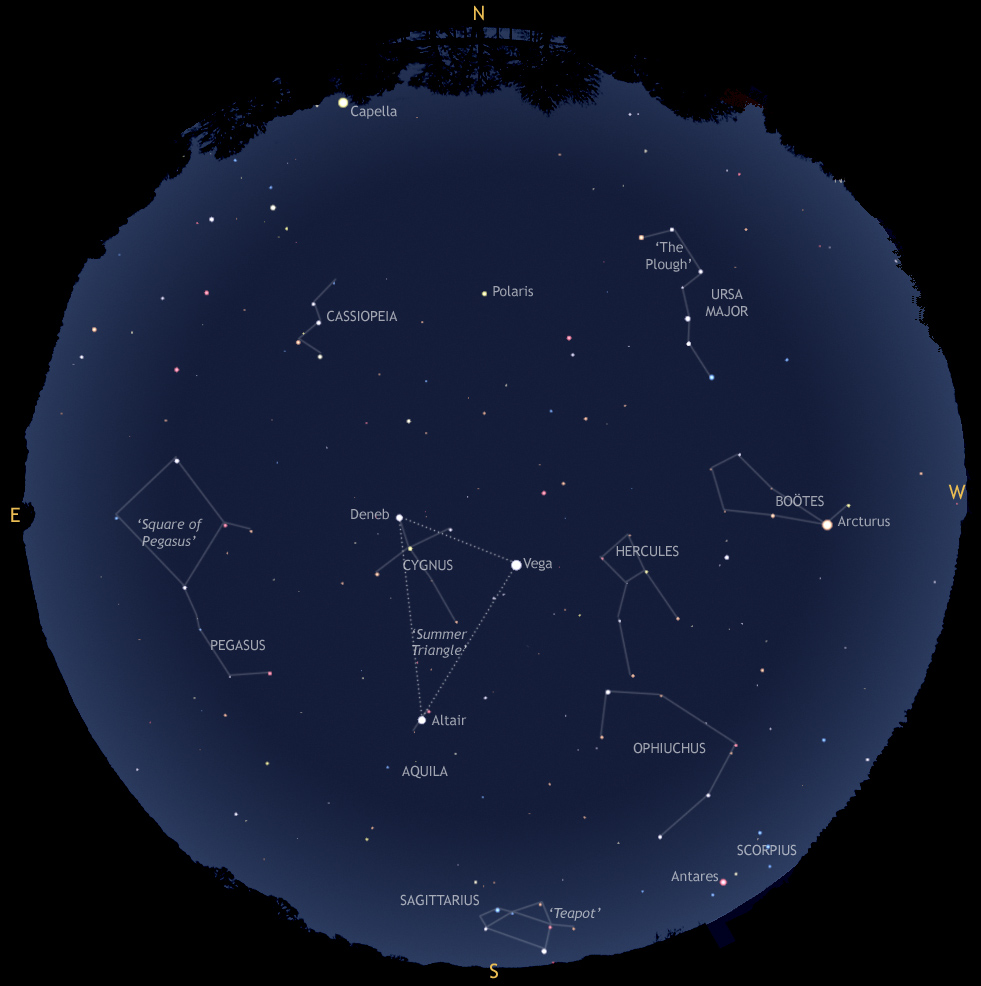
Wrong way round?
Now don’t write in and tell us that we have the points of the compass all wrong. This is a map of the sky, so you have to hold it over your head. When you do this, east and west will be the right way round.
It shows the whole sky, so the scale is quite small. Normally you turn to see different parts of it, so to see the view looking north, for example, hold the map upside down with north at the bottom.
The map shows the sky in mid August at about 10.30 pm, at the start of the month at 11.30 pm, or by the end of the month at 9.30 pm. All times are BST.
| TIP If you aren’t sure of the direction of north from your location, click here for a page on Getting Your Bearings. |
Making sense of the stars
This being summer, the best way to find your way around the sky is to use the Summer Triangle. Actually this is not as obvious as it seems, because this triangle still remains visible well into the autumn and even the winter, but the fact is that it’s a key feature of the summer skies so we might as well stick with the name.
Find it by looking right overhead to find a really bright white star, Vega. It’s the only bright star close to being overhead, so ignore all other stars and look really high up. The next star of the triangle, Altair, is halfway between Vega and the horizon. Altair has a fainter star on either side of it – look at the map to get the idea. The other star is Deneb, which is a bit lower down towards the eastern horizon than Vega. If you can’t spot these three stars straight away, remember that the map above is on quite a small scale, so think big and you should spot it.
Many people recognise The Plough, which if you want to get your bearings is over in the northwest. We’ve picked it out on the map. If you think of the Plough as a saucepan, then follow its handle round towards the horizon, you come to a bright star called Arcturus, which is about the same brightness as Vega but low down in the western sky. It’s also slightly yellowish, and if you thought all stars were white, compare it with Vega to see the difference.
Now use the map below to find more patterns nearby, but don’t expect to see those convenient lines helping you to see the patterns. If you do see them, clean your glasses.
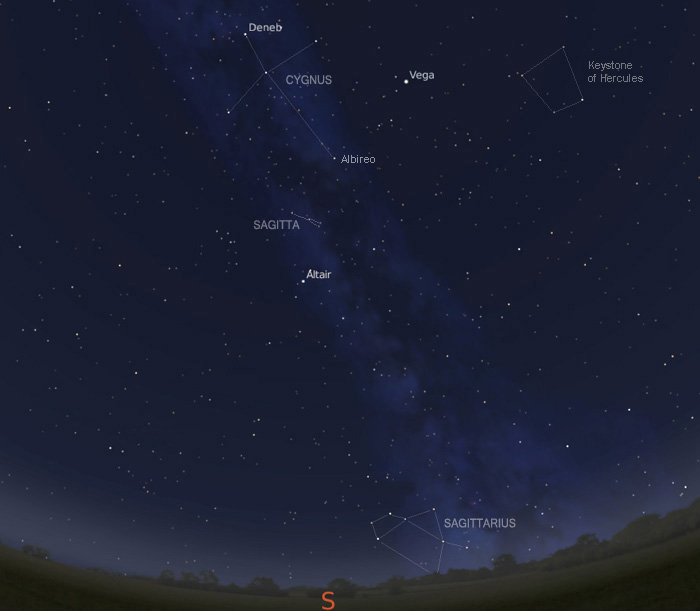
Map produced using Stellarium software.
Other constellations to look for
Once you have found the Summer Triangle, you can now start to look for some constellations. There’s Cygnus, the Swan, also known as the Northern Cross. It is a large cross-shape with Deneb at the top, marking the tail of the swan which flies down the Milky Way with outstretched wings. Fair point. You live in Neasden or Newcastle and can’t see this Milky Way which is shown on the map. You’ll just have to take our word for it that it’s there.
To find out more about Cygnus, including why it is unsuitable for children, click here. One of the best-known stars in Cygnus is Albireo, a fairly faint star marking the head of the Swan, or the foot of the Cross. Midway between Altair and Albireo is a rather cute constellation called Sagitta, which means Arrow. Use this to find some other interesting objects, and the constellation of Vulpecula, by clicking here.
This is the time of year to look way down on the southern horizon for the constellation Sagittarius, which form a sort of teapot shape. But unless you have a good, clear night and are well away from city lights, you might not see the stars of Sagittarius at all well.
There are plenty of nebulae and clusters visible with binoculars in this part of the sky, so check out our guide to them.
To the left of Vega is Hercules, whose most obvious feature is a parallelogram of stars called the Keystone, though it isn’t particularly bright.
The map shows the Milky Way as a pale band crossing the sky. This is a good time of year to look for it, though you won’t see it from light-polluted areas. The best chance of seeing it is high up in Cygnus, but if you go on holiday to a dark-sky area it can appear so bright you will wonder why you can’t see it at home.
If you want a map with all the constellation names on it, click here.
The month’s planets
Sorry, folks, there aren’t any! Of course, the planets are still around, but they just aren’t visible at the time for our map. Actually there are two around that you might be able to see. One of them is Venus, which is low in the evening sky after sunset. You can spot it for a short time in the evening sky looking west, around half an hour after sunset. It looks like a bright star, and it sets quite quickly as seen from the UK, and by the end of the month it’s so low that it’s not worth looking for.
And the other one is Saturn, the one with the rings. This is just rising in the east at the time of the map, so if you want to see it you’ll have to wait until around midnight at the start of the month, and look east. By the middle of the month it’s visible about half past eleven BST. It’s fairly bright, and a bit yellowish.
So you want to see Saturn’s famous rings, eh? Well, the good news is that even a small telescope will show them – you don’t need anything expensive. By ‘small’ we mean something that will magnify maybe 40 or 50 times. Give the planet a chance to rise over the houses and trees and you should see them.
Mars is in the early morning sky at the moment, low in the east, but it will be better visible a bit later in the year.
Jupiter is too close to the Sun to be seen at the moment. Mercury is in the early morning sky at the start of the month, but hard to spot.
Where’s the Moon, then?
At the very start of the month the Moon is just after full, as the actual full Moon was on 29 July. Last quarter is on the 6th, by which time it doesn’t rise until after midnight. We get new Moon on the 12th and then first quarter is on the 20th. The full Moon is on the 28th.
This month there are two eclipses, one of the Sun and one of the Moon. The solar one on the evening of Wednesday 12 August is a biggie, and while it is not a total eclipse as seen from the UK it comes pretty near it. It is actually a chance to see the true new Moon during the day. You’ll need to take special precautions to view it, so read our special eclipse page to find out all the details.
The lunar eclipse is on the early morning of 28 August is also quite a deep one, but the bad news is that you need to wait up until very early in the morning to see it. You just see the normal full Moon, very low down at this time of year, until just after 2:20 am, when it starts to enter Earth’s outer shadow. Then at 3:33 it starts to enter the full shadow, and looks as though it has a bite taken out of it on its left side. By 5:12 am it is at maximum eclipse, and you will only see a thin bright crescent of the Moon. But by this time it’s getting quite low in the sky and it’s starting to get light so if you just set your alarm for that time and look out of the window you might not be able to find it. Then the Moon starts to move out of the shadow, but it sets before the eclipse is over as seen from the UK. It will be a great sight, if you can get up early to watch it and have a good low south-western horizon.
We also have a whole section of this site about the Moon and what to observe, so do take a look.
August’s shooting stars
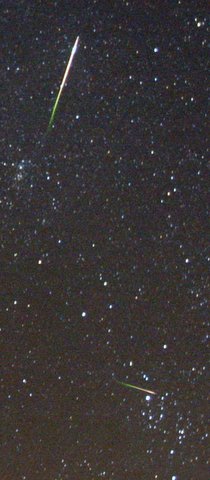
August is a great month for watching shooting stars – what astronomers call meteors. You can expect one every ten minutes or so on most nights, as long as you have a fairly dark sky. Around Wednesday 12 August we get the annual Perseid meteors, which are one of the year’s strongest showers. And this is the ideal year for watching them as the Moon is just new so we get a good, dark sky, clouds permitting.
The Perseids don’t just appear in Perseus (which is shown on our map at the top) but can appear anywhere in the sky. They appear to come from the direction of Perseus in the north-east, though the trails will be rather short in that direction so don’t concentrate your attention there.
You may hear that there could be 150 an hour visible or even more, but don’t take that too seriously. That’s a theoretical number based on perfect conditions, which we won’t get. But you should still see one a minute on average — though don’t be surprised if there are long periods without any.
You can find out a lot more about what to do when you see one in our guide to observing meteors.
Get more helpful info
OK, you’ve read all this for nothing, now comes the plug. This page is brought to you by the Society for Popular Astronomy, which is a really great society to join. It’s based in the UK but there are members in other countries as well. It doesn’t cost much to join, and there is a special rate for Young Stargazers. At least take a look at what we have to offer.
Text by Robin Scagell