Mira Brightening & R CrB Fading?

The long period variable Mira (Omicron Ceti) is now bright enough to be seen in binoculars, even from light polluted sites. From dark sky sites it may be visible with the naked eye as it approaches maximum in November. For UK observers, Cetus is low in the south-east in the early evening, but over the course of the night, it will be rising higher in the sky.

Conversely, there have been some observations suggesting that R CrB has faded slightly over the course of September (from magnitude 6.1 to 6.9). This could only be a slight fade, with R CrB remaining visible in binoculars until such time as it brightens again. However,  this could be the start of other long fade to minimum brightness. Corona Borealis is low in the western sky as darkness descends, but provided you have good western horizons, it should be possible to make some more observations before the star disappears behind the Sun.


R Trianguli now visible in binoculars.

The long-period variable, R Trianguli, varies between magnitudes of about six and twelve with a period of seven and a half months. It is predicted to reach maximum brightness in October and is already bright enough to be seen in binoculars.

If your not already observing this star, now is a good time to start. Finder charts can be found on the SPA’s website.

Three Bright Semi-Regular Variables for Summer.

If you are looking to add some new variables to your observing list, then here are some stars you may want to consider.

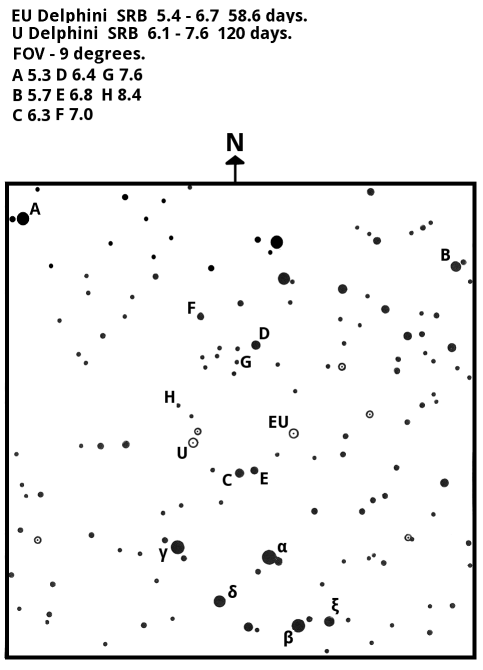
Delphinus contains two easy to find variables: EU Del and U Del. Both EU Del and U Del are pulsating red giants and both are classified as semi-regulars (SRB). EU Del has an amplitude of 5.4 – 6.7 and a period of about 59 days. U Del has an amplitude of 6.1 – 7.6 and a period of about 120 days.

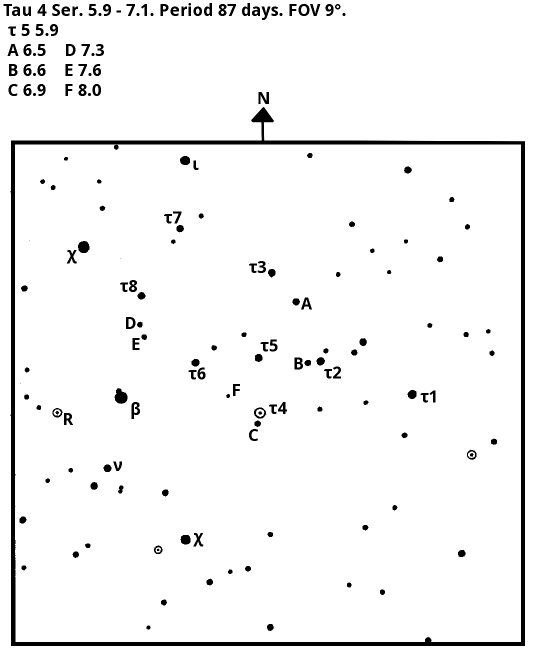
In the nearby constellation of Serpens, the bright variable Tau 4 Ser can be found not far from R Serpentis. Tau 4 Ser is another semi-regular variable (SRB) with an amplitude of 5.9 – 7.1, and a period of 87 days.

Below are finder charts for these stars, which have been adapted from the BAA Charts.


Three Mira Stars For May

Three of the Mira stars on the SPA program are will be visible in binoculars during May. T Cephei, a popular circumpolar star with a typical range of 6.0 – 10.5 was recently observed at about the seventh magnitude. It is currently on the rise and is predicted to reach maximum brightness in May.

Two more easy to find Mira stars on the SPA program are R Serpentis and R Bootis. R Serpentis variability was first observed by the German astronomer K.L.Harding in 1826. Harding is now best remembered as the discoverer of Juno; the third asteroid to be discovered. R Serpentis has a typical range of 6.9 – 13.4 and is predicted to reach maximum brightness in May. At the end of April, it was observed to be around the eighth magnitude.

R Bootis variability was first observed by the two German astronomers, E.Schonfeld and F.W.Argelander of Bonn Observatory while they complied their star atlas; Bonner Durchmusterung. R Bootis has a typical range of 7.2 – 12.3 and when it was last observed in April, it had a magnitude of 9.5. As it is also predicted to reach maximum this month, it should become visible in
binoculars over the course of May.

U Orionis Now Visible in Binoculars

If you out in the early evening you can still see the constellation of Orion low in the west; not long after sunset. Not far above Betelgeuse is U Orionis; a Mira type variable that typically varies between magnitudes six and twelve. During April we’ll have a brief chance to observe this star, in binoculars or a small telescope, before it disappears behind the Sun, at the end of the month.

U Orionis is predicted to reach maximum brightness in April and is just becoming bright enough to be seen in binoculars. One member, Johnathan Shanklin, has already observed U Orionis at just below the tenth magnitude. Hopefully, if the weather co-operates, we will all get a chance to observe this star before it disappears below the horizon.

U Orionis soon to be visible is binoculars?

U Orionis is one of our long-period variables, with a usual range of 6.3 – 12.0. It is due to reach maximum brightness in April/May, but observations by Don Matthews show U Orionis is increasing in brightness and may become visible in binoculars over the course of this month. Orion will remain visible, low in the west, for the next few weeks, so hopefully there will be some opportunities for visual observers to see this star before Orion disappears behind the Sun.

Below is a light curve, produced by Don Matthews, which shows the past behaviour of U Orionis.

R Leonis near Maximum

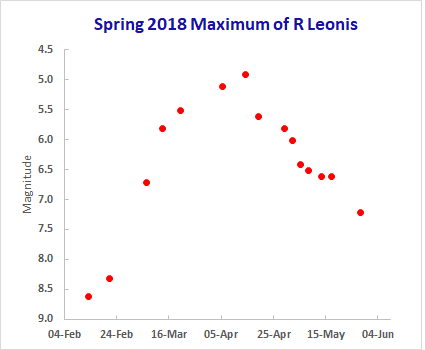
R Leonis, in the constellation of Leo the lion, reaches maximum this month.

R Leonis, a long-period variable, easily found near the bright star Regulus will reach maximum brightness this month. Like all long period variables, R Leonis is a red giant star and the variations in brightness are due to pulsations in the star’s outer layers.

R Leonis has an extreme range of 4.8 – 11.0, but a more usual range is 5.4 – 10.5. The exact behaviour of the star is never the same from one cycle of variation to the next. R Leonis is currently visible in binoculars and it will be interesting to see just how bright it becomes over the next few weeks.

Below is a light curve produced by Tracie Haywood showing the behaviour of R Leonis last year.


Two Eclipses for New Year’s Day

Happy New Year!

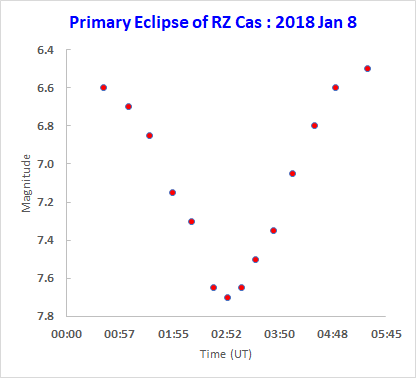
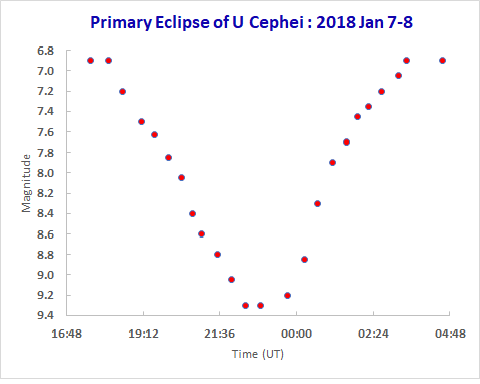
Weather permitting, astronomers in the UK can start the new year by observing both RZ Cassiopeiae and U Cephei on the same night.

There will be two eclipses visible from the UK on the evening of January 1st 2019. RZ Cassiopeiae will be in mid-eclipse at the start of the evening, mid-eclipse is at 17:30 UT, so you can watch RZ Cassiopeia brighten as the evening progresses. The duration of a RZ Cassiopeiae eclipse is almost five hours.

U Cephei will be in mid-eclipse at around 23:00 UT, so you can watch the eclipse over the course of the night, if it stays clear. The duration of an U Cephei eclipse is around nine hours.

These two light curves, produced by Tracie Heywood will give you some idea of what to expect.

Two Eclipses in November.

For observers in the UK, the 14th of November will be an opportunity to observe two eclipsing variable stars in one night. RZ Cassiopeiae will be in mid-eclipse at approximately 22:00 UT; as will Beta Persei.

The duration of RZ Cassiopeiae’s eclipse is approximately five hours and the duration of Beta Persei’s eclipse is nine and a half hours. You can start observing these stars as soon as it gets dark; using the charts on the SPA’s website. Try and make estimates every half-hour and report any observations you make to the SPA VSS.