The Annual Report for 2021 is now available for download. Look under the Section Report heading, or click on the link below:
https://www.popastro.com/variablestar/variable-star-reports/

The Annual Report for 2021 is now available for download. Look under the Section Report heading, or click on the link below:
https://www.popastro.com/variablestar/variable-star-reports/
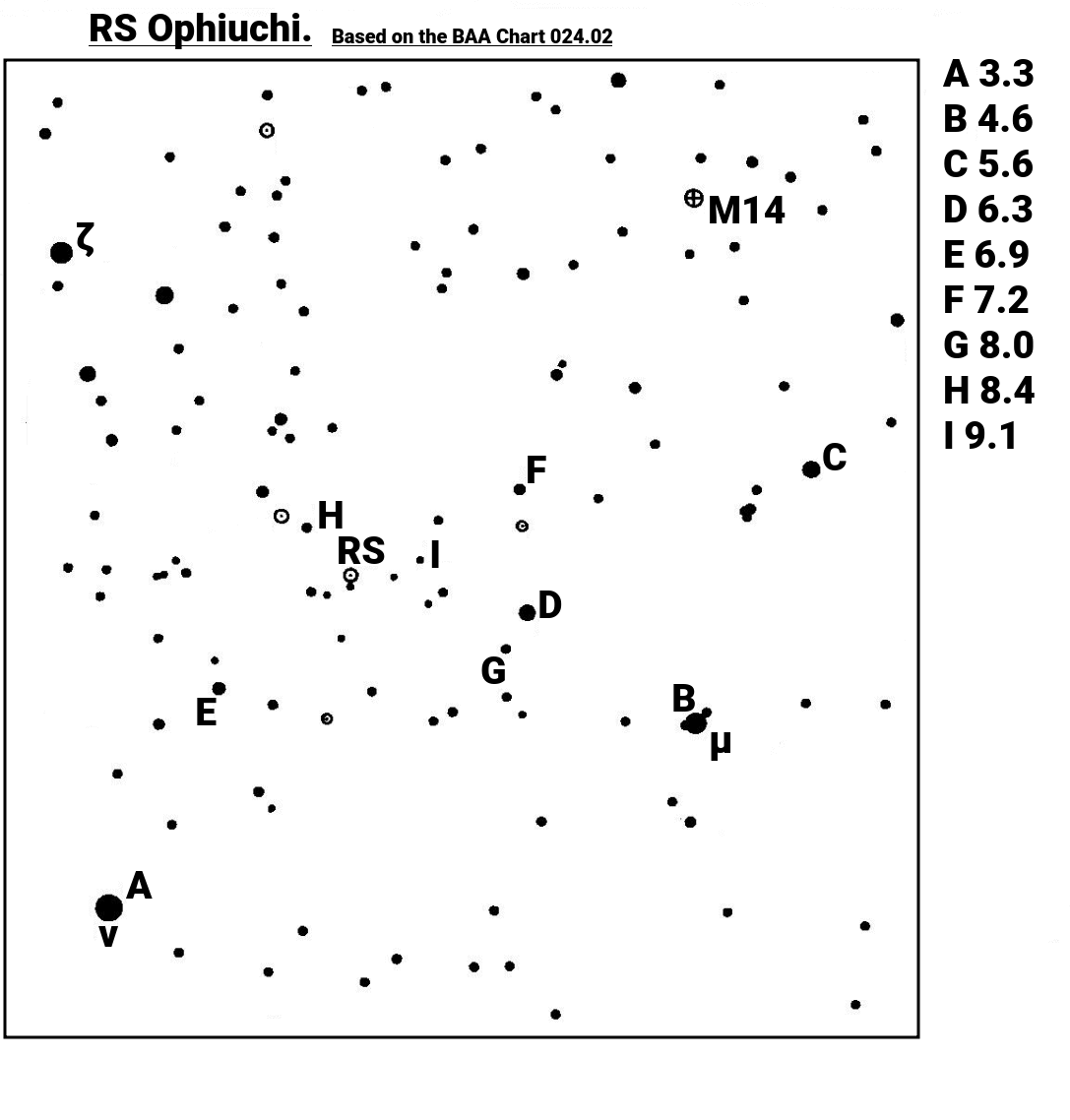
An major outburst of the recurrent nova RS Ophiuchi has been reported. It was seen at magnitude 6.0 on Sunday 8th August at 22h 20m UT by K. Geary of Co. Cavan in Ireland, and at magnitude 5.0 by A. Amorim in Brazil.
This star spends most of its time at around magnitude 12.5, but occasionally it undergoes a significant brightening. The last major outburst was in 2006, when it reached magnitude 4.5.
The outbursts tend to fade quickly, so if you want to observe the star at maximum you should make every effort to locate it as soon as possible. It is well placed in the evening sky and is on the meridian at about 21:30 BST.
A nova was discovered, in Cassiopeia, on the 18th of March, by Japanese amateur astronomer Yuji Nakamura, who reported it to Japan’s national observatory.
It has been confirmed as a nova on the basis of its spectrum. The nova is at RA 23h 24m 47.60s, Dec +61º 11′ 14.0″ (Epoch 2000.0)
This nova is currently visible in binoculars, at around the eighth magnitude.
Below is a finder chart, from the AAVSO, which will allow any interested members to make estimates.

The Annual Report for 2020 is now available for download. Look under the Section Report heading, or click on the link below:
https://www.popastro.com/variablestar/variable-star-reports/
Chi Cygni is now visible in binoculars and is predicted to reach maximum in March.
Chi Cygni reached magnitude 5.5 during its 2020 maximum, so it’ll be interesting to see how bright it becomes this year.
Chi Cygni is currently visible, low in the south-east, just before dawn.
Mira, or Omicron Ceti, is now visible to the naked eye. Mira was predicted to return to maximum brightness in October, but is already visible with the naked eye at around magnitude four. Hopefully, Mira will remain visible to the naked eye, or at least in binoculars, for the remainder of the autumn.
Also, Eta Geminorum, which is currently visible in the pre-dawn sky, is unusually faint at magnitude 3.6.
Hopefully, this autumn will present us with plenty of opportunities to observe both stars.
Two new stars have been added to the observing program: R Lyrae and RY Draconis. Both of these stars are suitable for the beginner, or more experienced observer, who likes a challenge. While both stars are easy to find, both are very red stars, and that means it hard to make accurate visual estimates. However, with patience and perseverance, it is still possible to make accurate observations. Hopefully, you’ll try your hand at observing either, or both, of these stars.
The Annual Report for 2019 is now available for download. Look under the Section Report heading, or click the link below:
https://www.popastro.com/variablestar/variable-star-reports/
Chi Cygni is a favourite long-period variable on the SPA programme and it is due to reach maximum at the end of January. It has already reached the sixth magnitude, so should be easily seen in binoculars. It may even be visible to the naked eye from dark sky sites.
Unfortunately, from the UK, Cygnus is very low in the western sky as night is falling, and after sunset, there will only be an interval of a couple of hours in which to make some observations.
If you’re able to observe in the early evening, then please send any observations to the SPA.
Betelgeuse, or Alpha Orionis, has been usually faint over the past few weeks.
Usually, Betelgeuse varies between magnitudes 0.2 and 1.0, however, Betelgeuse is now below the first magnitude. This is not unprecedented behaviour for Betelgeuse, but it is the faintest this star has been for fifty years.
Like all massive stars, Betelgeuse will end its life as a supernova, possibly in the next million years or so. Although it’s unlikely, it is possible that this unusual behaviour could be indicative of pre-supernova behaviour. When Betelgeuse does go supernova, it will outshine the Moon and be visible in the daytime.
The chances of Betelgeuse going supernova in our lifetime is slim, however, it does pay to keep an eye on Betelgeuse’s behaviour, just in case!