

Looking south
The August sky is very busy. Not only have we still got the rather plain constellations of early summer, such as Ophiuchus, but there are plenty of bright and faint stars forming constellations large and small. The reason for this is the Milky Way, which doesn’t appear on this map, but which is plainly visible from country sites. It appears as a band of light from Cygnus at top left down to Sagittarius at the bottom. Use your binoculars and you’ll see countless faint stars.
At this time of year we are looking towards the centre of our galaxy, which we also call the Milky Way galaxy. Mixed up chocolate bars, you might think, but the stars were there before someone decided that they would make good and wholesome names for chocolate. At least no-one has brought out an Ophiuchus bar yet. You might think that the actual centre would be a blaze of stars, but oddly enough it’s not actually visible. Unlike the chocolate bars, the real Milky Way contains a lot of dust, which is in effect the exhaust from stars, and this is concentrated along the central plane of the Milky Way.
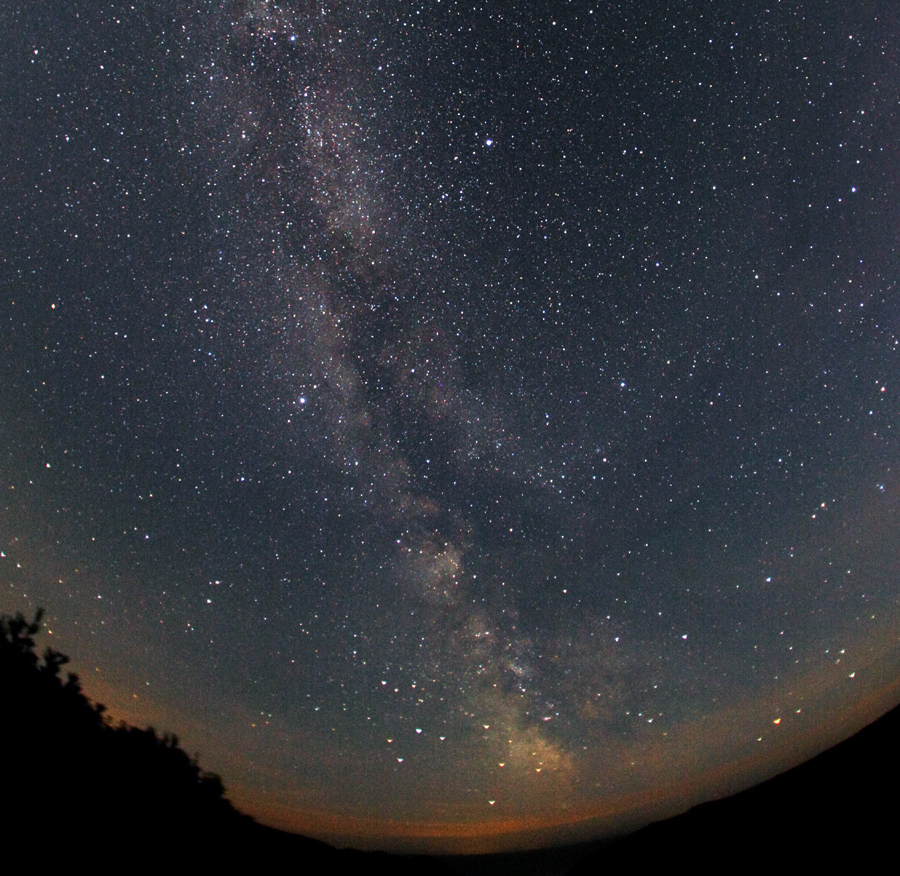
On a clear night you can actually see the dust, or rather the absence of stars that results, as shown in the photo below. This dark zone is known as the Great Cygnus Rift (or similar, depending on which author you read), and it hides much of the central plane of the galaxy from us, including the centre itself, which is in Sagittarius. If you picture Sagittarius as a teapot, the galactic centre is just at the end of the spout. From countries farther south than the UK the whole area is a spectacular sight, as it is higher in the sky, but even so when you are out in the country in the UK it is still breathtaking on a clear and dark night. You wonder why you can’t see it from the towns, but that just goes to show how bright the light pollution really is.
The three brightest stars in this part of the sky are Vega, which is virtually overhead at this time of year, Deneb, to its upper left, and Altair, in mid sky. The stars surrounding each of these add to their distinctiveness. Vega, apart from its brightness, is distinguished by the parallelogram of fainter stars below it, which make up the constellation of the Lyre. Altair has a fainter star on either side, while Deneb is at the top of the large constellation of Cygnus, the Swan. This takes the form of a cross, which in fact represents the swan flying down the Milky Way with outstretched wings, but which is often referred to as the Northern Cross. Incidentally, it is much larger and with fainter stars than the better-known Southern Cross.
Use the Summer Triangle to find the small but pretty constellations of Sagitta and Delphinus. There are some interesting objects to find in this part of the sky, covered in our Young Stargazers’ guide to them.
It’s a shame that Sagittarius is so low in UK skies, because it has more deep-sky objects than any other constellation, as befits its location in the direction of the centre of the galaxy. Our guide to the southern Milky Way covers some of them. You can spend a great summer evening with binoculars just sweeping along the Milky Way and identifying the various objects.
Looking north

The same stars are visible looking north all year round, but their orientation changes month by month. If you are accustomed to finding the Plough down near the horizon, as it is in autumn and winter, you might have trouble. Look high in the north-west and you’ll soon spot its familiar shape. The Plough is known as the Big Dipper in North America.
Use its two right-hand stars to point towards the Pole Star, Polaris, which is always in the same position in the sky. Once you’ve found it, you can use it to get your bearings on any night, though all the other northern constellations wheel around it anticlockwise. Keep going once you’ve found Polaris and you’ll see the W-shape of Cassiopeia, the stars that represent the fabled vain queen of the same name. At this time of year her husband, king Cepheus, is high in the sky, though his stars are nothing like as bright as those of his beautiful wife (whose trouble was that she would keep going on about how lovely she was, but that’s another story). Below Cassiopeia are the stars of Perseus, after which are named the Perseid meteors, which appear in greatest number every year about 12 August. They appear to radiate away from Perseus.
Low down is Capella, one of the brightest stars in the sky. It is almost exactly the same brightness as Vega, which is virtually overhead at this time of year, so it is at the top of our map, where it overlaps with the south-facing map.
< Back to July constellations On to September constellations >