
There are degrees of arc (angle) and degrees of temperature. When we are looking at the sky, it’s mostly angles, and astronomers use these a lot to describe distances between objects.
A full circle is divided into 360º, so the distance between the horizon and the overhead point (the zenith) is 90º. An object is mid sky is at an angle of about 45º to the horizon. Rather confusingly, this is often referred to as an altitude of 45º. You can have angles around the horizon as well, usually taken with north being 0º and going round through east. These are sometimes called azimuths. So east is an azimuth of 90º. south is 180º and west is 270º.
Often, astronomers need to refer to the distances in the sky between objects so it is worth having an idea of what these mean. One convenient measurement is to spread out your hand at arm’s length, which covers about 18º, while a finger at arm’s length is about a degree.
Each degree is divided into 60 minutes (symbol ′), and each minute into 60 seconds (symbol ″).
Other useful distances:
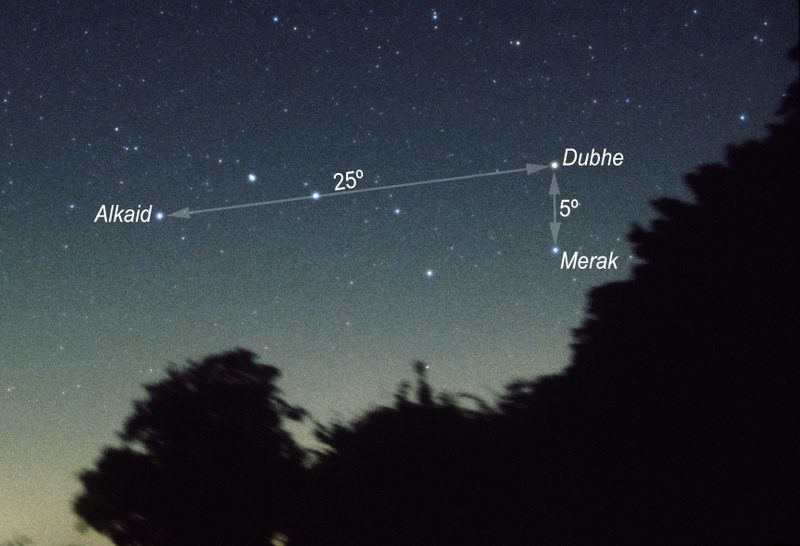
The Plough (the Big Dipper if you’re American): 25º from end to end. 5º between the ‘Pointers’:
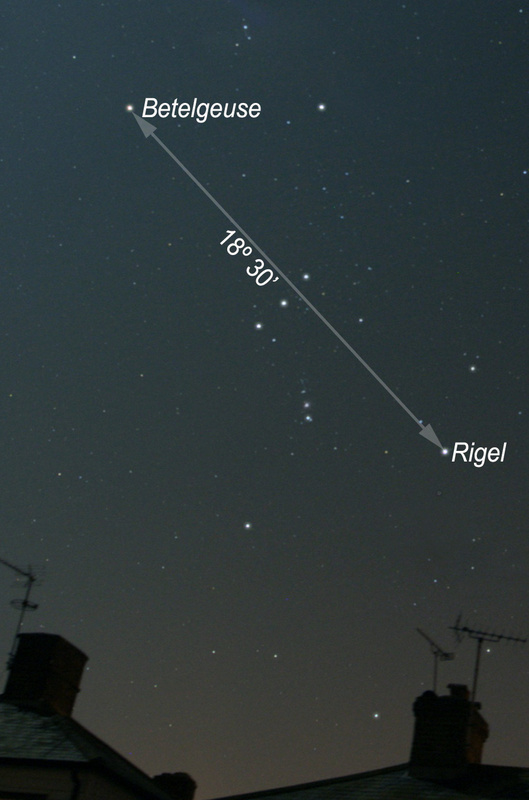
Orion: 18º 30′ between Betelgeuse and Rigel
Sun or Moon: about ½º or 30′ diameter
Jupiter and Venus: about 45″ diameter at maximum
Mars: about 25″ at maximum (but usually smaller)