Actually, it’s already here, glowing dimly near one of the paws of Ursa Major, the Great Bear, but the media buzz surrounding it is starting to grow louder, expectations are starting to climb, and a few people are getting just a little carried away. So let’s take a deep breath, a step back, and see what’s really going on with the comet some are already calling “The Christmas Comet”.
First, the basics. Comet Leonard – or Comet C/2021 A1 Leonard to give it its full name – was discovered on January 3rd of this year, by G. J. Leonard at the Mt Lemmon Observatory. Crunching the numbers revealed that the comet is a long period comet, in a long, elongated orbit and takes 80,000 years to go around the Sun. It has spent the last 40,000 of those years coming towards the Sun, and will be at its closest to it – “perihelion” – on January 3rd 2022, a year after its discovery, after which it will whip around it and head back out into deep space again.
So what’s all the fuss about?
Well, the comet is still a long way away from us, but it already showing signs of activity. Long exposure photos – not just those taken through large telescopes, but by amateurs’ DSLR cameras on tracking mounts – show it has developed a small dust tail, and some observers claim they have detected a hint of a gas tail too. At the moment Comet Leonard is shining at around tenth magnitude, but calculations suggest that it might reach naked eye visibility in December as it approaches the Sun, reaching around 4th magnitude, perhaps even reaching second magnitude.
So far so good! We might have a named eye comet in the sky at Christmas. But hang on. “Naked eye” doesn’t necessarily mean – as many people think, including many so-called “science reporters” on national newspapers – slap-across-the-face-obvious to the naked eye, like Comet NEOWISE was last year and Comet Hale-Bopp was all those years ago. It just means that under the right conditions (i.e. no bright Moon in the way, no light pollution around you), if you know where to look, you should be able to see it as a smudge without help from binoculars or a telescope. So if Comet Leonard behaves itself – and we can all remember past comets that have promised to put on great shows that have fizzled and faded away, leaving us shaking our fists at the sky like that old man in The Simpsons – then come December we might have a fairly decent comet to look for in the sky.
So why are people getting so excited? Because the geometry of this comet’s orbit means that there’s a chance that its brightness will increase dramatically for a couple of days around December 12-14, as the Sun’s light is scattered through its tail. There are some very optimistic predictions going around suggesting it might reach zero magnitude then, but there’s no way we can know that yet. We’ll just have to wait and see. It would be nice, yes, but don’t count on it…
Now that’s clearer there are three important questions: where is the comet now, where will it be in the weeks and months ahead, and what will you need to observe it.
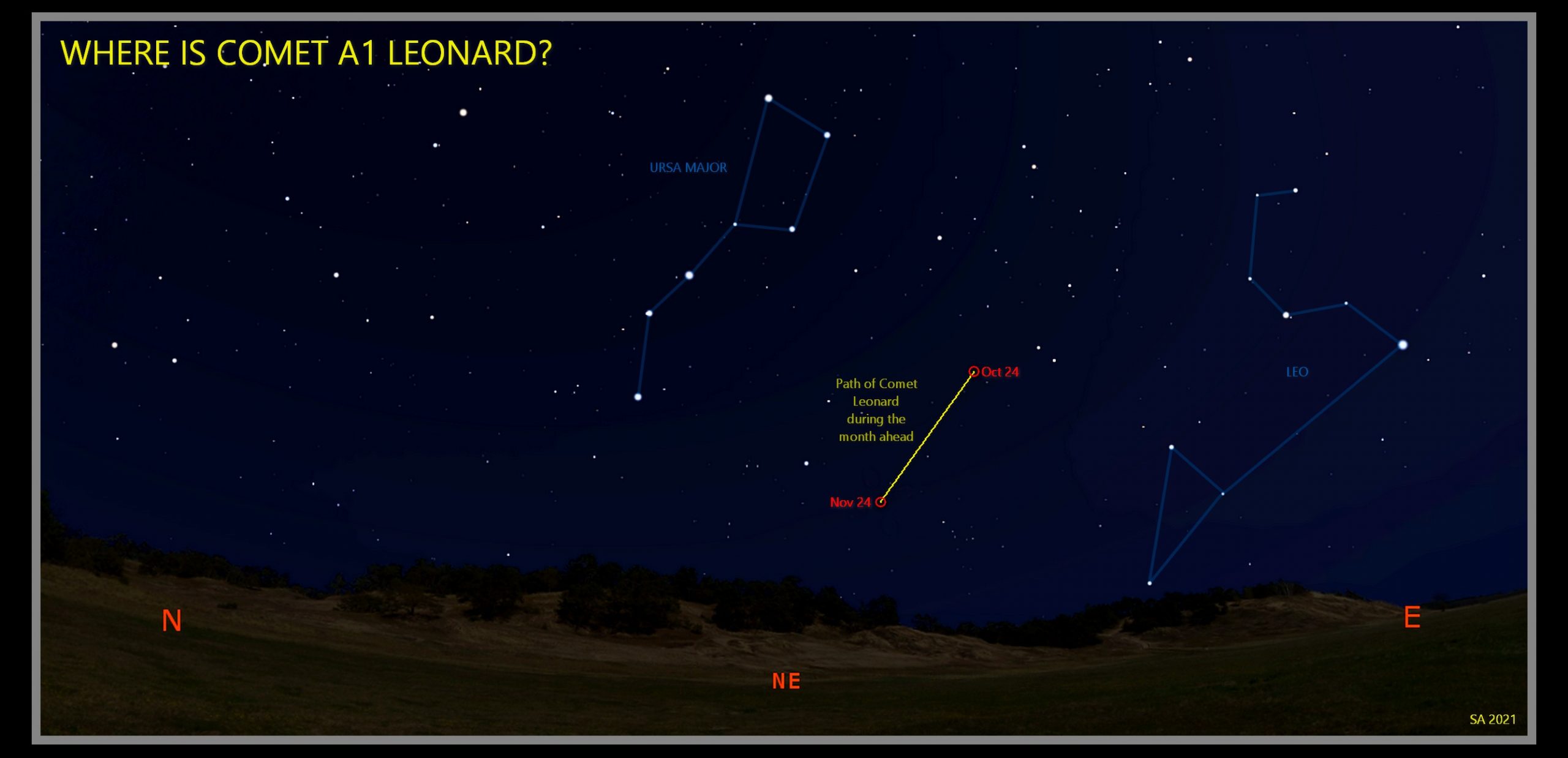
At the moment, Comet Leonard is in Ursa Major, moving only a tiny amount each night. It’s best seen – for northern observers – in the early morning hours, when it will be at its highest point in the sky. Here’s a very basic chart showing where it will be in the month ahead. Note: this chart is drawn for UK latitudes, for 2am…
The best time to see this comet will be in December, when it will be visible in both the morning and evening sky. Just like the planets and the Moon, most people will see it in the evening sky, because that requires the least effort, but this is going to be another “tree-grazer”, always low in the sky, so if you live somewhere with trees, buildings or hills on the skyline you’ll need to get away from them to somewhere with an uncluttered horizon and a bigger, clearer view of the sky if you’re going to see it at its best.
We’ll post more charts nearer the time, but just to whet your appetites, and to help you plan ahead a little, here are some charts showing where Comet Leonard will be in December. Again, all these charts are drawn for mid-UK latitudes, so if you live further north, or south, your view will be slightly different.
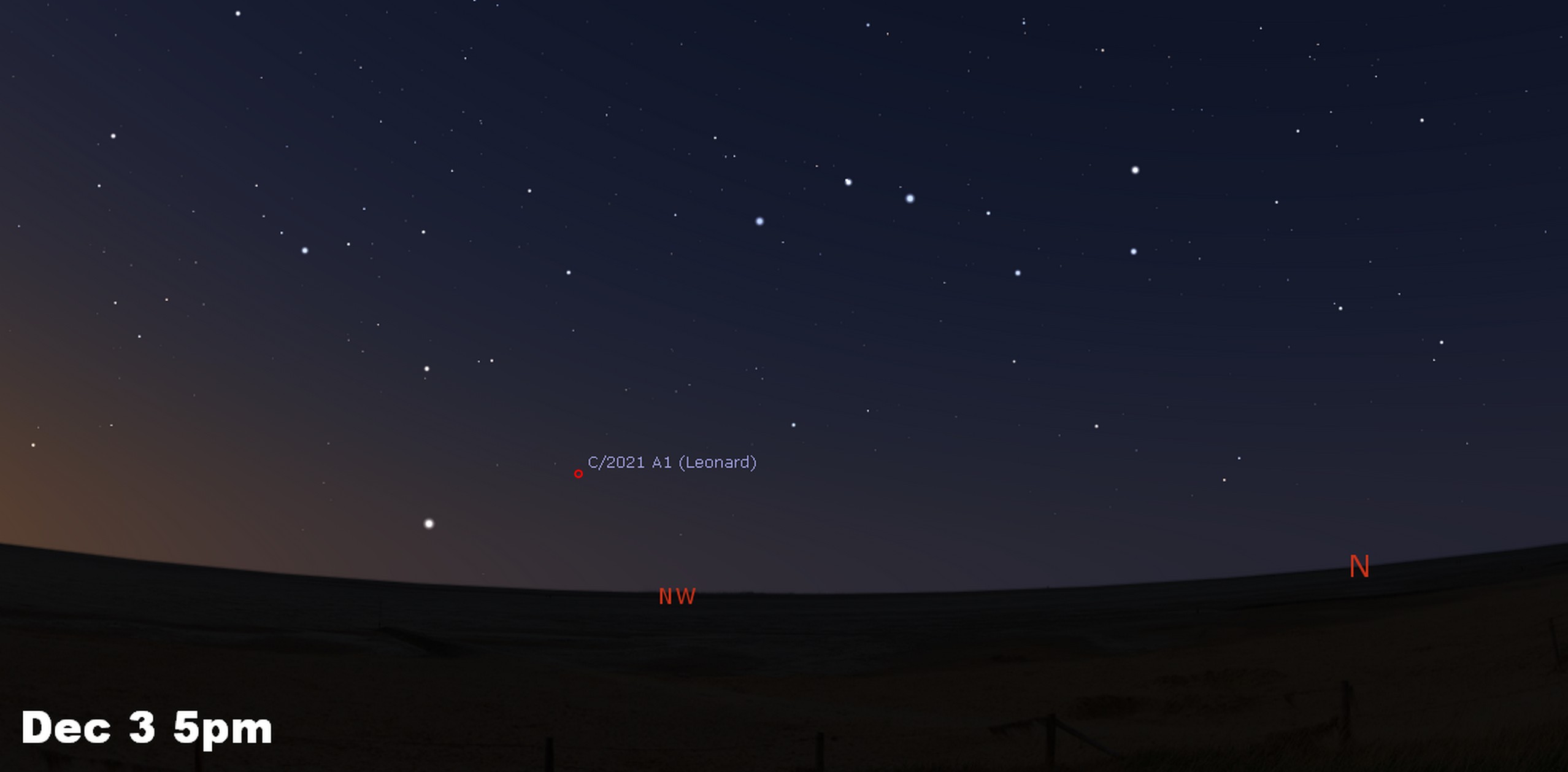
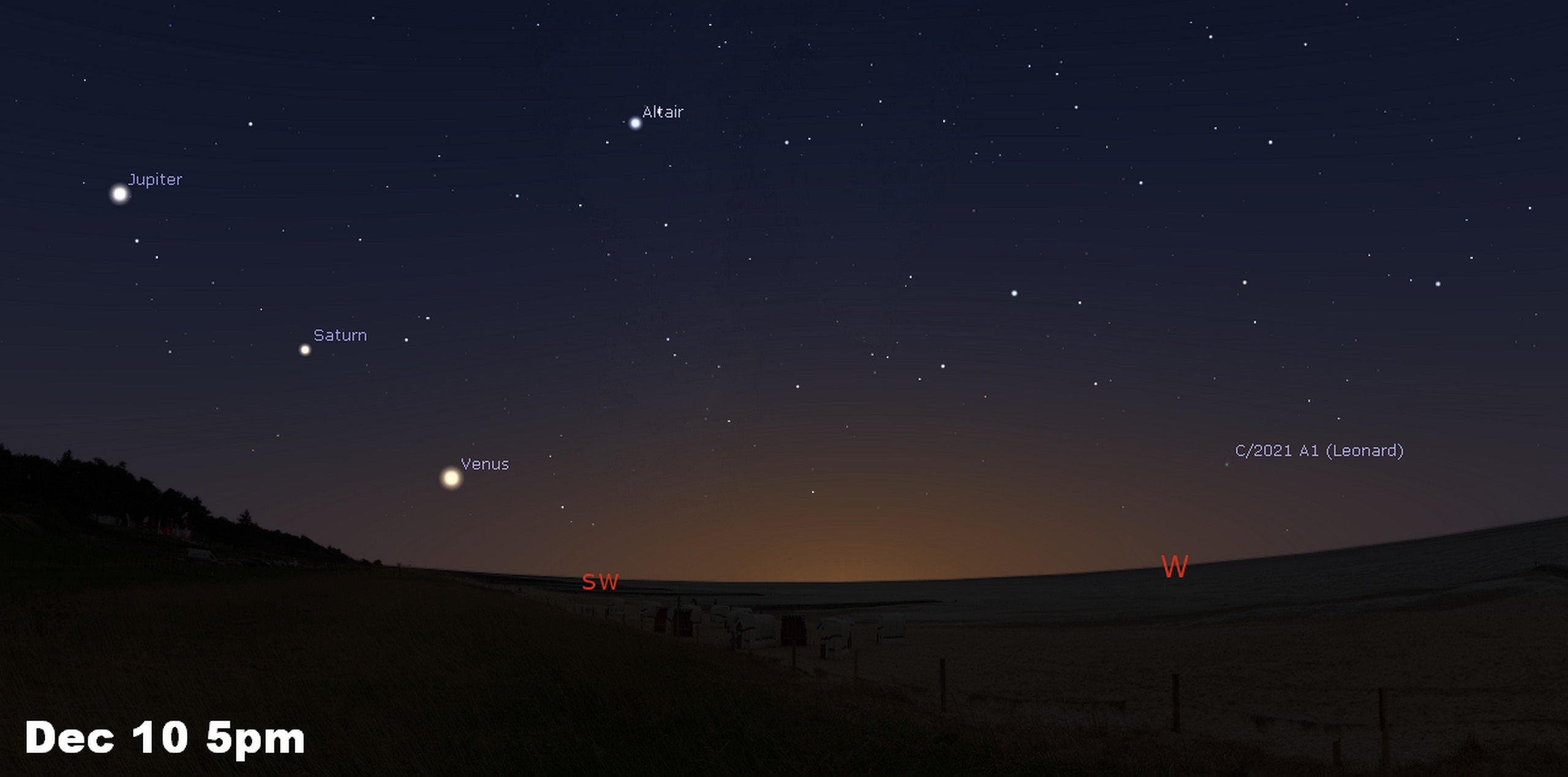
The best thing to do is use one of the many astronomy apps now available to check-out the comet’s visibility from your own specific location. But cross your fingers for clear skies around mid-month when it will be close to three planets in the twilight…
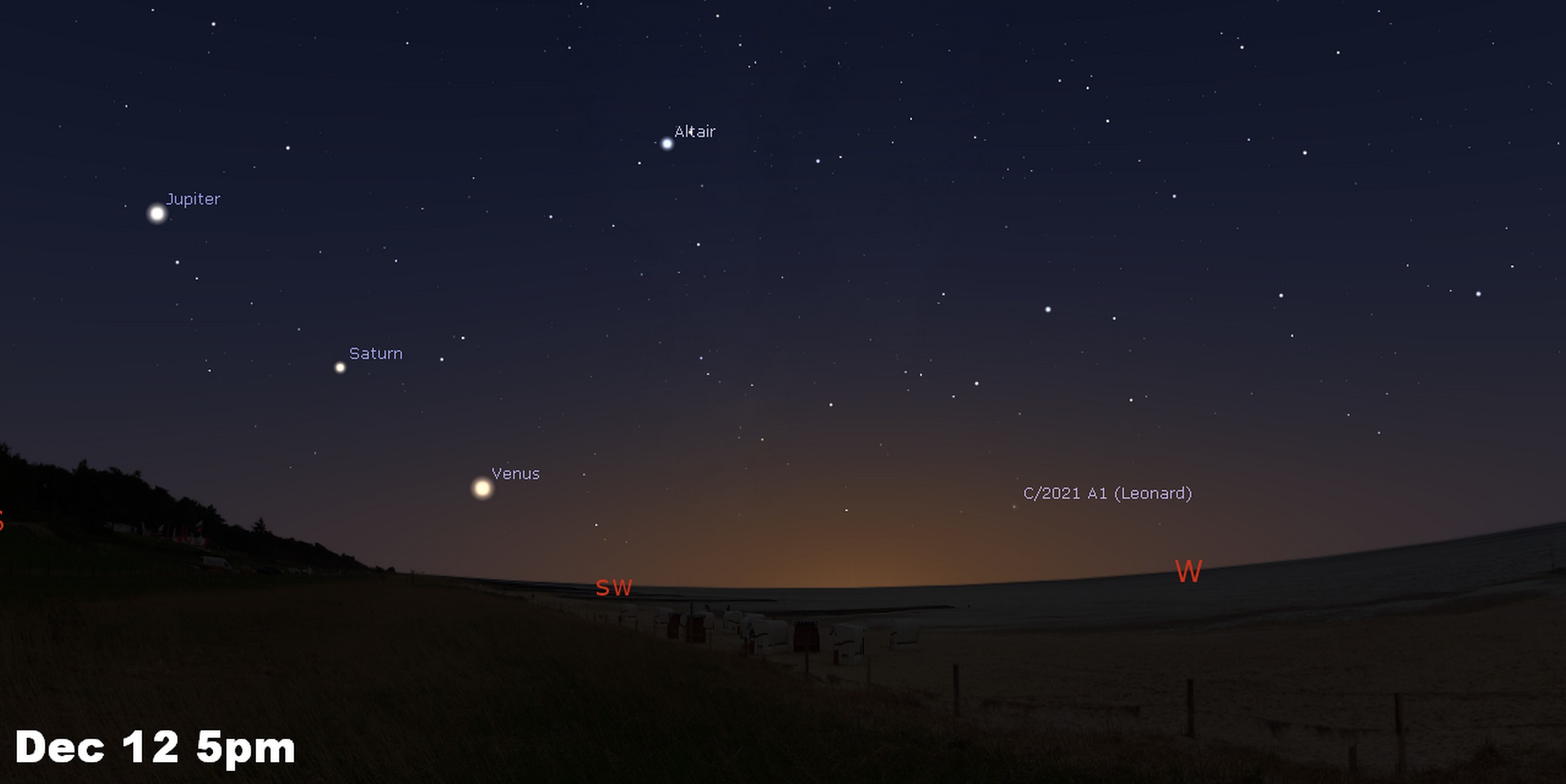
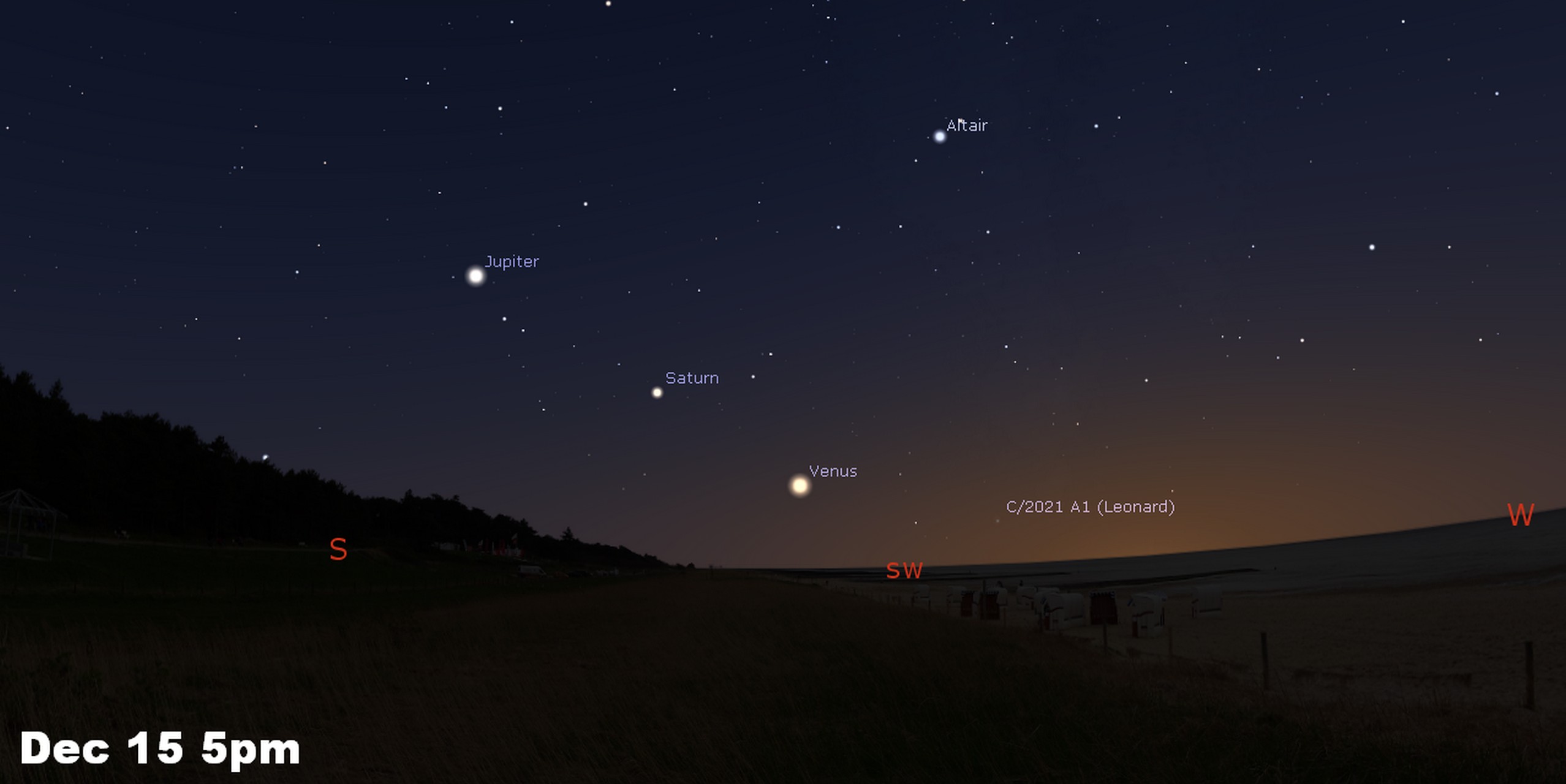
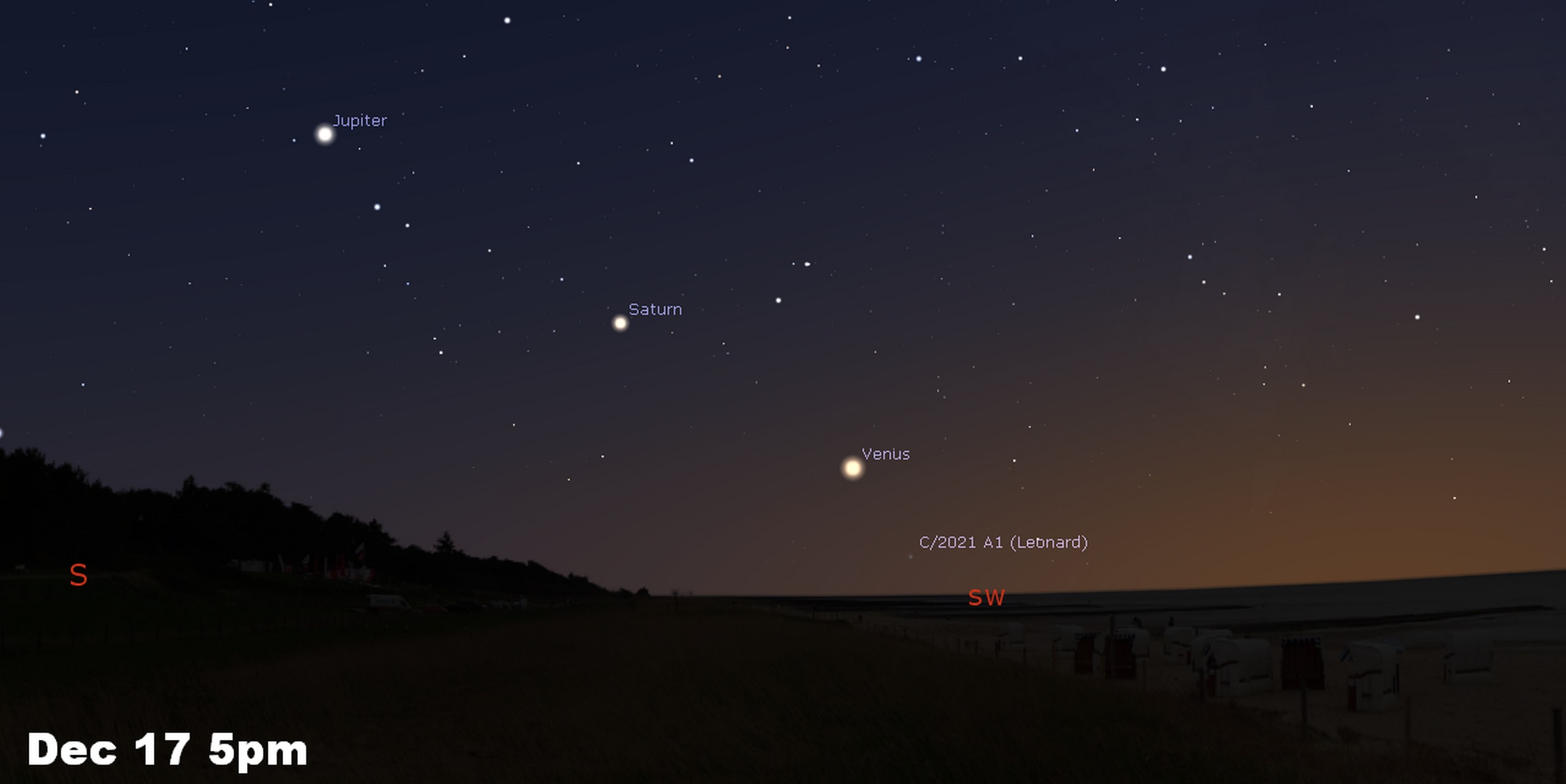
After mid-December the comet will be best seen from the southern hemisphere, but by then hopefully we’ll have some great memories to look back on.
As far as actually observing the comet is concerned, I strongly suggest having a pair of binoculars handy in December. Not just because the comet might not reach naked eye brightness, but because if it does binoculars will give you a better view, particularly of any tail it develops. A small telescope will show the comet well, and will help you pick out details in its tail, if it grows one. Want to photograph it? A DSLR on a steady tripod, taking time exposures, will capture it I’m sure, and if you have a motorised “tracker” that enables you to take even longer exposures, all the better.
Finally – it’s very important we don’t get too carried away here. It’s great to have something to look forward too, especially in these dark times, but no matter what you might read in the press, and from some enthusiasts, we simply don’t know yet how bright this comet is going to get. Yes, it might be a bright naked eye object for a brief time, but it might not. We don’t know how long a tail it will develop, or how obvious it will be in the sky. It’s too early to know any of that. So, for now, we just have to wait and see. It’s unlikely we’re going to see another NEOWISE in the sky in December, but it might surprise us! In the meantime, let’s not get caught up in comet fever – and please, take any breathless predictions you see in the media or online with a huge pinch of salt.
And always remember, no matter what we expect, predict or hope…