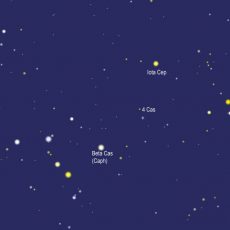
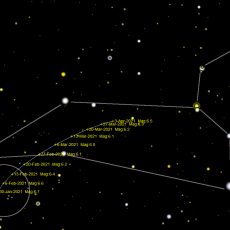
The nova in Cassiopeia that appeared on 18 March has provided another surprise – an outburst of over five times its brightness in a matter of a few days, to become bright enough to be visible with the naked eye.
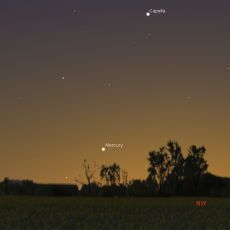
The mercury might not be rising as much as we’d like in early May in the UK, but Mercury is certainly doing so. The closest planet to the Sun is in the evening sky right now, in the north-west just after sunset.
A nova has appeared in the constellation of Cassiopeia. Novae are stars that suddenly undergo an increase in brightness of typically over a thousand-fold, so what looks like a new star appears. In this case, the nova is 8th magnitude, which is visible using binoculars. But while the star was expected to fade, it has remained almost constant in brightness.
Want to learn the spring sky in less than ten minutes? Take a look at our new video, recorded in a real sky, showing the spring sky as you’ll see it during late March into April as seen from the UK.
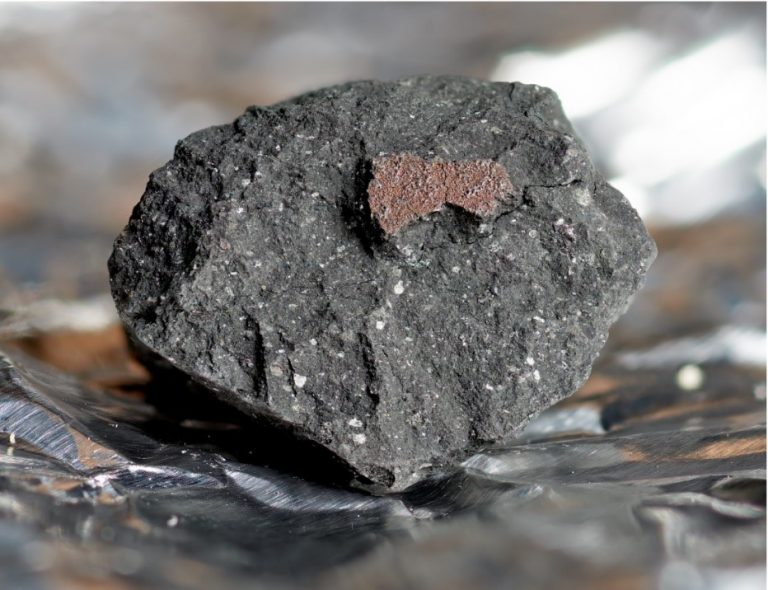
About 300 grams of meteorites have been collected in Gloucestershire following the fireball of 28 February, which was widely reported from around the UK and even from the Netherlands. And the meteorite was one of the rarest and most scientifically valuable of all types, a carbonaceous chondrite.
One of the fragments of meteorite recovered from Winchcombe. Credit: Trustees of the Natural History Museum
Using reports and photographs from dedicated fireball cameras, as well as security and doorbell cameras, it was quickly established that any meteorites from the event would have landed to the east of Cheltenham, with Winchcombe at the centre of the suspected fall area.
Within a day, a suspected meteorite was found embedded in a driveway. It was taken to the Natural History Museum for analysis, and a team of researchers began combing the area for more. More fragments were located in this way.
Chondrites are the most primitive and most pristine form of meteoroid, and can provide unique information about the conditions in which our Solar System was born, where our water came from, how the building blocks of life were formed and how the planets originated.
Over 1000 reports have now been received about the fireball that occurred over the UK on Sunday 28 February. Experts are predicting that any meteorites from the event would have fallen near Cheltenham.
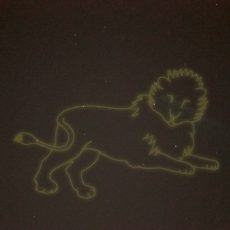
The brightest asteroid, Vesta, is putting in an appearance in the sky this spring. You can find it easily using binoculars, in the constellation of Leo, the Lion.
The International Space Station is making a spectacular series of evening passes over the UK, continuing until the first week in February. You can view it from your back garden as long as you have a good view of the sky, so there’s no need to travel anywhere to see it.
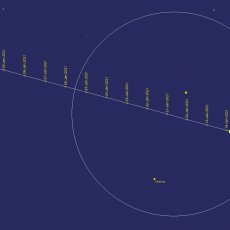
This January, finding the planet Uranus with binoculars is made much easier because there’s a brilliant pointer right beside it – Mars. It’s like having a big arrow in the sky showing you where to look.
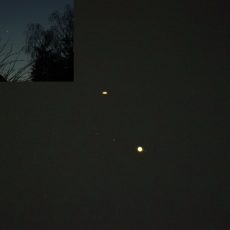
The Great Conjunction of 2020 – when Jupiter and Saturn were closer in the sky than at any time for nearly 400 years – has now taken place. Jupiter is now to the east of Saturn in the sky and is moving away from it daily, but you can still see the pair until the first week in January when they will start to get very low in evening twilight sky.