
Everyone knows that Neptune is the outermost giant planet, beyond Uranus. But how many people, even amateur astronomers, have actually seen the planet? In the second half of 2025, Neptune is actually quite easy to find, as there’s a big signpost to it in the sky – Saturn. All you’ll need is binoculars and a clear, dark sky.
Saturn is making a comeback to the evening sky, rising over in the east just after 10 pm as seen from the UK, although you might want to wait till midnight to let it get above your local surroundings. It’s the brightest object in that part of the sky so it’s quite easy to locate. It’s noticeably yellowish, and another distinguishing feature is that unlike stars it rarely twinkles. (Twinkling of stars is caused by the fact that they are points of light rather than having an actual disc, so the turbulence of our atmosphere easily disturbs their beams.)
Take a look at Saturn through your binoculars and you can almost see its disc and even its rings, although this year the rings are almost edge-on to Earth, so they are not as easy to spot as usual.
Now you need to look carefully at the faint stars surrounding Saturn. One of them is Neptune – at low magnifications its disc is tiny, so it just looks like a star. But which one? Here are some maps to help you, made using Chris Marriott’s SkyMap. Both Saturn and Neptune move slowly against the starry background, so you need to choose the map closest to the date you’re actually looking.
Tip: Look for the star a short way above Saturn, and use this as a reference point. Neptune moves past this star as the weeks go by.


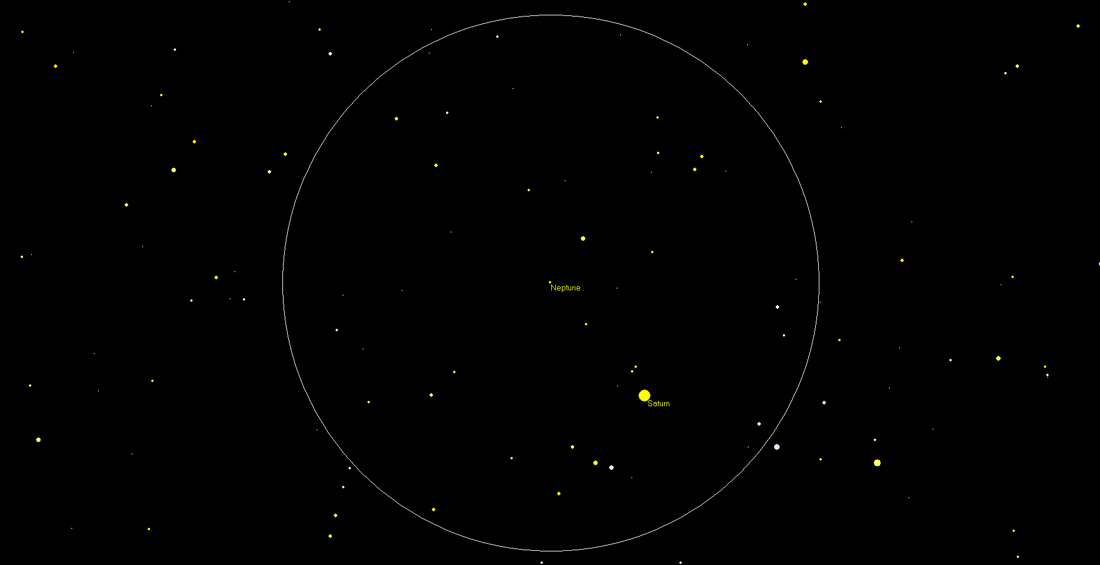

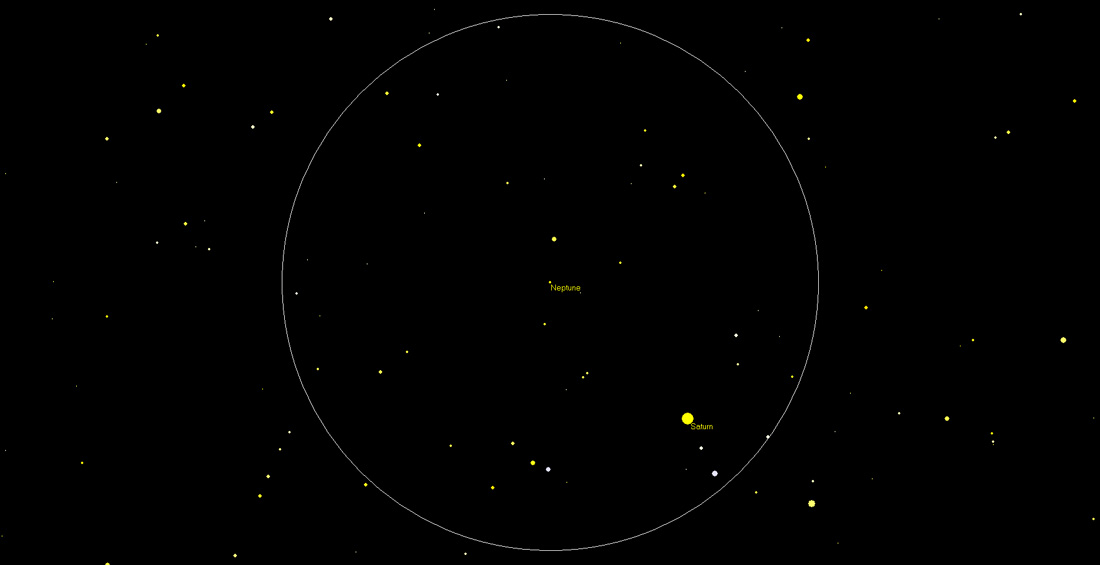
If you’re not sure that you have found Neptune, look again on another clear night and it should have moved, while the other stars will have remained in the same places.
Can’t see Neptune? You need a good, clear night, and a bit of haze will make it harder to see, so try again on another occasion. If you are in a light-polluted area, try and get away from the worst of the city lights. On 11 and 12 August, the nearly full Moon will be close, so avoid those nights. 10 x 50 binoculars or similar will be better than the smaller binoculars, but in the right conditions even 30 mm binoculars should show Neptune.
Bear in mind that if you are using an astronomical telescope, the field of view is usually upside down compared with the maps, any in some cases even back to front. A magnification of 25 or more is helpful.
About Neptune
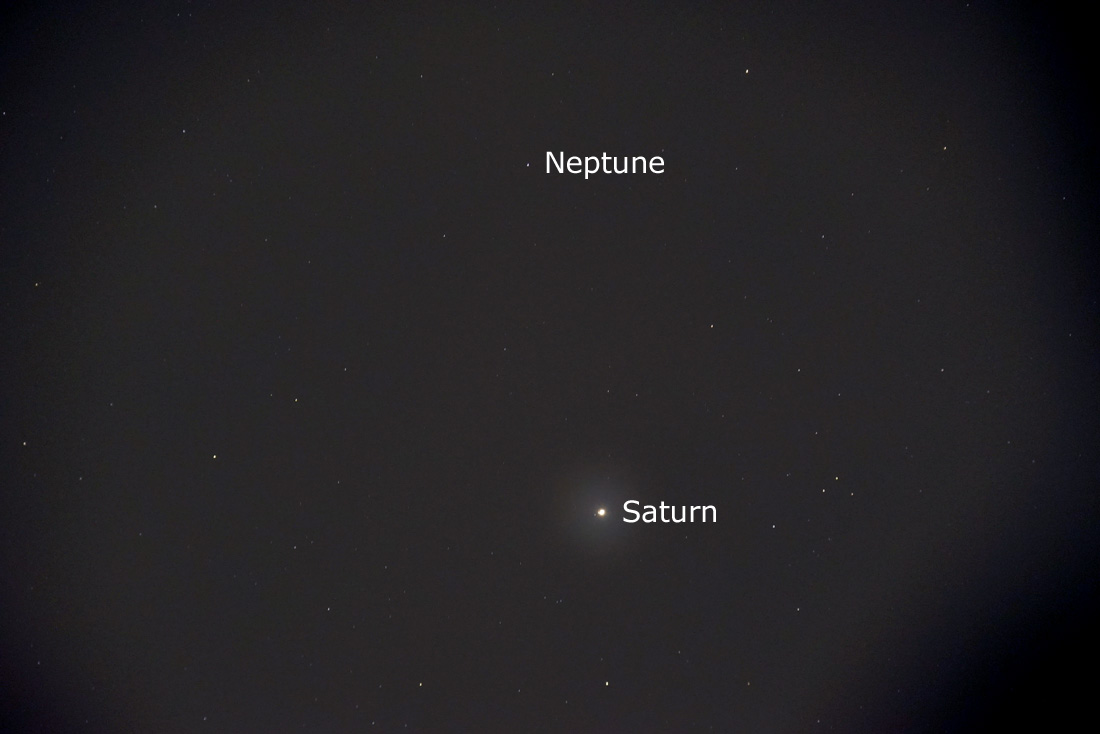
That tiny pinprick of light is actually a planet almost four times the diameter of Earth, over four billion km away (2.8 billion miles, if that makes it easier to understand, which it doesn’t really). As seen from Neptune the Sun would still be the brightest object in the sky, but it would be 900 times fainter than as seen from Earth and it would be tiny, so you wouldn’t actually be able to see its disc.

You couldn’t stand on Neptune, because it is an ice giant. That makes it sound as though it has an icy surface, but in fact it is a bitterly cold and dense gaseous soup of water, ammonia and methane. You would just descend through an atmosphere of increasing pressure. What looks like a surface is just the outer layer of its atmosphere. Better stay at home….

Looking at Neptune, you can understand why it wasn’t discovered until 1846. It’s about five times fainter than you can see with the naked eye, so it just appeared like another faint star until in the early 19th century astronomers found that the positions of the next planet in, Uranus, were being affected by the pull of a more distant planet.
It took some nifty calculations to work out where to look, and two astronomers, one British and one French, arrived at the same conclusions at about the same time. But the British astronomer who tried to find it in the sky, James Challis in Cambridge, was hampered by not having good charts of the area. Some say that he was about to spot it when his wife called him in for tea, and when he got out again it had clouded over! But the German astronomer Galle in Berlin had better charts and spotted the planet first.
Neptune takes 165 years to go around the Sun, so it was only in 2011 that it was in the same place that Galle found it. But when Galle first located it, Neptune was also close to Saturn. Since then, it has only been in line with Saturn five times previously.
Neptune remains close to Saturn throughout 2025 and into early 2026 and can be found using sky mapping apps.