
The UK weather doesn’t often allow whole eclipses to be followed in full.
However, three eclipses have been well observed during January.
AB Cassiopeiae : 2018 Jan 19
This eclipse was observed by David Smith, who adds “These readings were taken with a William Optics Megrez 90 and Atik 460EX CCD camera with a Johnson V filter. Each image was just 10s exposure.” The gap during the fade was due to a technical issue.
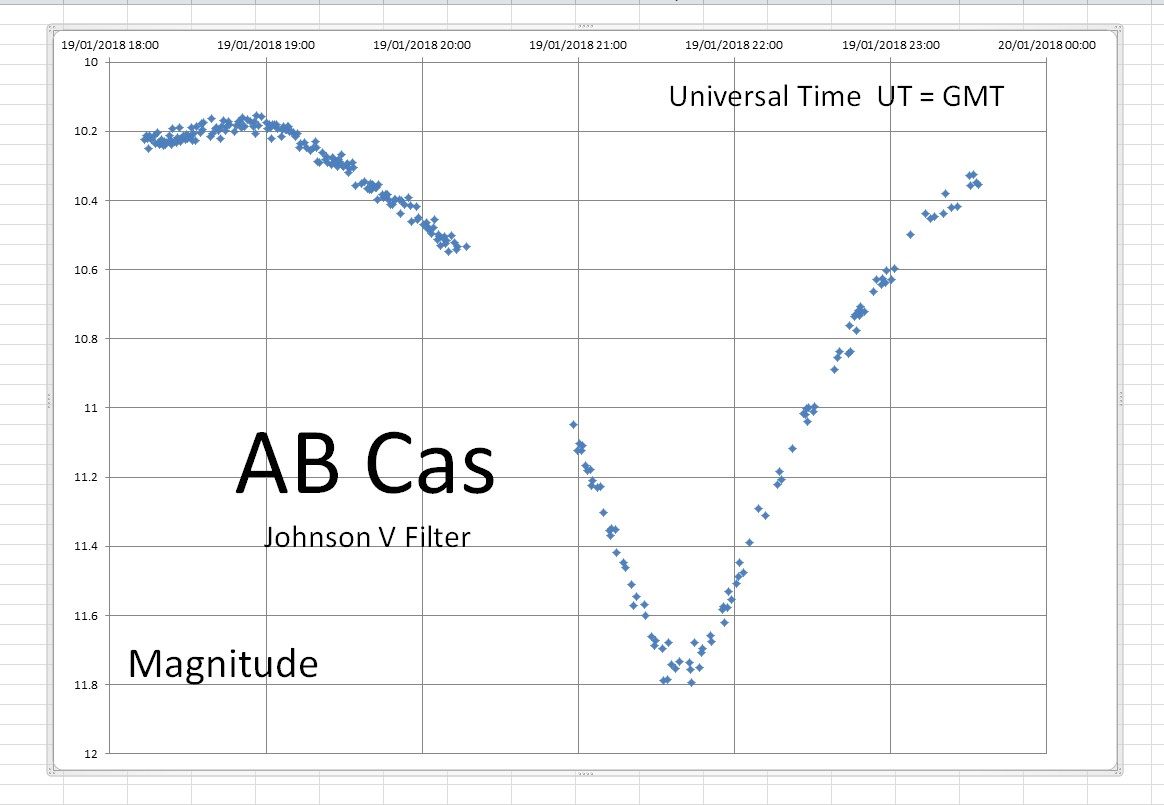
The period of AB Cas is 1.367 days (approx 33 hours), with eclipses lasting for about 5.5 hours.
As can be seen from the accompanying light curve, which runs from 18:00 to 00:00, AB Cas faded by 1.6 magnitudes during the eclipse.
The predicted time of this eclipse using the latest “Krakow” elements was 21:47 UT and David’s light curve shows that the eclipse was more or less on time.
AB Cas is an Algol type eclipsing variable. The “V” shaped nature of the eclipse shows that the eclipses are partial rather than total.
RZ Cassiopeiae 2018 Jan 8
This eclipse was observed visually by Tracie Heywood, using 11×80 binoculars. Brightness estimates were made every 20 minutes or so.

Eclipses of RZ Cas last for 4.8 hours, during which time RZ Cas fades by more than a magnitude.
RZ Cas is an Algol type eclipsing variable with a period of 1.195 days (approx 29 hours). Eclipses are “V” shaped, indicating that they are partial rather than total.
Eclipses of RZ Cas are currently occurring around 2 hours later than predicted by the GCVS elements in the General Catalogue of Variable Stars (GCVS), but are more or less in line with predictions based on the “Krakow” elements”
Nevertheless, the period of RZ Cas continues to change slowly and continued monitoring is required in order to revise the “elements” and thus keep predictions accurate.
U Cephei 2018 Jan 7-8
This eclipse was observed visually by Tracie Heywood using 11×80 binoculars. Brightness estimates were made around every 30 minutes.
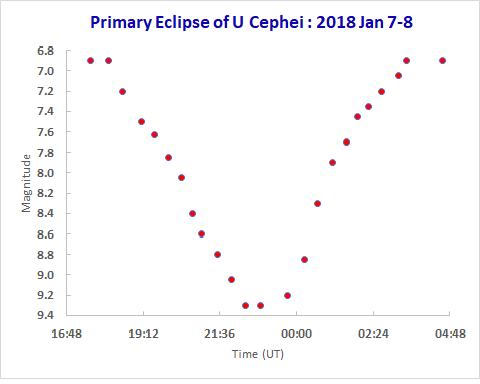
U Cephei is an Algol type eclipsing variable. Primary eclipses occur every 2.5 days and last for approx 9 hours.
During primary eclipses, U Cephei fades by approx 2.5 magnitudes. The eclipse is flat-bottomed, indicating that it is a total eclipse.
Eclipses of U Cephei are currently occurring around 5 hours than would be predicted using the GCVS elements, but are more or less in line withn the latest “Krakow” elements.