U Monocerotis is the second brightness example of a RV Tauri-Type star known to astronomers. The brightest example of such a star is R Scuti; a variable star already on the SPA’s programme.
Like all RV Tauri-Type stars, U Monocerotis is a yellow supergiant, currently evolving form a red giant to a white dwarf. Indeed, it may be in a pre-planetary nebula phase, a phase that only lasts a few thousand years, which is why stars of this type are so rare.
Just like R Scuti, U Monocerotis has two periods, one short, lasting about 92 days, and a longer period lasting 2475 days. It varies from around the fifth magnitude, to around the seventh magnitude, making it easily to follow in a small pair of binoculars.
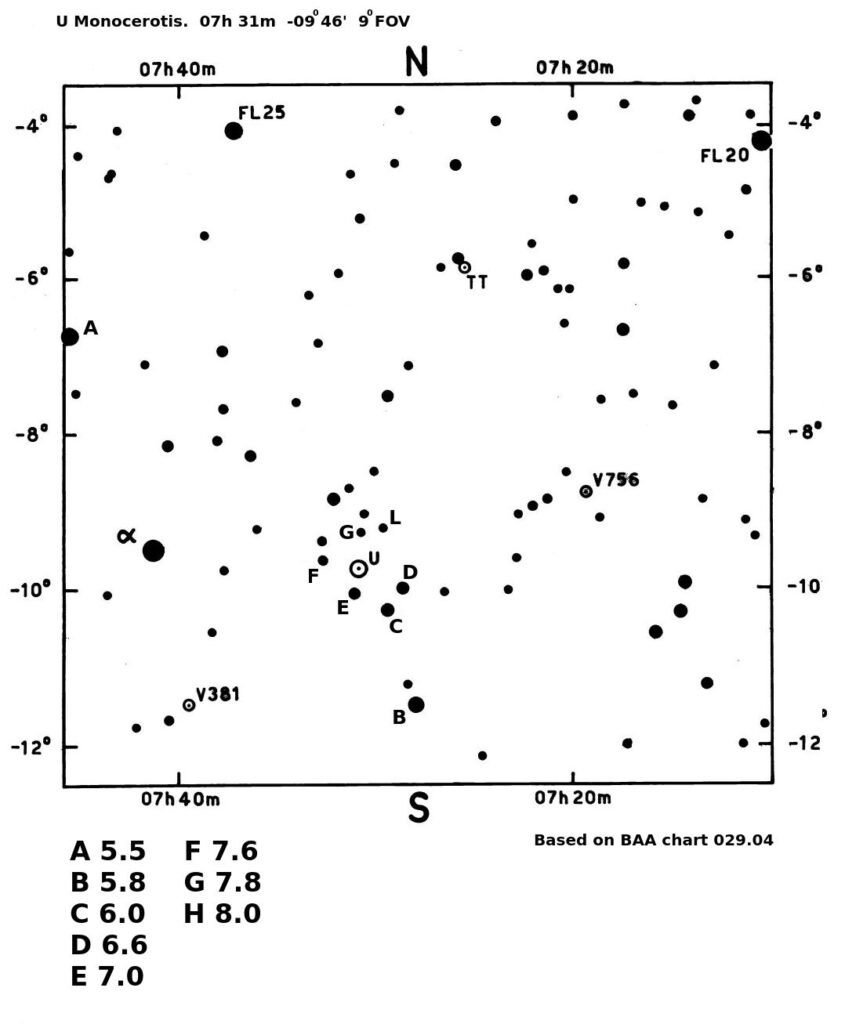
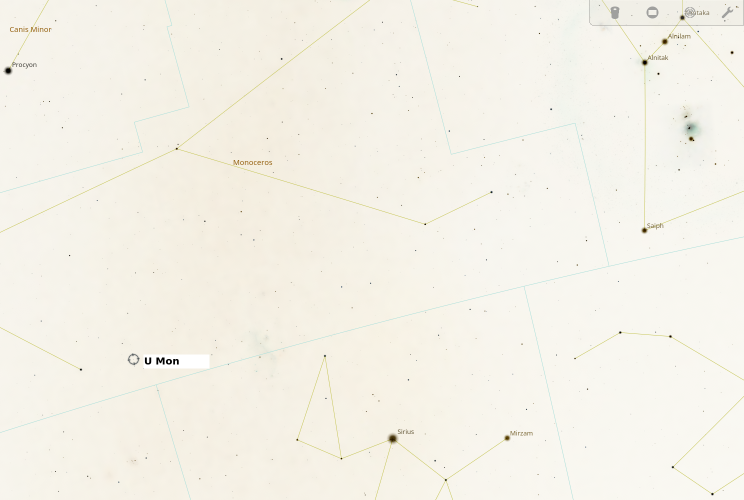
It is easy to find, as it’s in the same binocular field of view as alpha Monocerotis. As alpha Monocerotis is a fourth magnitude star, it can be hard to locate in light polluted skies. However, it can be found by following a line east from Rigel through Saiph; the two stars that make-up the base of Orion. It is also east of a line connecting Sirius and Procyon.
A finder chart is included below to help you locate U Monocerotis; as well as a comparison chart for making your observations. The constellation of Monoceros is a winter constellation, but can be observed from September through to April.
| Extreme brightness range | 5.1 – 7.5 |
| More typical range | 5.1 – 7.1 |
| Period of variation | Short period: 92 days. Long period: 2475 |
| Frequency of observation | Once a week, or every ten days. |
| Observe using | 40mm or 50mm binoculars will suffice for most of the time. |
| Visibility | Can be observed from September through to April, but best observed during November to February. |