
A year ago, the Mira type variable chi Cygni produced one of its faintest ever maxima, reaching only about mag 6.5.
Author: Tracie Heywood
R CrB plummets!
No sooner had we published the news item The slow fade of R CrB continues on June 4th, when the fade then accelerated !
The slow fade of R CrB continues
There was a time when R Coronae Borealis would behave in the way described in astronomy texts. It would spend most of its time near maximum (around mag 6.0) but then, at times that were unpredictable in advance, it would fade dramatically. Sometimes it would fade by a few magnitudes; sometimes it would fall all the way down to 15th magnitude. Then, after an interval of between a few months and a year, it would return back to maximum.
Is R CrB starting to fade?
Recent observations suggest that R Coronae Borealis may have peaked in brightness around early March and has started to fade.
Following its record breaking minimum of recent years, R CrB became visible in binoculars again during autumn 2014. Although R CrB is usually around mag 6.0 when at maximum, this recovery slowed in early 2015, with observers reporting it to be still a magnitude or more below this level.
In recent weeks, it seems that the brightening trend has actually reversed with the latest brightness estimates being in the region of mag 7.8.
We have no way of knowing whether this is a temporary setback, or whether R CrB is going to dive back down to 15th magnitude. As ever, the only way to find out is to go out and have a look for yourself.
Currently, R CrB is still (just) within the brightness range covered by the comparison stars on this first chart.
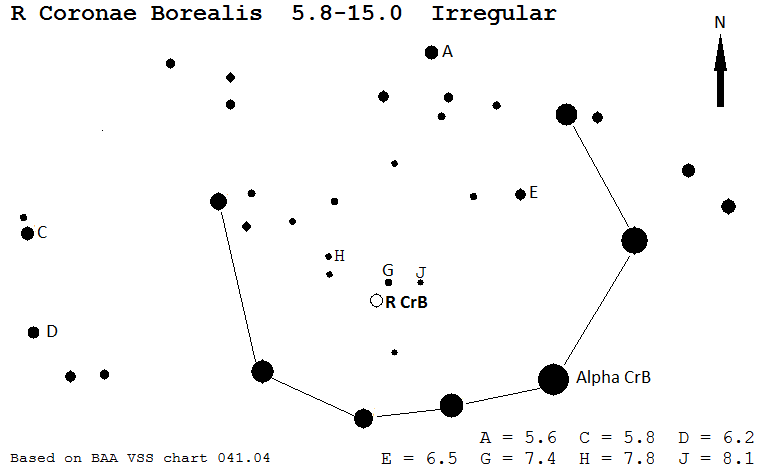
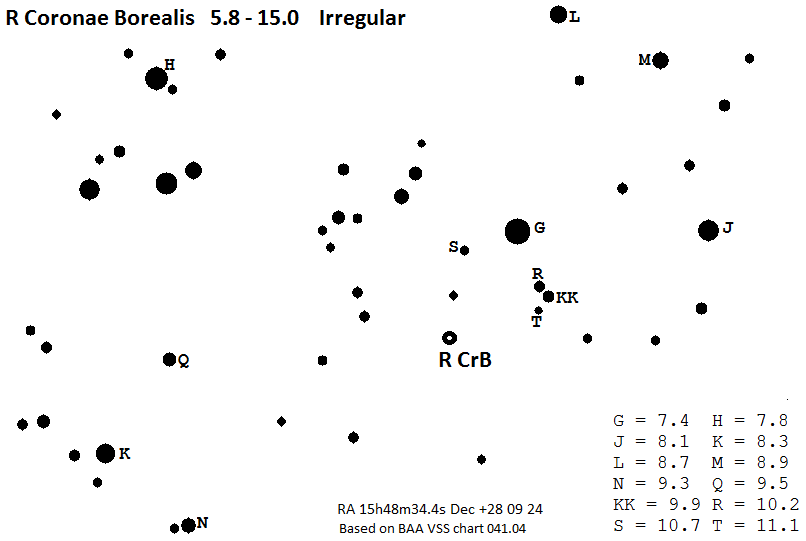
If it fades much further however, you will need to switch to using this second chart.
A new look to the VSS Programme Listing
Traditionally, the section’s programme listing has grouped stars according to the type of variability seen. Hence you would see a list of Eclipsing variables, a list of Cepheid variables, a list of Semi-regular variables … and so on.
However … with the SPA particularly focussing on newcomers to observing, it would seem better to order the list of variable stars to take into account how often and for how long the potential observer is able to observe.
Hence the new look, in which the stars are split into 5 categories:
– stars that can show significant brightness changes over the course of a few hours
– stars that show brightness changes over a week, sometimes from night to night
– stars that show brightness changes over the course of several months
– stars that show very large brightness changes over the course of a year
– stars that are totally unpredictable
To see the list of stars, click on this Programme Listing
For each variable star listed, clicking on its name takes you to a guide and finder chart(s) for that star.
As you will see, the programme includes a mixture of naked eye and and binocular variables (for stars in the 4th category you would also need a telescope if you wanted to follow them all the way down to minimum).
Section members are, of course, free to observe and report observations of any variable star, but experience has shown that the stars in the Programme Listing do tend to prove very rewarding to follow.
New Variable Star Section Director
After nearly 7 years in the role, David Scanlan stepped down as Section Director during January 2015.
The SPA Council meeting at the end of the month appointed Tony Markham as the new Section Director.
This is Tony’s second spell as Variable Star Section Director, having previously held the role between 1992 and 2000.
Here is Tony’s account of how he became a variable star obsever and how his observing has developed over the years:
 I never intended to become a variable star observer. It was only by accident that I started to observe them. Soon, however, I was hooked!
Towards the end of 1977, I decided to investigate how faint I could see using my 10×50 binoculars. The easiest way to do this was to see which of the comparison stars that I could see on a finder chart for the variable star R Ursae Majoris. I did this on several occasions. On the first few nights, R UMa itself was too faint for me to see. Then, on one night in early November it had brightened enough to become visible. I compared its brightness with that of the comparison stars and estimated it to be of magnitude 8.6. I repeated this on each clear night and found that my observations produced quite a nice light curve.
I then tried observing some other variable stars. Some produced quite nice light curves. For others, to be honest, my light curves looked like scatter diagrams!
 Over the years, the number of variable stars that I followed steadily increased. The vast majority of the observations have been made using binoculars, with 11×80 binoculars taking over from the 10×50’s during 1992-93. I have also made observations with the naked eye but have never made a variable star observation using a telescope (I almost did once. Someone showed me the Perseus double cluster through a telescope and I came close to estimating the brightness of a variable star within it … but I resisted the temptation …).
In the early years, my variable star observing had to compete with my meteor observing – I once carried out over 100 hours of meteor watches in one year. However, since my move to Leek in late 1989, variable star observing has dominated. Whereas meteor observing requires long clear spells (which are rare in Leek), variable star observers can make good use of short clear spells and quickly take advantage of any gaps in the clouds.
 In 1992, I was invited by John Isles to take over from him as the Variable Star Section Director and held the post for 8 years. Now I’m back again!
I have had many variable star highlights over the years. I particularly remember how the summer of 1984 produced a dramatic fade in the star CH Cygni and an unusually prolonged Nova in Vulpecula. More recently, chi Cygni has produced some unusually bright and unusually faint maxima and R Scuti has also shown some rather interesting activity.
The joy of variable star observing is that you never know which star will surprise you next.