
SOLAR SECTION REPORT – JANUARY 2023
CARRINGTON ROTATION NUMBERS: 2266-2267
First of all, belated Happy New Year to all Solar Section members, and many thanks to all who sent in information and images.
January was a good month for observing sunspots, but perhaps not very good as regards the weather. Also, the low Sun angle in the sky caused problems, but despite this, members still sent in observations, and there were signs that the activity on the Sun is increasing. In the first part of the month the south showed large, and sometimes, complex groups. Towards the end of the month AR3190 was the largest group with a very large spot leader and following spot/pores. Once this group went around the west limb, the north now had the majority of active regions although they were merely spot/pore groups. By the month’s end activity was very low with only a few small spot/pore groups and single sunspots. Now we are passed the winter solstice, the Sun will start to rise in altitude and will be easier to observe. Most images received are put on the News part of the Solar website, as and when received.
Some of my images seem to appear in different colours as an when I put them up. This is due to my telescopes having a different objective solar filters, and the use of IR/UV cut off and Solar Continuum filters.
Detailed Report as follows:
1 January 23. A number of groups are transiting the disc. All groups are relatively small. AR3173 and 3179 is reaching the west limb. AR3180 has come over the east limb showing a ‘tri-spot’ group configuration. AR3176 is a wide group with the leader showing multiple umbrae. AR3177 is a small close group consisting of 3 umbral areas. A new spot is appearing on the east limb in the south.
2 January 23. All groups appear to be remaining stable, and the new spot (AR3181) is now well over the east limb and showing a faculae trail. In Hydrogen Alpha there were some magnificent prominences images taken by Carl Bowron, along with Calcium H and white light.
4 January 23. AR3180 is the biggest group on the Sun at present. All others are stable or may have decayed slightly, notably AR3177.
7 January 23. AR3182 and AR3181 shows as large developing groups and appear quite active.
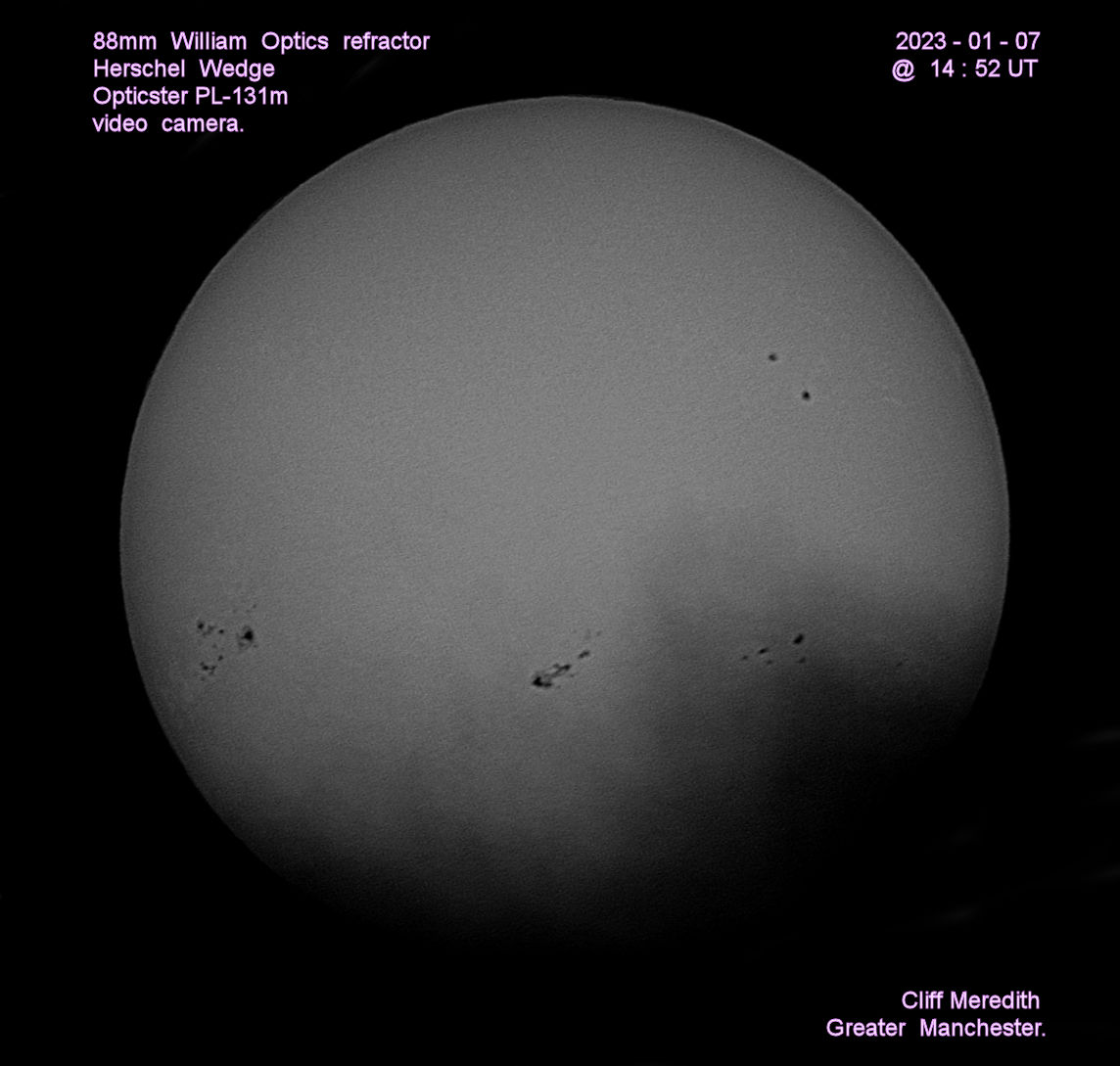
Image by Cliff Meredith
8 January 23. AR3177 has reached the west limb, but most of the activity is in the south, AR3181 and AR3182 are fairly large complex groups following AR3183 in the west and which may have decayed slightly.
9 January 23. Another group has come over the east limb, AR3184. AR3181 and 3182 still apparent but these do not appear to have changed much. A new small pore group has appeared in the north near the centre of the disc.
11 January 23. AR3184, AR3182, and AR3181 continue to transit the disc in the south. AR3181 has changed with the group now a long straight group, which has also appeared to decayed slightly since the last observation. Only AR3185, AR3187 and AR3186 are in the north, and are small groups.
12 January 23. AR3181 has reached the west limb and AR3182 and AR3184 are still transiting the disc. AR3187 appears to have decayed leaving only AR3185 and AR3186 in the north
13 January 23. Due to weather no white light image available but the hydrogen alpha drawing by Ian Lee shows the busy nature of the Sun with numerous prominences and filaments.

Drawing by Ian Lee.
15 January 23. A large sunspot has come over the east limb. AR3190 has a large umbra and followed by small spot/pores. Two other groups AR3191 and AR3192 have also come into view in the north and both are wide spot/pore groups. AR3186 is a medium bipolar group with a spot leader and somewhat irregular spot follower. AR3188 is a small wide pore group and AR3184 a small bipolar group just crossing the central meridian. AR3182 is nearing the west limb. Ian Lee’s drawing in Hydrogen Alpha is again showing large filaments and numerous prominences especially in the northwest.
16 January 23. Cliff Meredith’s image of the Sun shows activity across the disc and AR3190 being very prominent in the south, and AR3191 and AR3192 being prominent in the north. Hydrogen Alpha views by Ian Lee shows a large prominence to the northwest and a large filament to the central meridian.
17 January 23. Some development in most areas. AR3191 and AR3192 have developed spot regions. AR3190 is still the largest spot with spot/pore followers. AR3188 appears to have decayed slightly while AR3186 and AR3184 are stable. AR3193 has emerged as a small bipolar pore group. Images by Carl Bowron show AR3190 in great detail in white light, Hydrogen Alpha and Calcium H.
18 January 23. AR3192, AR3191, AR3186 and AR3184 appear to be stable. AR3193 seems to have decayed, while AR3188 has also decayed slightly. AR3190 remains as a large spot leader, but follower spot/pores appear to be less apparent. In Hydrogen Alpha a large wide filament is imaged by Carl Bowron along with an image of AR3190 in white light.
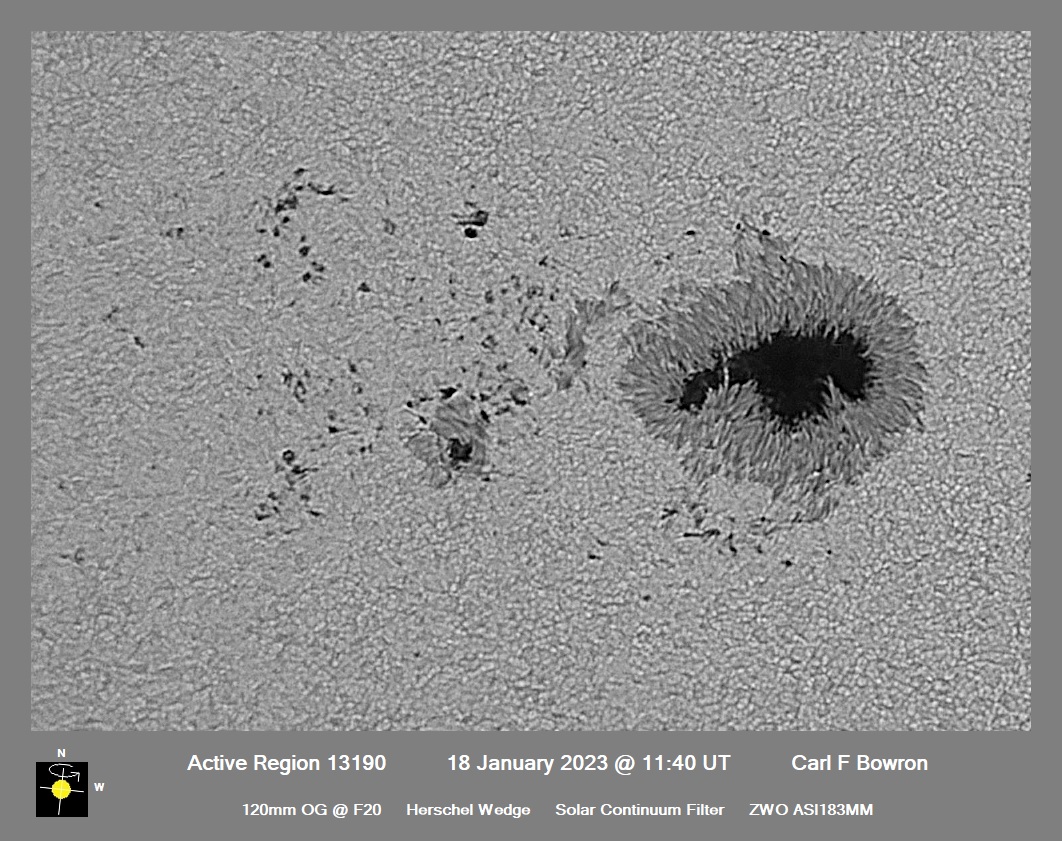
Image by Carl Bowron
19 January 23. All groups appear stable with AR3190 still the largest group. New regions AR3196 is a small bipolar group, AR3195 and AR3194 are small pore regions. AR3191 is a bipolar group, with multiple umbrae in the leader spot. AR3192 is a complex, wide spot/pore region close to AR3191. In Hydrogen Alpha Ian Lee had noted a large wide filament to the south and prominences to the northeast and southwest. Mike Fullerton sent in an image of AR3190 using a video camera.
20 January 23. AR3190 has crossed the central meridian and remains stable. AR3194 has developed slightly. Two new groups, AR3197 and AR3198 are now transiting the disc. AR3191 and AR3192 have not changed and AR3195 has become a pore group. AR3184 and AR3186 have reached the west limb. Ian Lee’s Hydrogen Alpha drawing showed multiple plage activity across the central part of the disc near AR3190, AR3191 and AR3192. A loop prominence was evident on the south limb.
21 January 23. AR3191 and AR3192 appeared to have decayed slightly, but AR3194 has broken into a multiple small spot/pore group. AR3186 is on the west limb and shows a faculae stream behind it. A new spot/pore group has emerged in the east. AR3190 as a large sunspot still prominent. Hydrogen Alpha drawing by Ian Lee showed plage activity with most groups in the north and around AR3190. Some filaments around the northwest associated with groups AR3191, AR3192 and AR3195 and in the central regions.
22 January 23. The north is displaying a line of individual spot/pore groups from east to west, the largest being AR3192. AR3190 continues to transit the disc and it is noted that new umbral activity is seen in the northern penumbra. AR3194 continues to develop. Another new spot has come over the east limb. AR3199 is a wide spot/pore group.
23 January 23. The north of the solar disc still has a number of small groups. AR3190 still shows activity within the northern penumbra with umbral forming and showing preceding spot/pores. Hydrogen Alpha drawing by Ian Lee shows reduced activity in the south but still some in the north. Multiple medium prominences around the limb of the Sun, with large ones apparent in the north.
24 January 23. Not much has changed with in the next 24 hours. Still a line of small spot/pore groups and a further spot has come over the east limb. AR3190 has reached the west limb, and still developing.
26 January 23. Activity is much lower than normal with the line of spot/pore groups still apparent in the north. At the time of the observation there were 8 groups. AR3202 is a new spot but heading to the west limb.
27 January 23. Activity is now quite low with only 7 spot/pore regions transiting the disc. A bright patch of faculae is apparent on the east limb. Ian Lee’s Hydrogen Alpha drawing shows a lot of prominence activity around the limb especially in the north with two large prominences.
29 January 23. Activity is still low. The largest spot is AR3201. A new spot has come over the southeast limb.
30 January 23. Activity low. AR3201/3204/3205 still stable as they reach the west. Another spot AR3206 appears to have a faculae stream trailing behind. There is a hint of another spot directly on the limb in the southeast. But Ian Lee’s observation in Hydrogen Alpha shows large prominence activity in the north and around to the east. Some minor prominence activity in the central region. Carl Bowron’s Calcium H image shows what appears to be active streams in the northern and southern hemispheres.
31 January 23. Activity still low, and only 5 areas showing on the surface. The most prominent one is AR3201. AR3207 appears over the limb as a small double spot, but with a surrounding of faculae. In Hydrogen Alpha Ian Lee’s drawing again has active prominences in the north and one in the southwest.
MDF = 6.61 (amended 23 February 23)
R = 103.85 (amended 24 February 23)
Prom R = 6.75
Results will be updated as observations arrive.
Data and Images were sent in by Alan Heath, Carl Bowron, Roger Heard, Cliff Meredith, Ian Lee, Ian Macdonald, Bob Steele, Jonathan Shanklin, Michael Fullerton, and the Director.
If there is anyone who is interested in becoming the SPA Solar Director please let me know.
If you are interested in Solar Observing, then it is recommended that you first read the comprehensive guidance on the SPA Solar Section website, and if you have any questions, please do email me or write to me at the address in Popular Astronomy.
John Chapman-Smith