
OCTOBER 22
Carrington Rotation Periods: 2262-2263
Click on an image to enlarge
Many thanks to all those members who have sent in observations, the standard of which is very high. The main event in October was the sunspot group AR3112, which emerged around the east limb on the 1st October and remained until the 13th October. Another group very close, but to the north was AR3116 which appeared to nearly merge with AR3112 but remained a separate group because of its latitude. Overall, it was quite an active first two weeks, although after the activity appeared to become quite low with only small spot/pore groups developing. October was a great month for observing as the weather held and allowed members to observe on most days. Activity waned during the next two weeks, but there still remained some large active areas.
Prominence activity was also high, with many bright prominences and filaments to be seen throughout this month.
The next event this month was the Partial Solar Eclipse which occurred on the 25th October. I put most of the pictures sent in on News and again reasonable skies allowed many to observe and send in their results.
Daily observations from members are given below:
1 October 22. AR3112 is coming over the east limb and appears to be active. AR3111 is stable as a large spot and 2 surrounding pores. AR3110, a large singular sunspot, sporting double umbrae, has developed slightly with the emergence of 2 small pores, and is followed by a small complex group AR3113. In the south-west AR3105 and AR3107 have now reached the west limb and is surrounded by faculae. A new bipolar group has developed in the south-east.
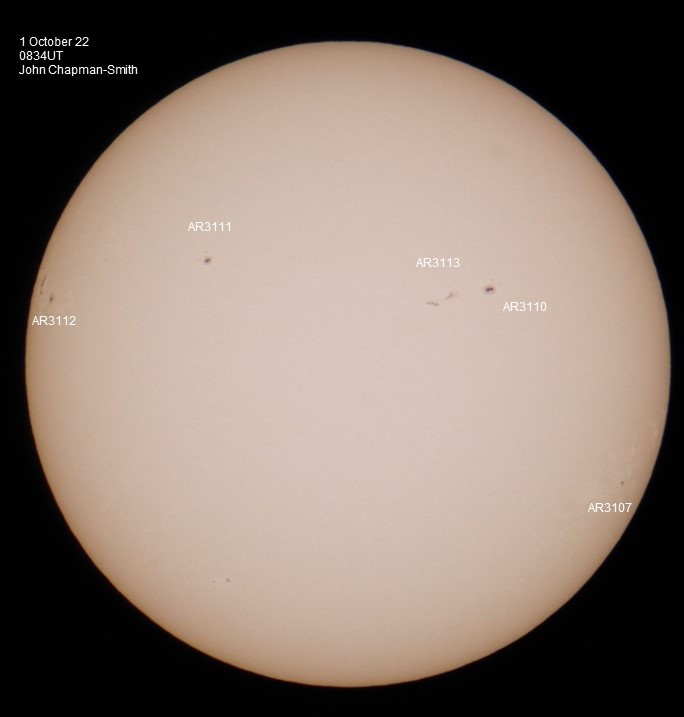
Image by John Chapman-Smith

Image by Cliff Meredith
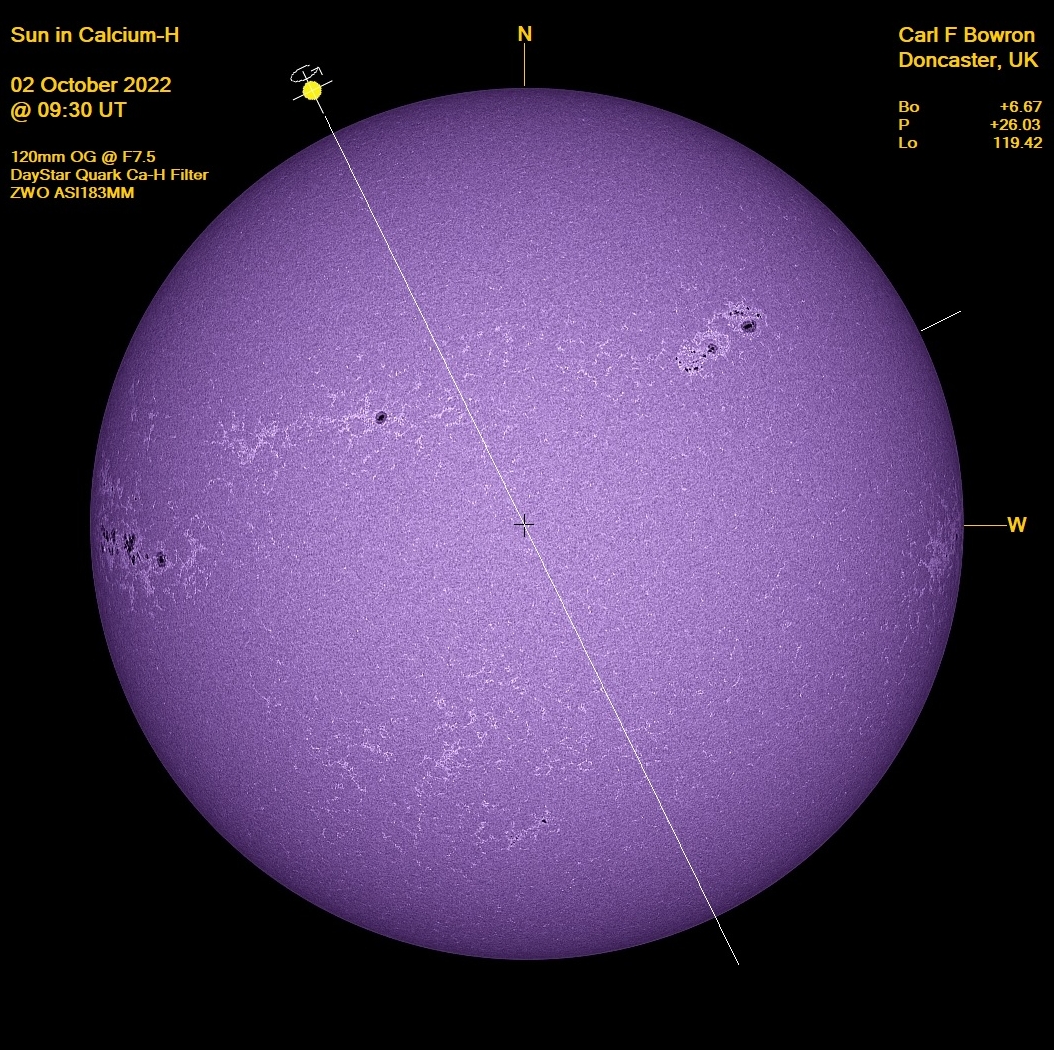
2 October 22. AR3110 is now a much larger spot with an elongated umbra with 2 spot/pore areas to its top. AR3113 has also increased slightly with spot/pore groups increased in number and slightly dispersed. AR3111 has decayed slightly as it is a single spot. AR3112 has now come over the east limb and is a large, an apparently, active group. It’s view may be affected by foreshortening, but none the less is surrounded by bright faculae. AR3114 is a bi-polar group to the south, and the remains of AR3107 appears as a mass of faculae to the south-west.
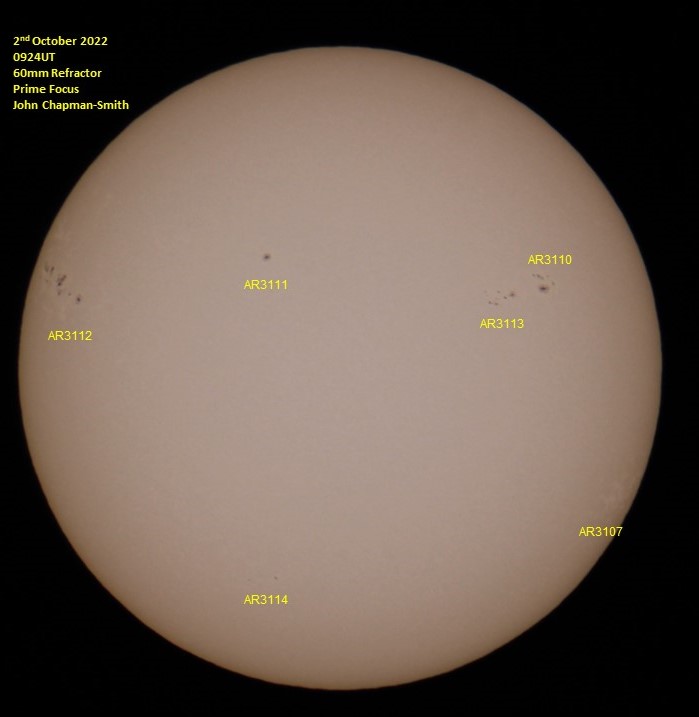
Image by John Chapman-Smith




Above images by Carl Bowron
3 October 22. AR3112 has now began to transit the solar disc and appears to be an active large spot/pore group, which is surrounded by bright faculae which reaches to some activity to the north of the group. AR3111 is remains stable, while AR3114 has developed slightly from the previous day, with multiple pores and distinct umbra within the leader spot, with a further bipolar group to the west of this area. AR3113 has changed appearance with slight development in the leader spot, which now sports 3 umbrae. AR3110 has now become a chain of spot/pores with a small spot at the top.


Image by John Chapman-Smith Image by Cliff Meredith
4 October 22. AR3112 still the main sunspot group on the disc, with a large active region covered with spots/pores and two main spot areas. The group appears to be elongating as it transits the disc. A separate group has emerged to the north of the area and may be associated with it (but is classed with a different AR number). AR3110 and 3113 have reached the west limb, and AR3111 is still a solitary sunspot. AR3117 has decayed, but AR3115 has remained stable. AR3114 appears to have decayed.

Image by John Chapman-Smith
5 October 22. AR3112 continuing its transit across the Sun, and seems to remain fairly stable, with a large central spot with some spot/pore leaders and a group of spot/pore followers behind, AR3116 is a small group a little way above this larger group showing spot leader and follower with some pores in between. AR3111 is still a singular spot, while AR3113 is now on the west limb and AR3115 has now developed slightly to become a small bi-polar group with some pores in the centre.

Image by John Chapman-Smith
6 October 22. AR3112 still transiting the solar disc and has slightly increased pore activity in the rear part of the group, but on the main there has not been much change. AR3116 has developed slightly also with the enlargement of the rear spot area. AR3115 has remained stable and AR3117 shows as a small pore. AR3111 remains a single sunspot.

Image by John Chapman-Smith
7 October 22. AR3112 now reaching the Central Meridian, and has changed little from the previous day, and the same goes for AR3116 which still follows AR3112 to the north. AR3111 remains stable while AR3115 appears to have decayed slightly with AR3117 having decayed completely.

Image by John Chapman-Smith

Image by Cliff Meredith
8 October 22. AR3112 is in the centre of the disc but has appeared to have decayed slightly but the close proximity to AR3116 would seem that the two area may be merging. Nevertheless, the area is still large with a large spot leader with two umbrae (with minor spots preceding) and with numerous spot/pore followers. AR3116 has two main spots with spot/pores following the main leader spot, which appear to edge down towards AR3112. AR3119 is a new group which has just appeared. AR3118 remains stable as it transits the disc. AR3120 is a new spot which appeared on the 7th. AR3115 and AR3111 have reached the west limb. Carl Bowron and Mick Jenkins shows some magnificent activity in their images. Ian Lee shows a large amount of activity in Hydrogen-Alpha, notably the large prominence to the south.

Image by John Chapman-Smith

Image By Mick Jenkins

Drawing by Ian Lee


Images by Carl Bowron
9 October 22. With the exception of AR3112, activity appears low. AR3112 and AR3116 now past the central meridian. On looking they appear to have merged. However, the reason they have separate AR numbers is that they have different lattitudes. AR3112 have increased activity slightly in that the rear following pores have developed, while the leader appears to be stable. AR3116 appears as a two-umbra spot leader, with surrounding pores and a spot/pore region following. AR3120 is a small spot/pore group preceding AR3112. AR3118 is a small bipolar group which appears stable. AR3119 has developed into a large spot showing 3 umbrae with spot/pore leaders.

Image by John Chapman-Smith

Image by Cliff Meredith
10 October 22. AR3112 still dominates the solar disc, with a large leader spot, a double umbra spot in the centre followed by a complex group of spots/pores, and with AR3116, showing a double umbra, above it the whole area makes a fair size group. AR3119 has developed slightly and AR3118 has decayed slightly.

Image by John Chapman-Smith

Image by Cliff Meredith

Image by Carl Bowron

Image by Carl Bowron


Images by Carl Bowron
11 October 22. AR3112 and AR3116 still remain, although slightly decayed. AR3112 still has a large leader spot, but the central spots have separated into individuals. The following pores seen the previous day have lessened considerably. It is now reaching the west limb and it is notable that there appears to be a faculae stream preceding the groups. AR3119 has developed further from the previous day with a large spot following a stream of spot/pores. The large spot appears to have a Lightbridge, or double umbra. AR3120 is now a small pore nearing the west limb. AR3118 appears to be decaying.

Image by John Chapman-Smith

Image by Cliff Meredith
12 October 22. Activity getting less. AR3112 and AR3116 have reached the west limb and AR3116 appears to have decayed to a single large spot, but AR3112 continues to remain as a large group although appears slightly decayed. AR3119 appears to remain stable and AR3118 has decayed further. New activity has appeared on the south-east limb with a pore with a large amount of faculae.

Image by John Chapman-Smith
13 October 22. Activity fairly low. The main groups are now going over the west limb. AR3116 and AR3112 appear stable, whilst AR3119 appears to have decayed slightly. There are two other Ars in the east (1x 2×2) and a pore to the south-east. Surrounded by considerable faculae.

Image by John Chapman-Smith

Image by Cliff Meredith

Image by Carl Bowron

Image by Carl Bowron

Calcium H image by Carl Bowron

Active prominences. Image by Carl Bowron

Image by Carl Bowron
14 October 22. Activity now low. AR3116 and AR3112 are on over the west limb, although there is a large amount of faculae still associated with them. AR3119 appears to have decayed slightly again. New area AR3121 is a small group consisting of two spot leaders and spot follower. Pore still apparent in the south transiting the disc. Another pore is apparent to the west.
15 October 22. The solar disc is showing very little activity now that the main groups have gone over the west limb. AR3119 appears to have decayed further and only two very small singular spot/pore groups are noticeable.
16 October 22. Activity still very low. North. AR3119 and 3123 (newly formed?) have reached the west limb. New group AR3122 is a new bipolar group. South. 1 new group (as yet un-numbered) has developed in the south consisting of spot/pores.

Image by John Chapman-Smith

Image by Carl Bowron

Image by Carl Bowron

Image by Carl Bowron

Image by Carl Bowron

Image by Carl Bowron
17 October 22. Activity still very low. 2 regions in north AR3122 decayed slightly and AR3123 reaching the west limb. Bright faculae surrounding 3123. AR3124 has developed into a bipolar spot group. New AR has appeared on central meridian, consisting of spot/pores combination (arrowed). Bright faculae to south-east.

Image by John Chapman-Smith

Image by Cliff Meredith
18 October 22. Activity continuing to be very low. Only AR3124 remains as a medium spot group now reaching the west limb. The new AR seen on the 17th (AR3125) remains as a small, relatively faint, spot/pore group. Nevertheless, Carl Bowron shows that in H-alpha the activity may be quite high, especially prominence activity.

Image by Cliff Meredith

Image by Carl Bowron

Image by Carl Bowron

Image by Carl Bowron

Image by Carl Bowron
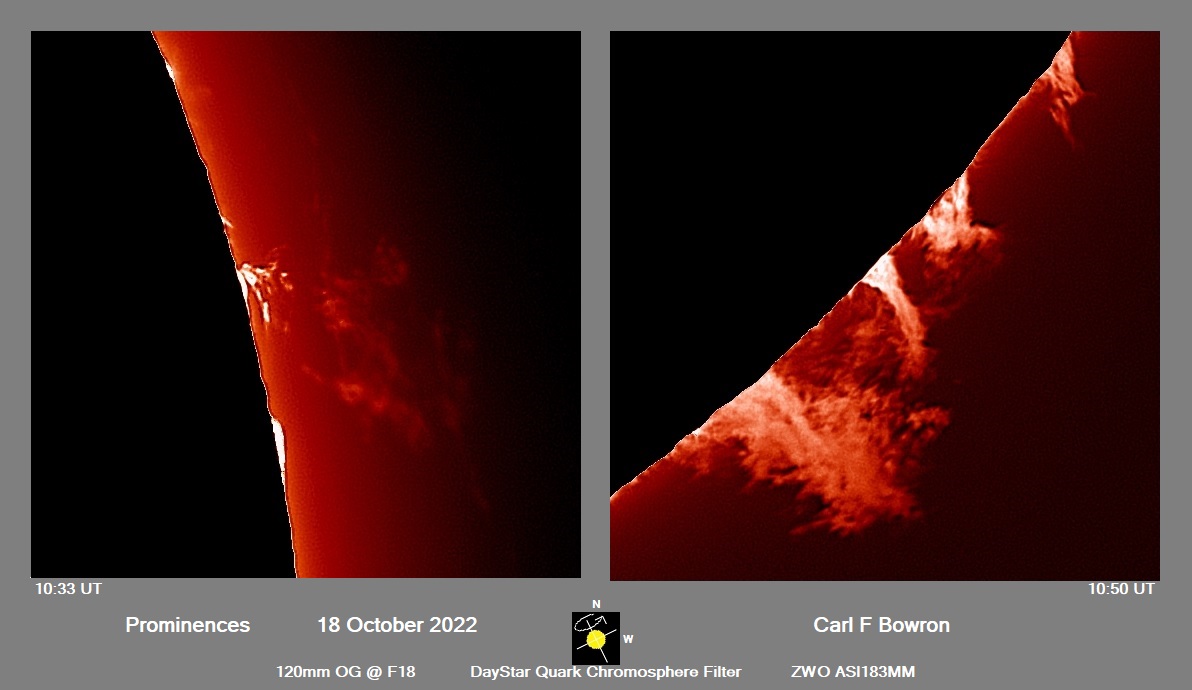
Image by Carl Bowron
19 October 22. Activity very low. AR3124 now on the west limb still as bipolar group but surrounded by faculae. AR3125 appears to have decayed somewhat, now is just a pore. A new group has emerged to the south-east, again consisting of spots/pores.
21 October 22. 1140UT. Activity still very low. 2 groups AR3126 and AR3127 are spot/pore groups near to the central meridian. AR3126 is the biggest. Another pore is visible in the west with some faculae preceding (arrowed). Some faculae on the west limb may indicate some activity.

Image by John Chapman-Smith

Image by Cliff Meredith
22 October 22. Activity very low, but groups have all developed slightly. AR3125 has developed into a singular spot approaching the west limb. AR3126 has become more of a bipolar spot/pore group, whilst AR3127 has grown very slightly into a small spot/pore group. Carl Bowron shows some great prominence activity.
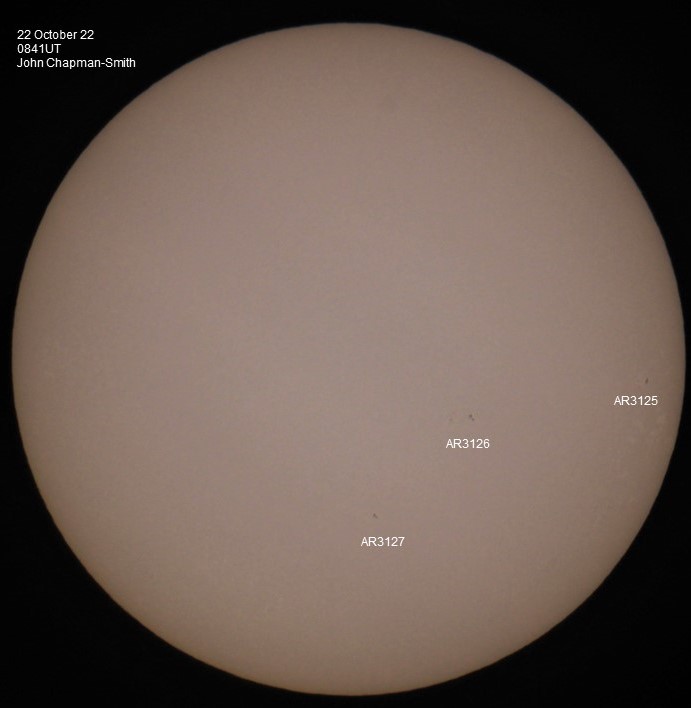
Image by John Chapman-Smith

Image by Cliff Meredith

Image by Carl Bowron

Image by Carl Bowron

Image by Carl Bowron
23 October 22. Activity still very low. Image shows 2 Ars AR3126 which appears to have decayed slightly, and a small spot/pore to west central. Some faculae to south-west limb.
24 October 22. 1308UT. Activity at present constantly low, although AR3126 has developed slightly and AR3130 is shown as a bipolar spot/pore group. A new spot has come over the east limb.
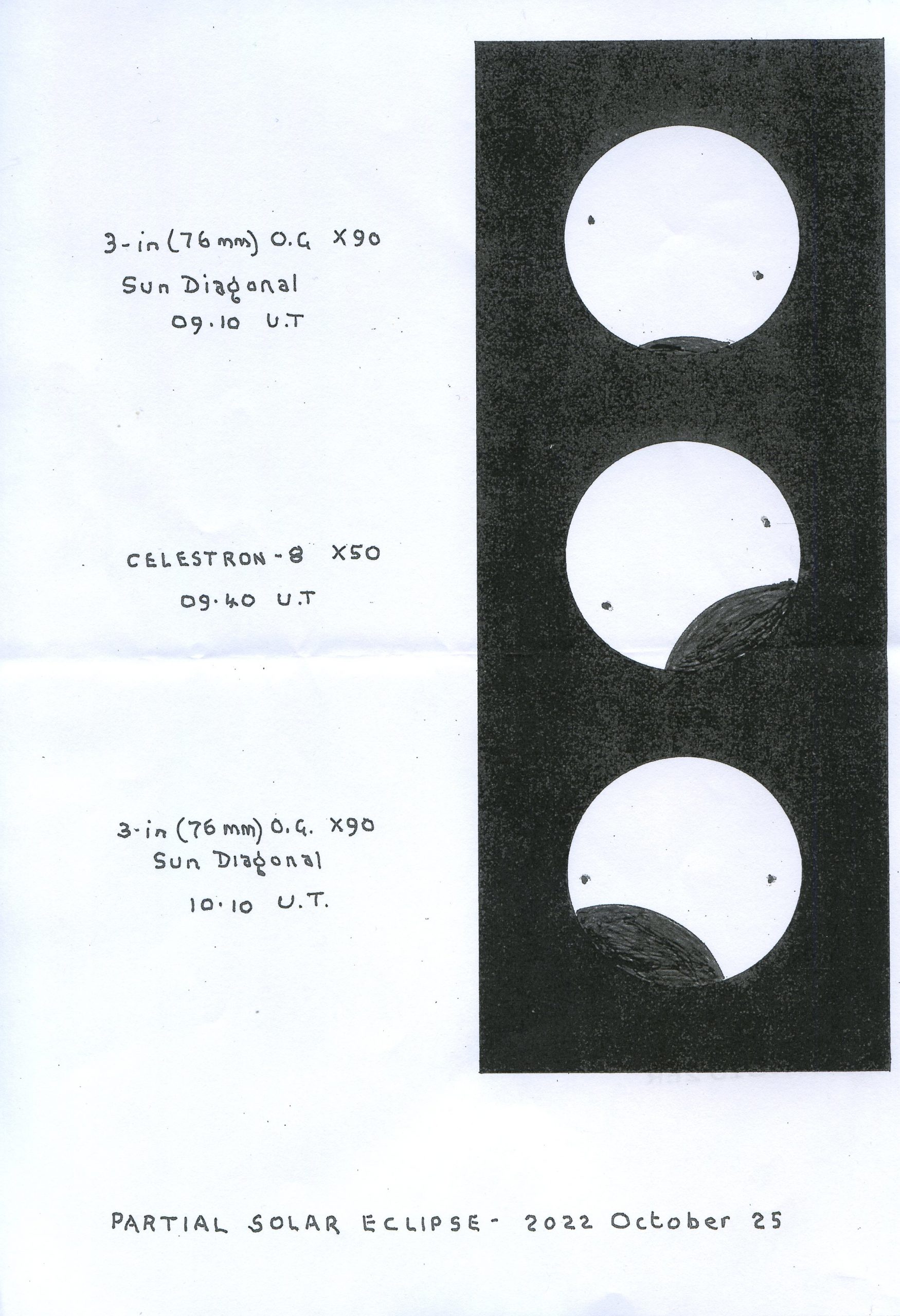
25 October 22. Partial Solar Eclipse. Activity still very low. AR3126 appears to have developed slightly but is nearing the west limb. 2 small spot/pore groups (one marked AR3130) just past the central meridian, and new spot AR3131 has now rounded the east limb and appears to be a singular spot. Weather not the best but many observed partial solar eclipse. Carl Bowron has very good images of white light activity. Ian Lee shows that activity was high again in Hydrogen Alpha with a magnificent prominence to the south.

Image by John Chapman-Smith

Image by Carl Bowron

Drawing by Ian Lee
Drawings by Alan Heath
26 October 22. AR3131 has come around the east limb with another region AR3133. 3131 is a large singular spot with sizeable penumbra, whilst AR3133 is a small spot/pore group. AR3132 is a single pore whereas AR3130 is a small slightly complex group, with a double umbra spot leader with several spot and pore followers. AR3126 has reached the west limb and appears to be a double spot shrouded with faculae. Cliff Meredith’s image shows the activity quite well.

Image by Cliff Meredith
27 October 22. AR3131 has seen slight development with two pores now following. AR3133 is right behind and is a small mixture of spots/pores. AR3130 remains stable as a small group with AR3132 now showing as a small single spot and two pore followers. Again, this image by Cliff Meredith shows the activity.

Image by Cliff Meredith
28 October 22. AR3131 is again a single large spot with AR3133 following behind and appears stable. AR3132 has decayed slightly and AR3130 is still a group showing two distinct groups surrounded by pores/spots.

Image by John Chapman-Smith

Image by Cliff Meredith
30 October 22. Cliff’s image shows the activity on the limb in the east. AR3131 is still a large singular spot, with some minor pores. AR3135 is prominent as a large group. AR3133 is the group between the two. Large faculae activity to the east limb. AR3132 and 3130 have reached or gone over the west limb.

Image by Cliff Meredith
31 October 22. Activity still fairly low. AR3131 is still a large spot with a couple of pore followers. AR3135 is a bipolar group with a central spot and some pores leading to the following spot. Some extensive faculae to the east.

Image by John Chapman-Smith
Although activity may be low, it is noted that the regions seen are quite large and sometimes complex. However, the duration of some areas have been quite small.
Congratulations to Jonathan Shanklin who observed on 30 days
MDF : 3.83 (updated 23 February 23)
R : 61.90 (updated 24 February 23)
Prom R: 5.86
Updates to MDF, R and Prom R will be made as observations arrive.
As stated in Popular Astronomy, I have taken over the Solar Section for a limited time, therefore if anyone is interested in becoming the director, please let me know.
Images and Data were sent in by Michael Fullerton, Carl Bowron, Roger Heard, Cliff Meredith, Jonathan Shanklin, Robert Steele, Mick Jenkins, Hugh Philps, Lee Macdonald, Ian Lee, Alan Heath and the Director.