
Solar Rotation Nos: 2215 – 2216
Very quiet start to the month, then a period of activity mid-month and near the end of March.
Here are the solar highlights of March 2019 together with a selection of images.
Sunspots
No sunspots were seen in the first five days of March. It was not until the 6th that a very long stretch of 33 spotless days came to an end.
AR2734 appeared on the 6th just above the solar equator at +8° latitude and was a type Cro sunspot group. This was reported as having an ‘unusual magnetic polarity’ and this suggested that this was from the new sunspot cycle (No. 25). However, its low latitude meant this sunspot was from the current Sunspot Cycle (No. 24). A minor C-class solar flare erupted briefly on the 8th just as the sunspot was passing over the centre of the Sun’s disc. A dark filament was ejected on the 10th but this was not widely seen. AR2734 disappeared over the western solar limb on the 13th.
The Sun was then spotless again from the 14th until the 17th.
AR2735 slowly appeared on the Sun’s disk as a tiny Bxo type sunspot on the 18th. This too was from Cycle 24 being almost on top of the solar equator at latitude +3 °. It finally went over the western limb on the 23rd.
AR2736 was a lot more active when it appeared not far from AR2735 on the 21st at +09°. Its rapid appearance meant also that it was minor flare active as well. This said, it did remain a type Dac throughout the time is was visible until it went over the limb on the 25th.
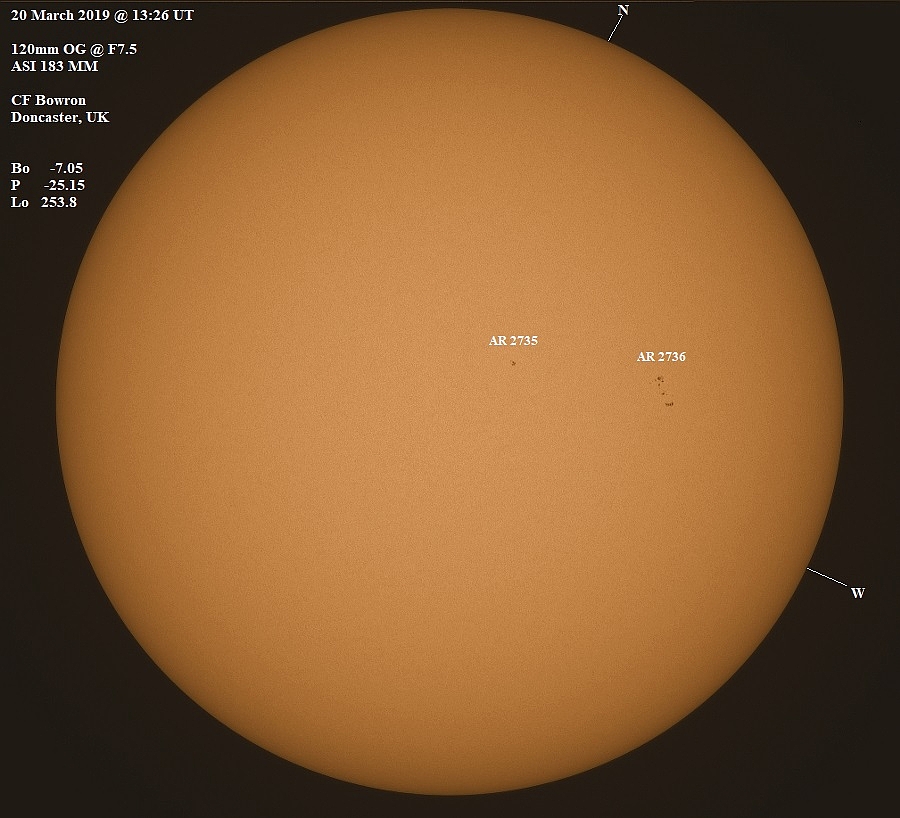
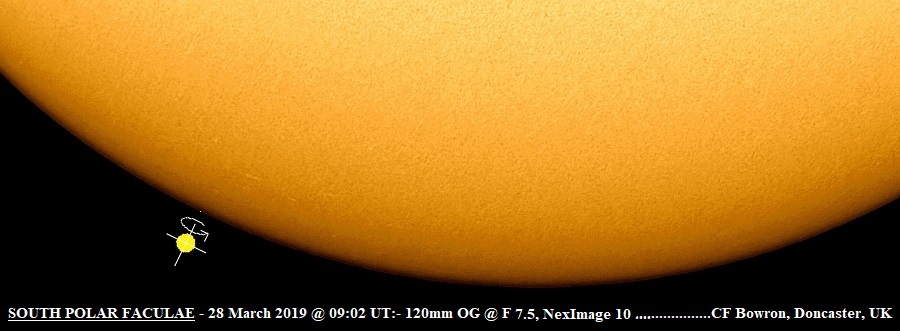
The Sun was again spotless from the 26th up to the end of March when it was thought on the 31st that a new Active Region might soon appear (but nothing had appeared yet). South polar faculae were seen and imaged by Carl Bowron on the 28th.
SPA Sunspot Mean Daily Frequency (MDF): 0.44 (was 0.00).
SPA Relative Sunspot Number: 5.59 (was 0.00).
Solar Prominences, Plage, Filaments and Flares
Prominences were few and far between at the beginning of the month and none were visible on the 4th and 17th. In contrast to the start, the last half of March saw more activity peaking on the 27th when eight prominences were visible.

The 13th saw a some particularly bright and sizable prominences largely along the eastern limb.
A particularly dark and long-lasting filament was seen on the solar disc from the 15th until the 24th by which time it was nearing the western limb of the Sun.


Both bright plage and dark filaments were seen around AR2734, AR2735 and AR2736 but the filament bridge seen on the 20th across the two main sunspots of AR2736 (with bright plage surrounding it) was the most striking. A solar flare was seen by Alan Heath on the 24th at 1000UT just as AR2736 was nearing the western limb.
An extensive low hedgerow prominence was seen on the 26th and 27th lying along the north eastern limb of the Sun.
SPA Prominence Mean Daily Frequency (MDF): 1.94 (was 1.29).
Well done to Jonathan Shanklin who both observed 27 days, to Bob Steele who managed 25 days (from Australia!) and to Michael Fullerton for 25 days observed.
Detailed count records of Active Regions and Relative Sunspot Numbers came from: Brian Gordon-States, Michael Fullerton, Alan Heath, Ian Lee, Jonathan Shanklin and Bob Steele.
Images and drawings were supplied by: Carl Bowron, John Fathers, Ian Lee and Cliff Meredith.
Geoff Elston
Director