
Solar Rotation Nos: 2258 to 2260
In early to mid-June we saw a slight dip in sunspot activity but this soon gave way to numerous small sunspots crossing the Sun right up until the month end. The northern hemisphere was the more active.
In July we saw an increase in sunspot activity with some substantial sunspots appearing particularly around mid-month. The northern hemisphere was again more active.
The sunspot MDF was slightly down in June but recovered in July to a level last seen around 2014. So far, Sunspot Cycle No. 25 seems to be shaping-up in a similar fashion to the previous Cycle No. 24. It should start to overtake but this is yet to happen.
Here are some solar highlights for June and July 2022 with a selection of images.
Sunspots
(June)
AR3024 appeared in late May at the high southern latitude of -33° it was by the 1st June still visible lying just over the Central Meridian (the CM is the imaginary centreline that divides the Sun’s disc into equal east and west halves). It went over the west limb on the 7th.
AR3027 appeared at -17° on the 1st positioned just over the CM. It was a quiet sunspot but was unusual in that it was mentioned as having a reversed polarity (think of a sunspot group as being like a magnet with one spot having a positive charge while the other has a negative charge with a magnetic field looping up above and over them) to all the other sunspots visible at that time, possibly meaning it was an old Cycle 24 sunspot. It did not develop any further and was not seen after the 9th.
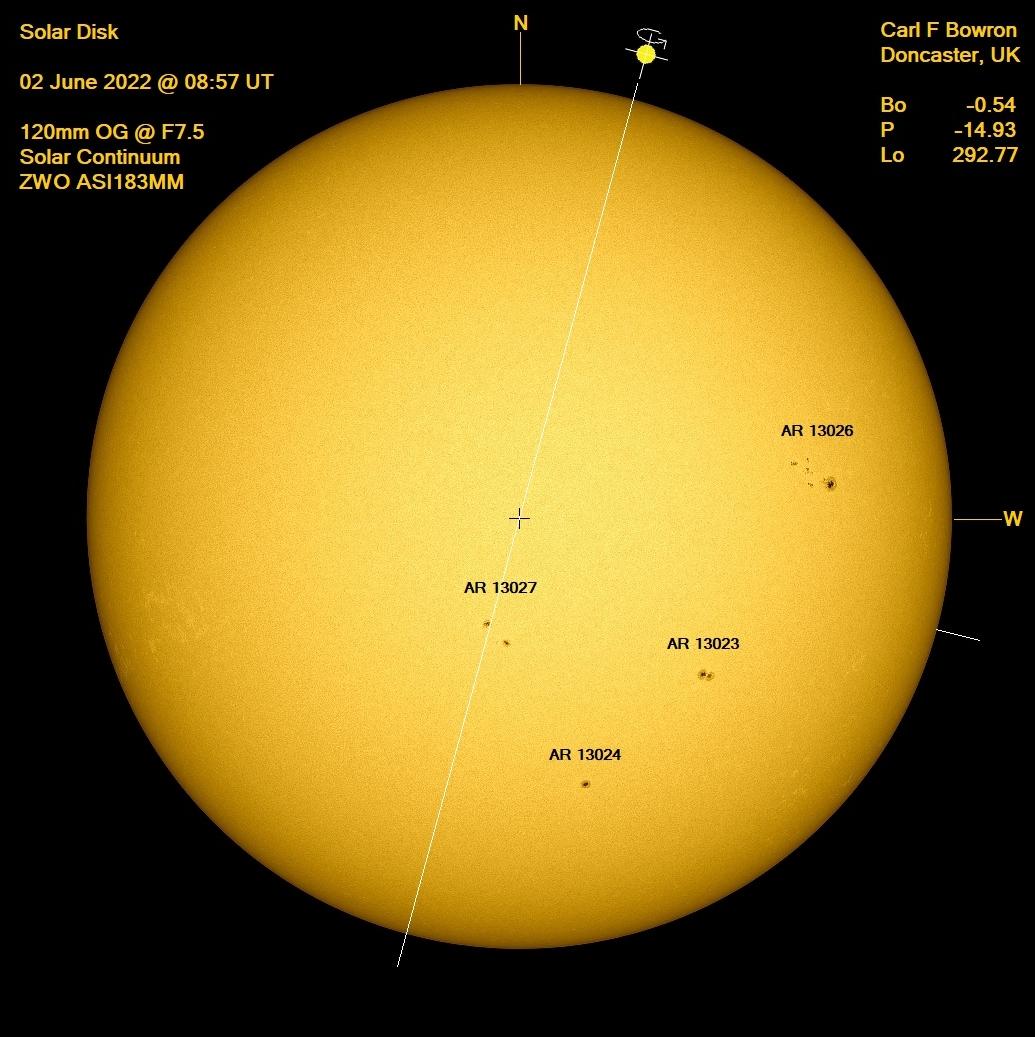
By the 4th all sunspots were visible nearing the west limb and with no new sunspots the solar disc appeared relatively quiet from about the 6th until the 10th.
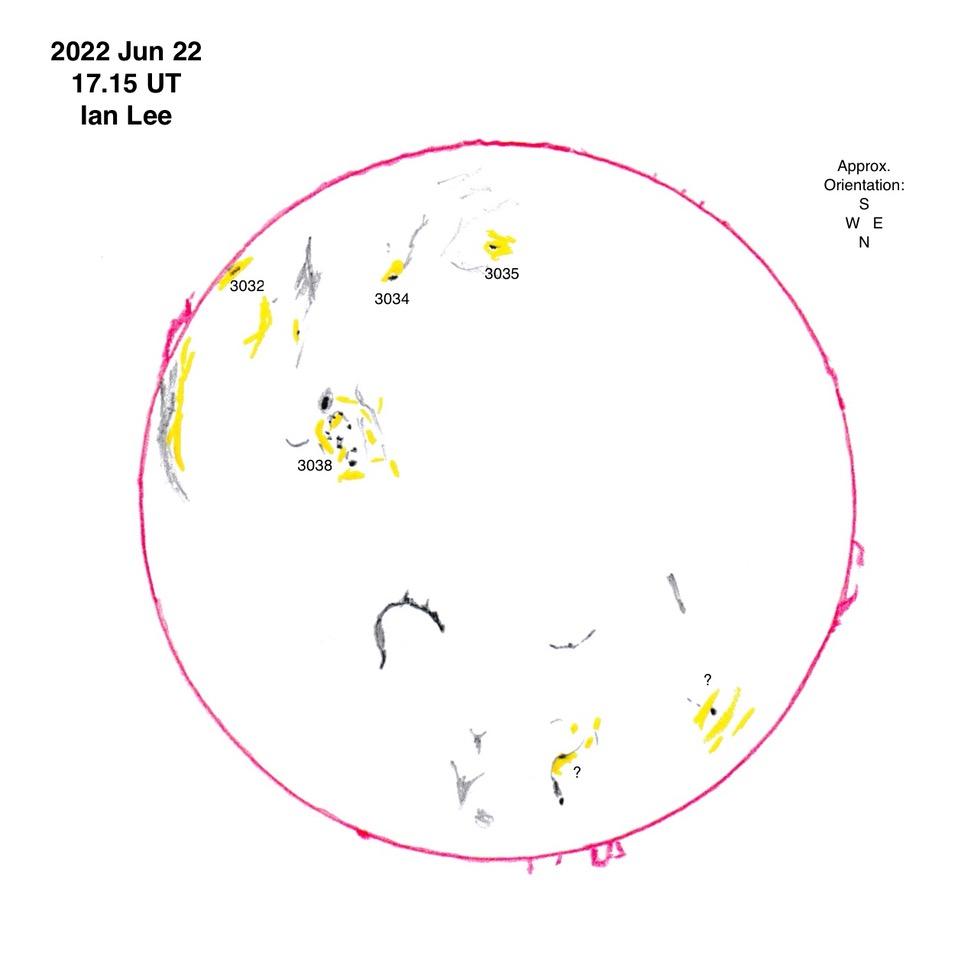
AR3030 appeared over the east limb on the 11th at the northern latitude +20° and was minor solar flare active. It was still producing minor solar flares on the 17th. It went over the west limb on the 22nd.
AR3031 appeared on the 12th at -27° and was by the following day, seen developing with more spots appearing within the group as it neared the CM. The group continued to develop on the 16th and appeared the most active mid-month with minor solar flares cropping-up from time to time.
By the 13th new sunspots AR3032, at +21°, and AR3033, at +17° had also appeared close to AR3030. AR3032 produced a long duration (over several hours) M-class flare on the 13th. They were both fairly active right up until about the 20th when they started to fade before going over the west limb around the 22nd.
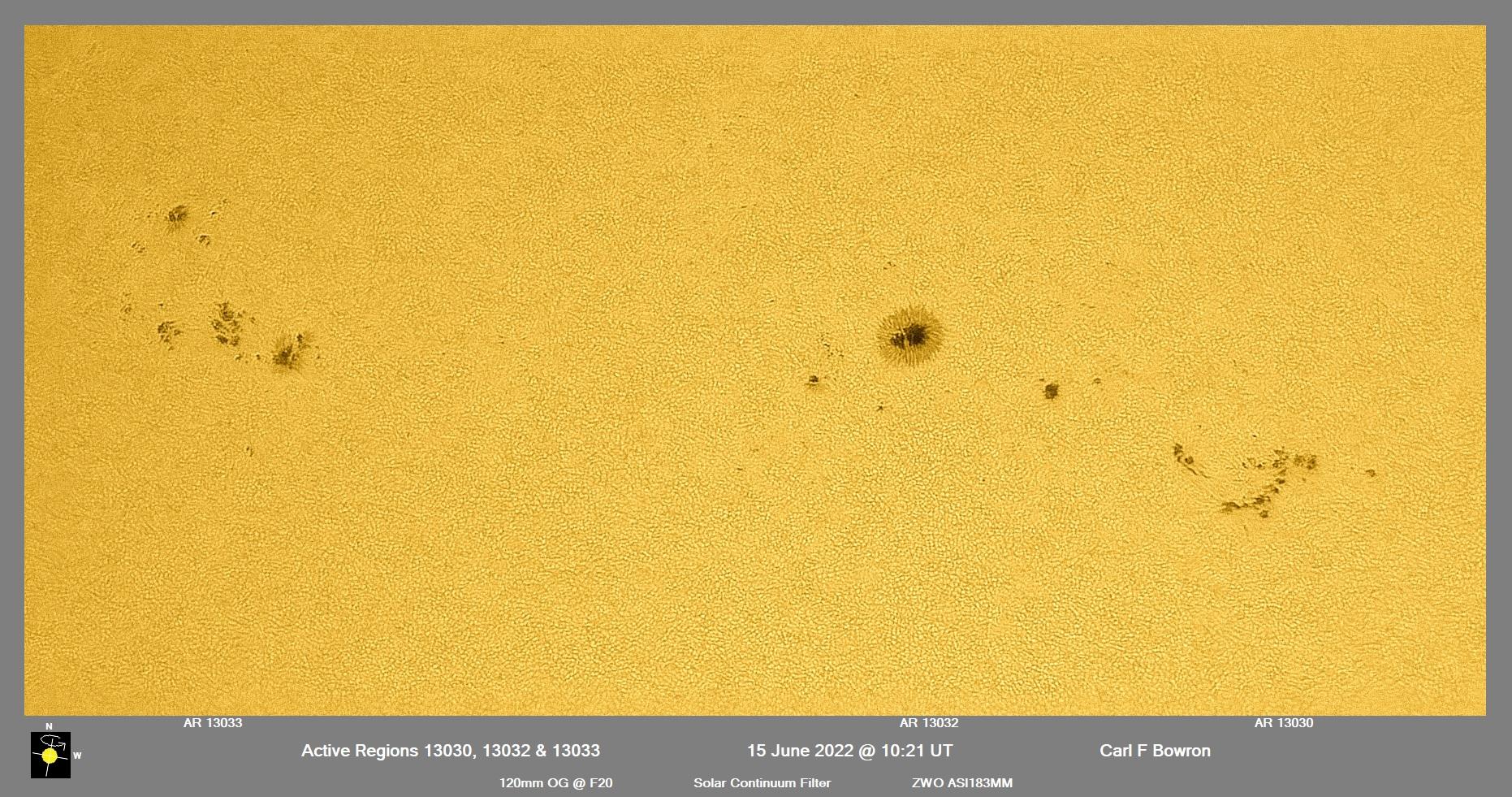
The Sun’s disc from the CM to the east limb appeared very spotted around the 15th and 16th.
AR3038 appeared near the east limb around the 17th at +12° and was seen to develop as it headed westwards. By the 20th and 21st AR3038 was quite prominent as it neared the CM and it was minor flare active too. It was not until the 25th that it started to decay as it neared the west limb.
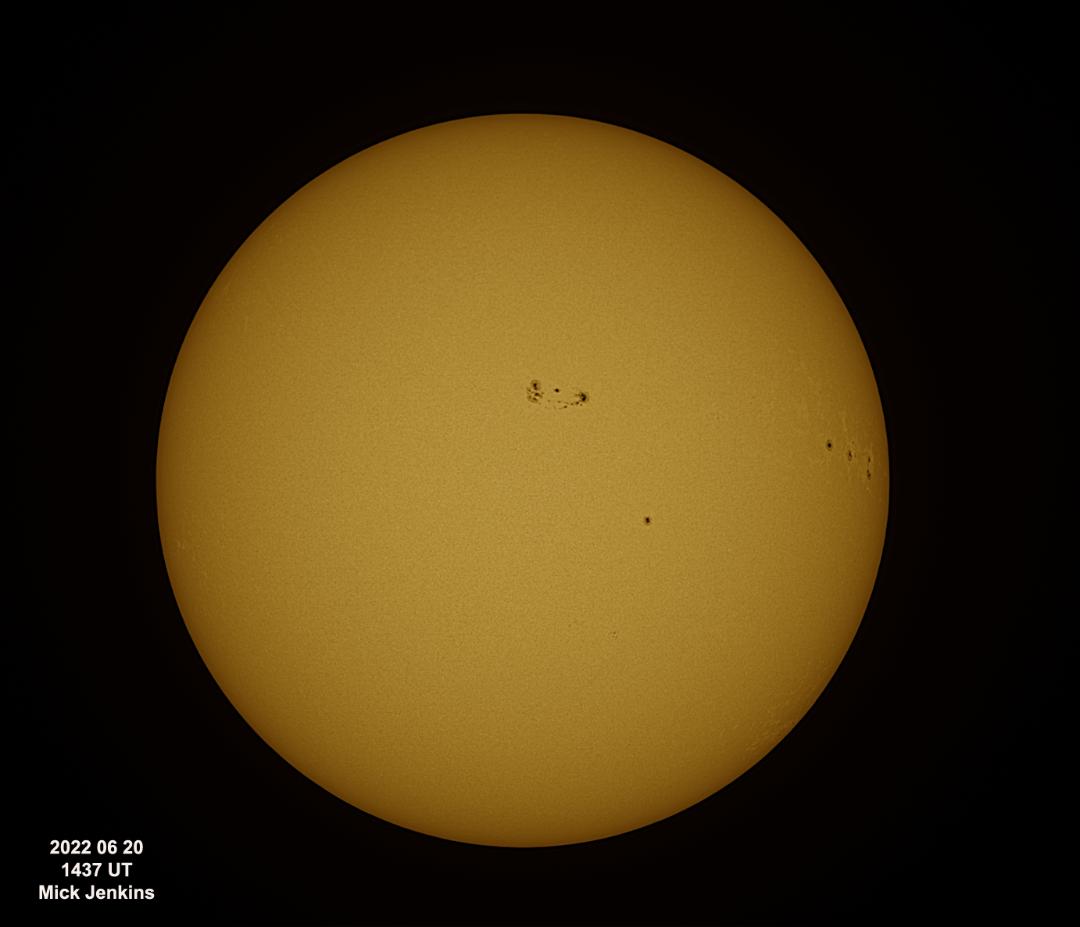
AR3040 popped into view near the east limb at -13° on the 22nd but it did not seem to change much as it crossed the CM and headed westwards towards the end of the month.
SPA Sunspot Mean Daily Frequency: 3.32 (was 3.97)
Relative Sunspot Number: 43.74 (was 52.74)
(July)
AR3040 was still visible on the 1st but otherwise the Sun appeared quiet and nearly spotless. AR3040 was not seen after the 4th.
AR3046 appeared over the east limb around the 1st and by the 3rd had developed. It reached the CM around the 7th and was not seen after the 12th.
AR3053 came over the east limb around the 6th. As it moved away from the solar limb it was the following parts of the sunspot group that developed rapidly from the 7th onwards. It remained active right up until 13th when it started to decay.

AR3055 came into view near the east limb at -18° on the 8th. It rapidly developed in the following days into two main sunspots easily visible across the CM around the 12th. It appeared to start to decay from the 14th onwards.
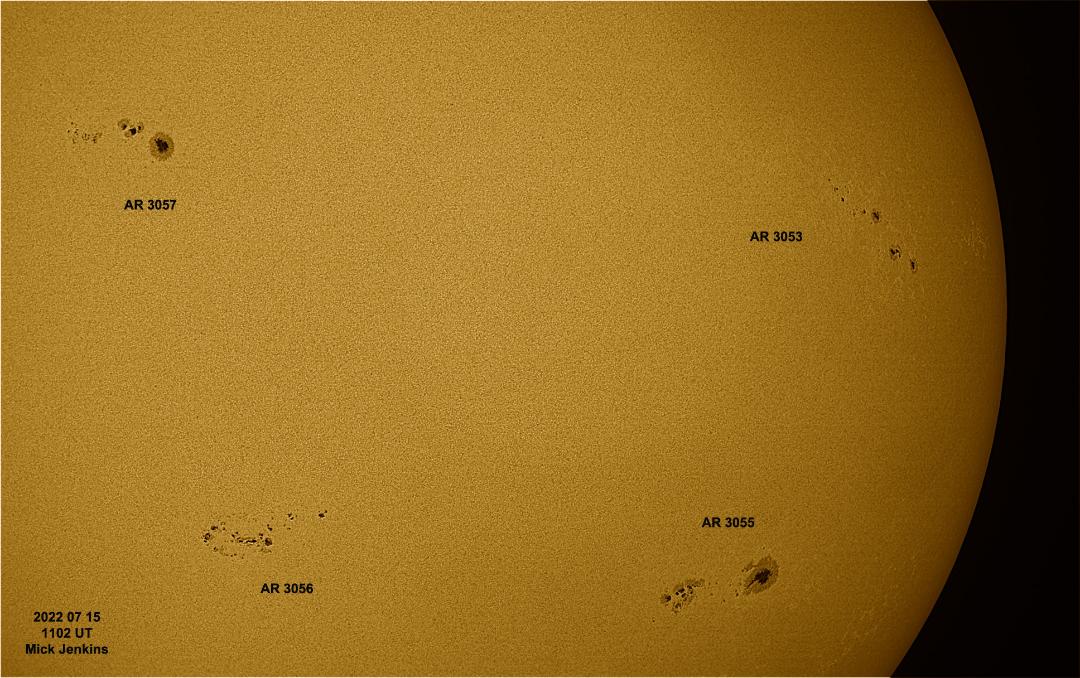
AR3056 appeared over the east limb at -15° on the 11th and was flare active. It developed rapidly over the next few days producing an M-class flare on the 17th when the sunspot group seemed to reach it peak development. It faded quite quickly after the 19th as it neared the west limb.
AR3057 came over the east limb on the 11th and was seen to develop until it reached the CM on the 17th as a trail of sunspots. These sunspots persisted for several days until they faded away as the group reached the west limb on the 25th.
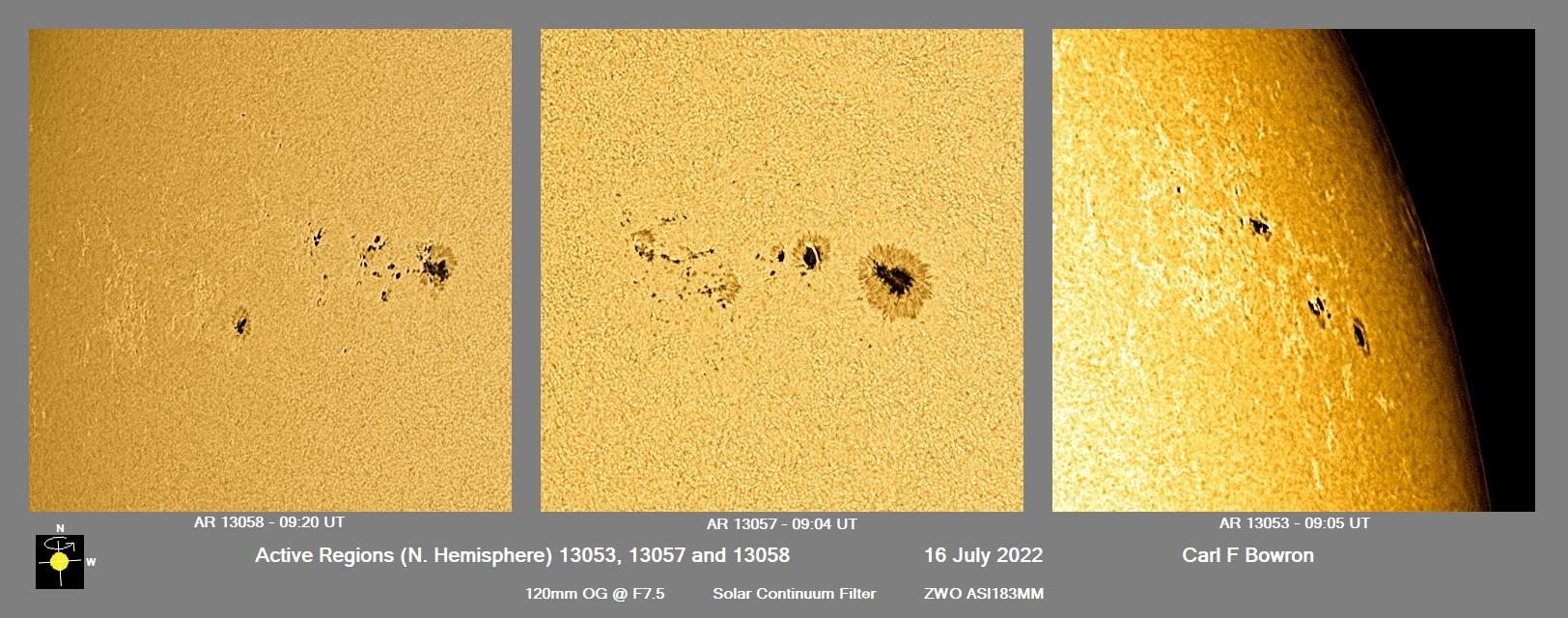

By the 17th both north and south hemispheres appeared very spotted but by the 21st there were numerous small sunspots scattered along just the northern hemisphere. By the 25th the north was much quieter, and it was the turn of the southern hemisphere to show more sunspot activity in the form of AR3062 (-25°) and on the 29th with AR3068 appearing over the limb at -16°.
SPA Sunspot Mean Daily Frequency: 5.18 (was 3.32)
Relative Sunspot Number: 79.71 (was 43.74)
Solar Prominences, Plage, Filaments and Flares
(June)
Many interesting prominences were seen throughout the month.
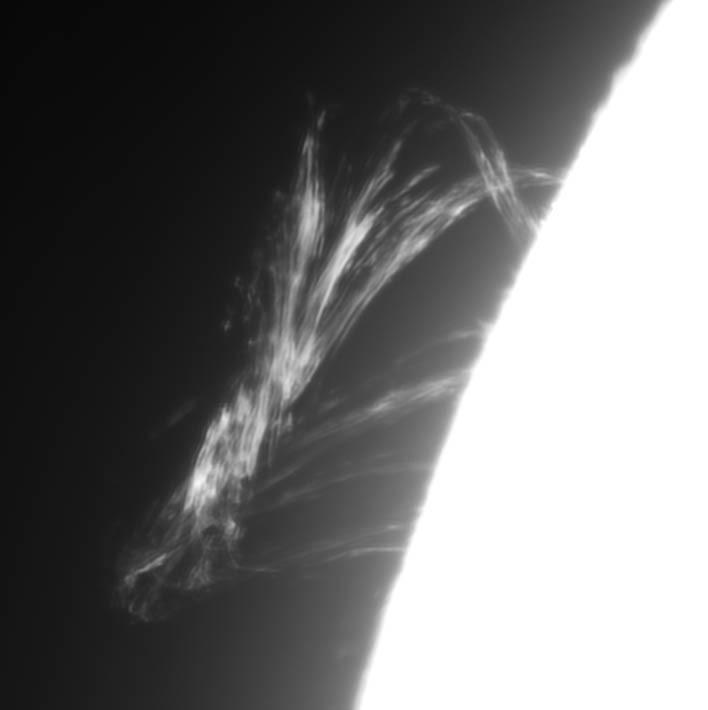
An eruptive and somewhat unusually shaped prominence was seen on the east limb on the 10th.
Dark filaments and bright plage were numerous on most days, the plage heavily associated with the sunspots in most instances.
A long broad dark filament was seen on the southern hemisphere on the 1st. Later in the month from about the 15th onwards a very long filament was seen extending northwards from sunspot AR3032.
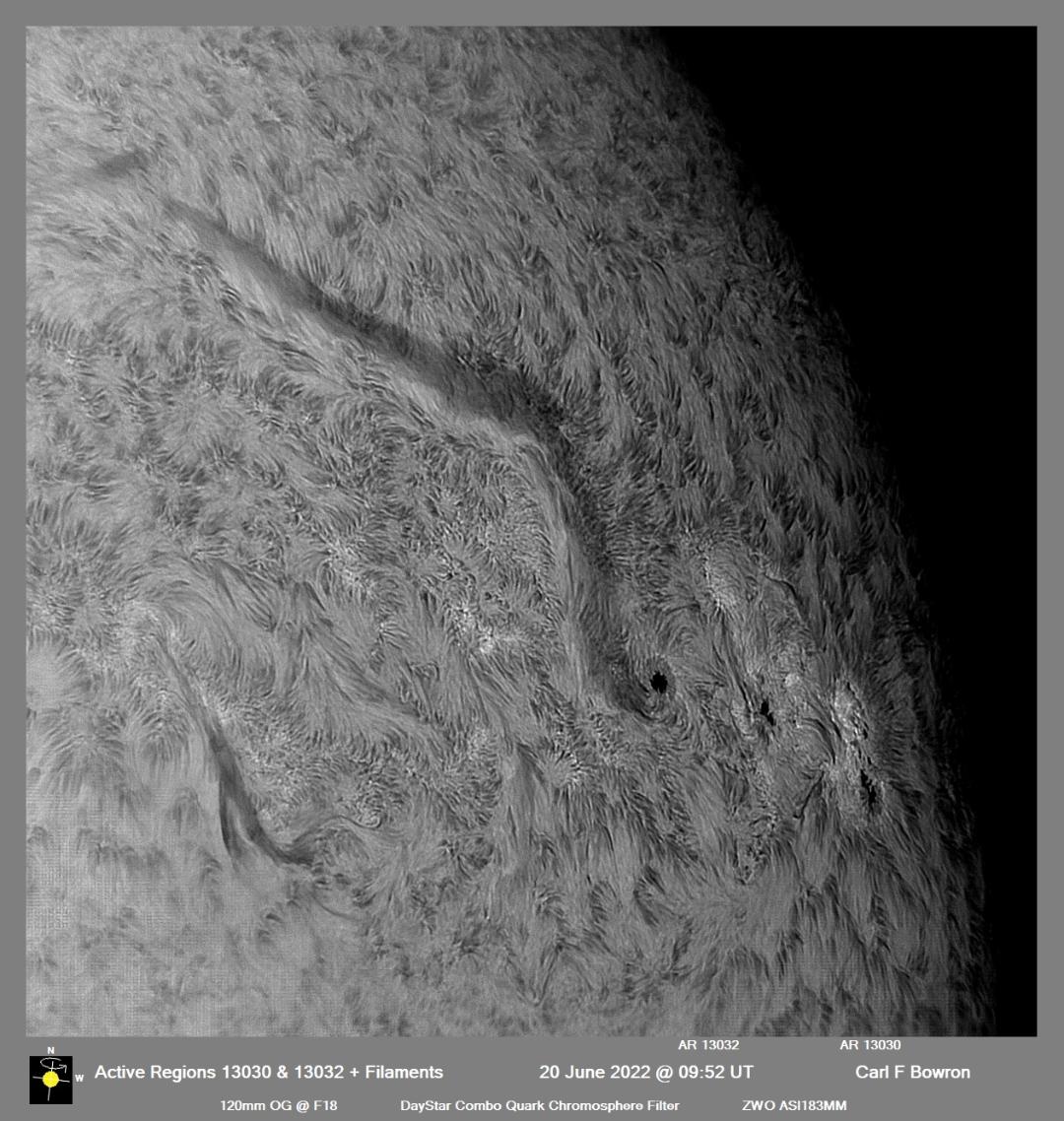
By the 19th it was estimated to be around 370,000km long (roughly about the same distance between the Earth and the Moon). As this filament went over the southwest limb on the 22nd it produced an exceptionally long “filaprom” (filament and prominence seen attached together).
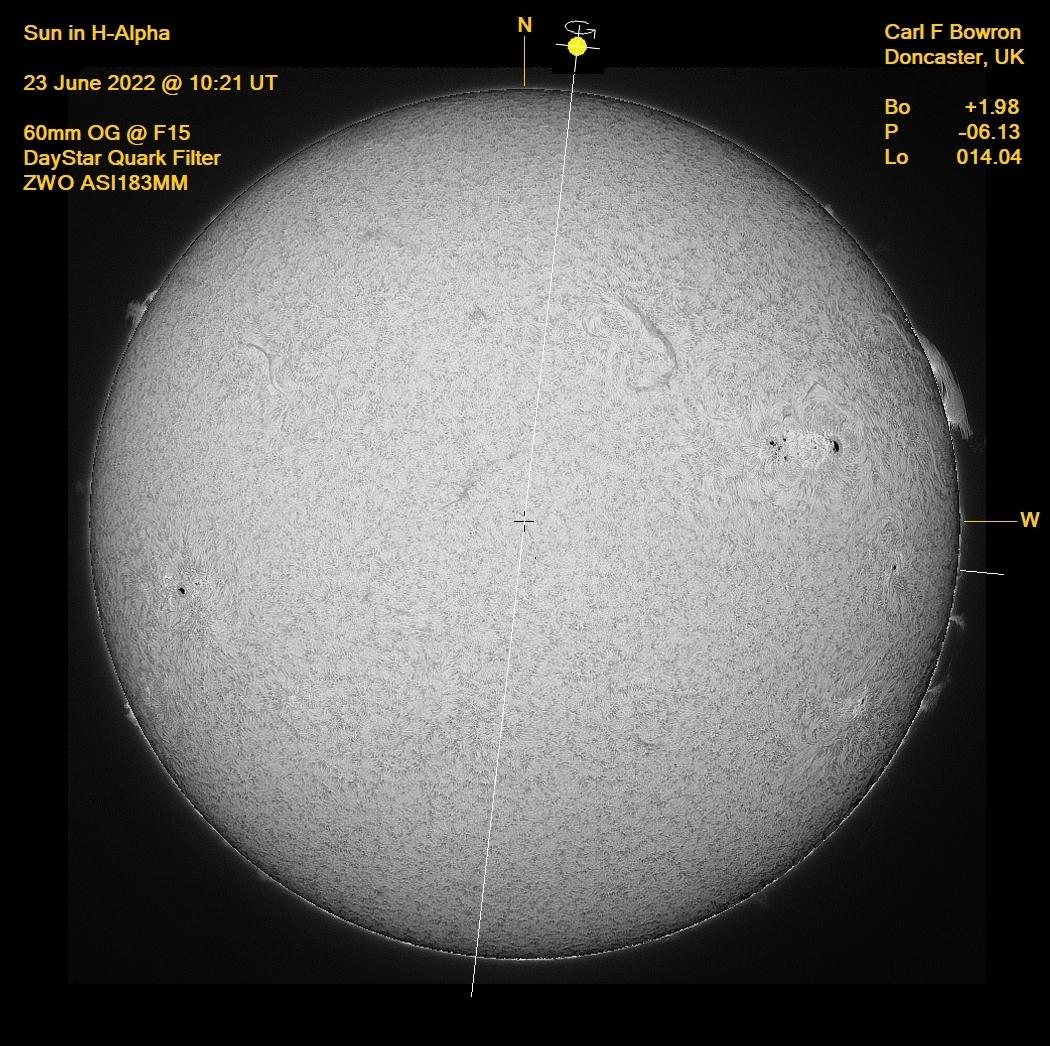
SPA Prominence Mean Daily Frequency: 5.20 (was 4.64)
(July)
A high hedgerow prominence was seen on the east limb on the 7th. A long hedgerow prominence was seen along the southern limb on the 15th. A tall but compact prominence was visible on the southern limb on the 18th.
Some long and elaborate looking filaments were seen in early July. Particularly on the 2nd, 7th and 9th. The 10th saw four substantial filaments across the southern hemisphere and the 15th saw eleven filaments visible across the whole of the solar disc.
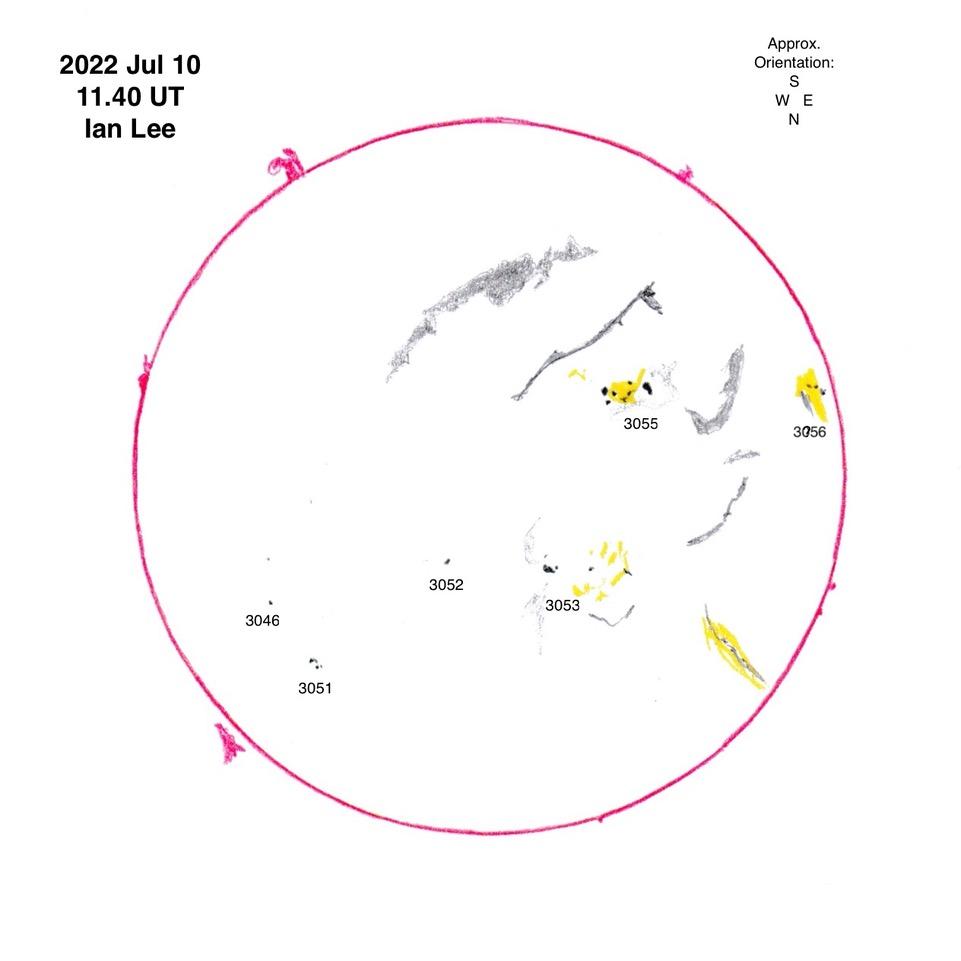
Numerous bright plage were seen throughout July usually associated with the sunspots as they came and went.
SPA Prominence Mean Daily Frequency: 4.88 (was 5.20)
Michael Fullerton, Alan Heath and Jonathan Shanklin each observed 27 days in June. While in July, Michael Fullerton and Jonathan Shanklin achieved 30 days with Alan Heath 29 days.
Detailed count records of Active Regions and Relative Sunspot Numbers came from: Simon Brown, John Chapman-Smith, Michael Fullerton, Alan Heath, Ian Lee, Lee Macdonald and Jonathan Shanklin.
Images and drawings were supplied by: Mark Beveridge, Carl Bowron, Paul Brierley, John Chapman-Smith, John Fathers, Mick Jenkins, Ian Lee, Cliff Meredith.
Geoff Elston