
Solar Rotation Nos: 2245 to 2246
There is current speculation that prediction of sunspot activity based on new sunspot data indicate that the maximum of Sunspot Cycle 25 might peak earlier than expected. Solar Maximum might occur in late 2024 rather than in mid 2025.
A month of surprises, a naked eye sunspot was seen at the beginning of July with plenty of smaller sunspot activity, one at very high latitude. Around the 21st six sunspot groups were visible on the Sun something we have not seen since late 2017. The first X-class solar occurred in AR2838. This was followed by a blank Sun at the end of the month!
Here are the solar highlights for July 2021 together with a selection of images.
Sunspots
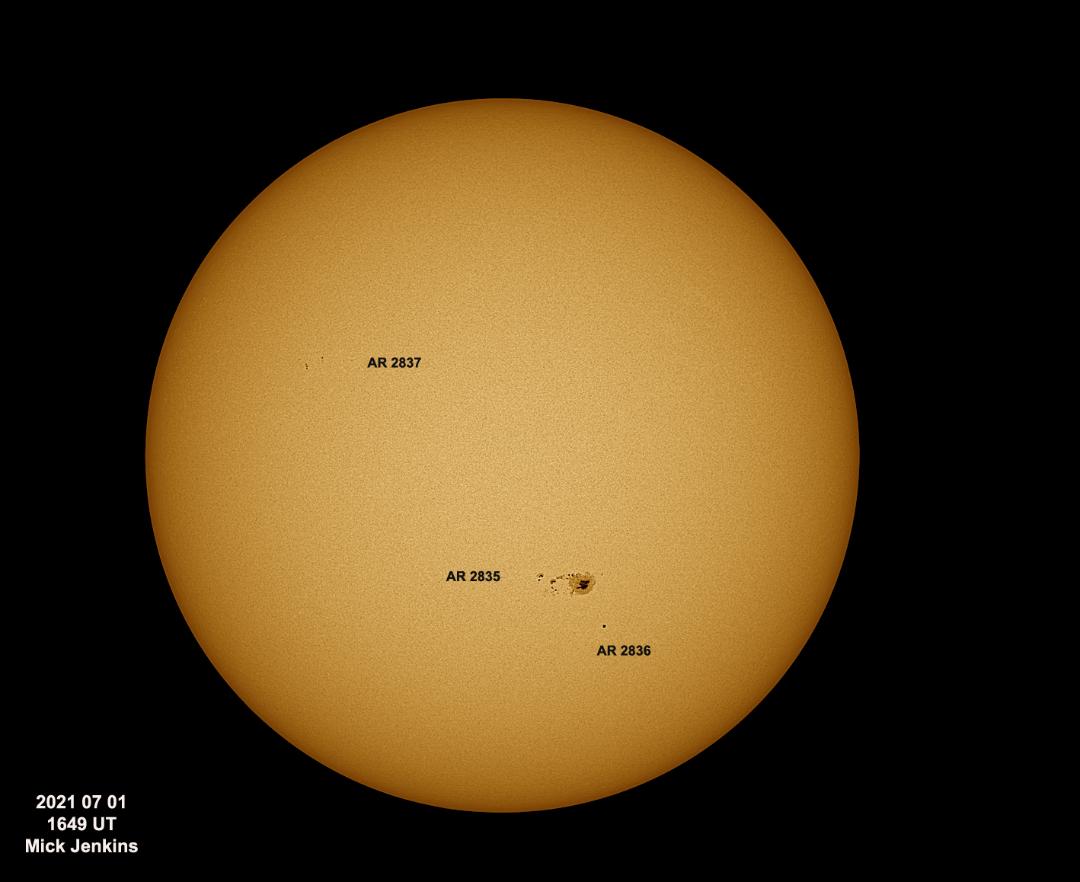
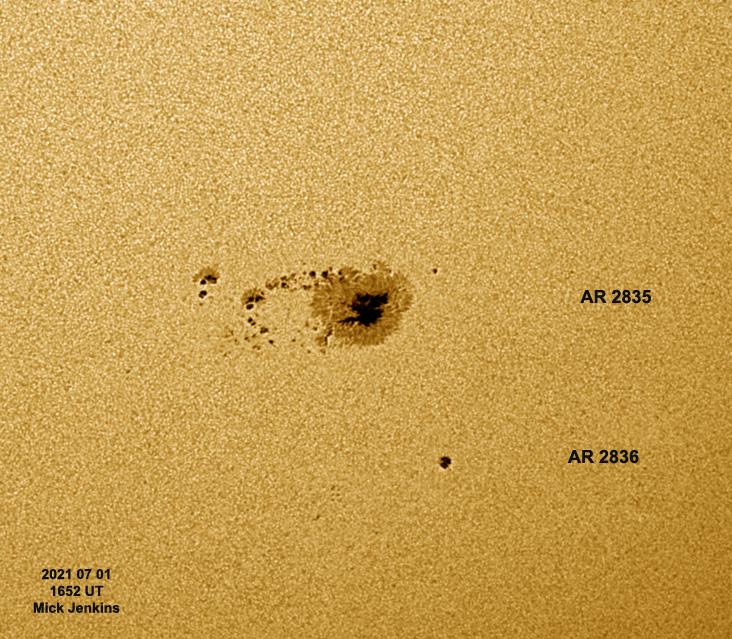
AR2835 at -18° was seen just west of the Sun’s Central Meridian (CM) on the 1st. Classed as type Eki, 11 spots were counted within, and it was glimpsed with the protected naked eye by Alan Heath from the 2nd to the 4th. Thereafter, it seemed to decay and the main sunspot appeared to split into two on the 6th. It went over the west limb by the 8th with bright faculae visible.
AR2836 on the 1st at latitude -27° was just visible to the southwest of AR2835 as a single sunspot. It had gone over the west limb by the 5th.
AR2837 was still visible on the 1st as a cluster of small sunspots nearing the CM but north of the equator at +17°. It went over the west limb by the 8th.
AR2838 appeared on the disc close to the west limb on the 3rd at +24°. It was solar flare active and produced the first X-class flare of Sunspot Cycle 25. Being near the limb it disappeared over it a couple of days later.
AR2839 appeared near the east limb on the 5th at +19°. It seemed to be initially quite active as type Cro but appeared to slowly fade away as it headed westwards, finally disappearing by the 11th.
AR2840 was another sunspot to pop into view near the west limb. It appeared on the 7th at +27° type Bxo but was easy to miss visually. It passed over the limb on the 9th.
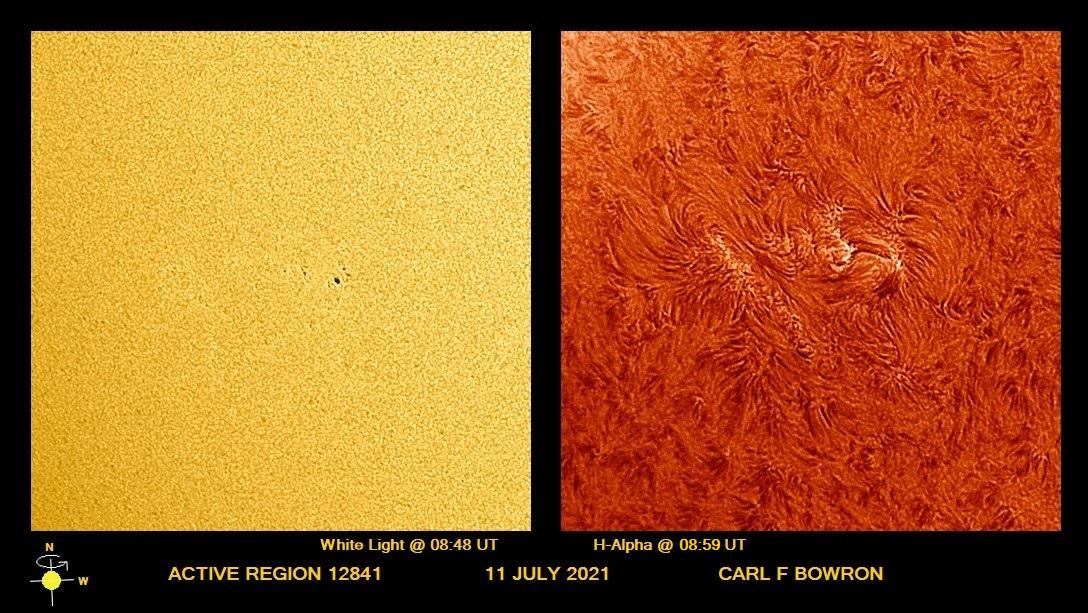
AR2841 was a small type Bxo cluster of pores that came over the east limb on the 10th at -18°. Barely visible in white light, but better in H-alpha, it had gone by the 14th leaving faculae behind.
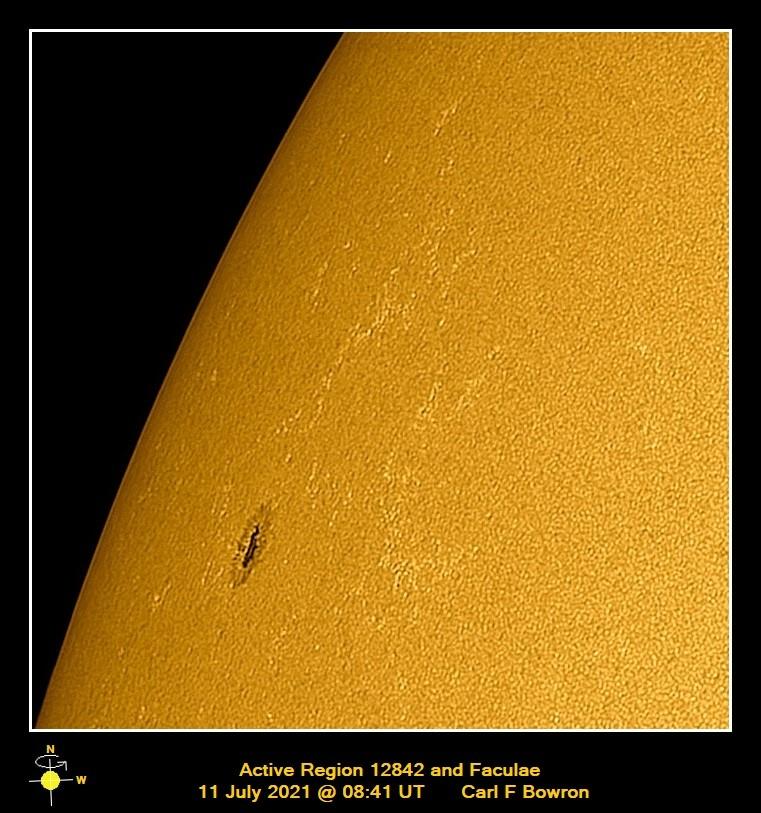
AR2842 was a single Hsx sunspot that came over the east limb on the 11th with bright faculae around it. It was seen as a group of small spots/pores on the 20th It seemed to stay much the same by the 20th and started to show faculae as it headed westwards. It went over the west limb by the 24th.
AR2843 was a small Bxo type group of spots that appeared near the west limb on the 15th at -17°. It went over the limb on the 19th.
AR2844 appeared over the east limb as a single Axx type pore (almost invisible) with scattered faculae on the 16th at the extraordinary high southern latitude of -43°. Short-lived, it disappeared by the 20th leaving faculae visible.
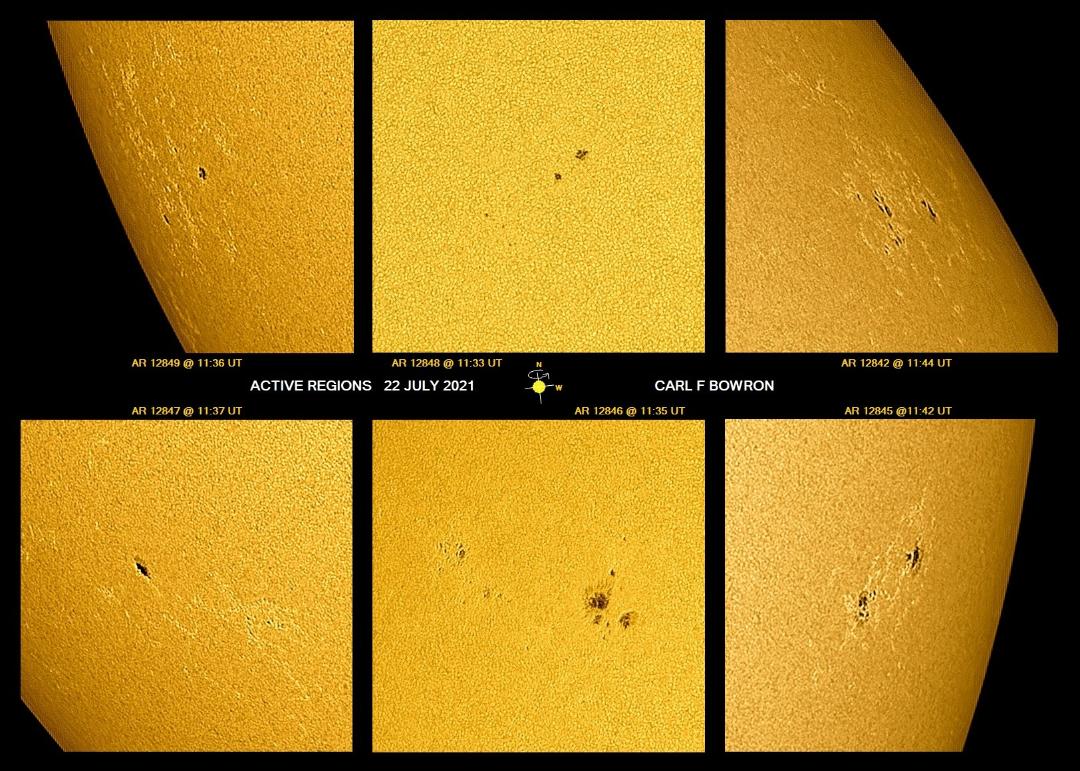
AR2845 came into view as a cluster of small spots/pores just west of the CM on the 18th at -16°. It was thought that a solar flare occurred while imaging in H-alpha on the morning of the 22nd but later no flares were reported elsewhere so it much have been an imaging artefact. AR2845 went over the west limb by the 24th.
AR2846 came over the east limb as on the 20th at +25°. Still active this was the return of former AR2838 seen last month. It was seen decaying by the 28th.

AR2847 came over the east limb on the 21st at -29°. It was seen decaying by the 28th.
AR2848 appeared near the east limb on the 21st at +20° but was short-lived and was gone by the 25th.
AR2849 came into view near the east limb on the 22nd at -18°, type Axx, it only lasted a couple of days and had disappeared by the 25th.
The Sun was spotless from the 29th to the 31st.
SPA Sunspot Mean Daily Frequency: 1.95 (was 1.45)
Relative Sunspot Number: 27.17 (was 18.85)
Solar Prominences, Plage, Filaments and Flares
Sunspots AR2835 and AR2836 were impressive in ordinary white light but more so in H-alpha.

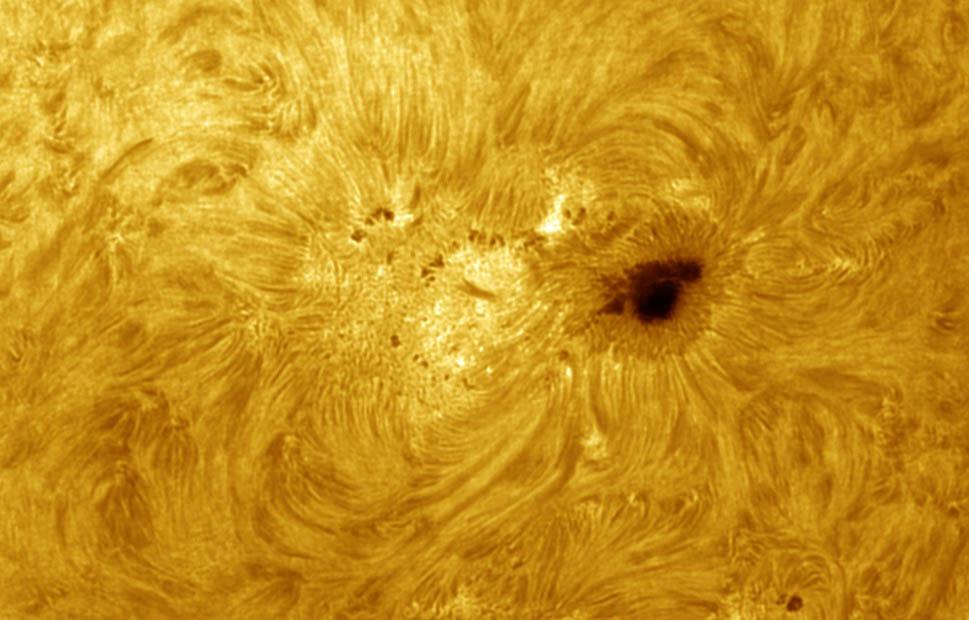
AR2841 showed much more activity in H-alpha.
Prominence activity seemed a little muted in July but there were exceptions.
A filaprom was seen on the southwest limb on the 5th.
Three largish prominences were seen on the 8th.

An unusual cloud-like prominence (resembling an anteater to my mind) was seen on the SW limb on the 10th.
A faint loop/arch prominence appeared on the west limb on the 13th. This appeared to separate into three separated prominences on the 14th.
There were plenty of filaments seen this month, some lengthy and elaborate in appearance. One such filament was seen following AR2842, initially one long feature it was seen splitting into five parts by the 17th.
A long snake-like filament seen extending behind AR2842 on the 18th.
Near AR2847 a long snake-like filament bordered by bright plage to the southeast and a line of three smaller filaments nearby on the 25th. These seem to persist until the 28th and possibly longer.
Bright plage were visible around AR2842, AR2844, AR2845, AR2846, AR2847, AR2848, AR2849.

SPA Prominence Mean Daily Frequency: 2.36 (was 2.53)
Congratulations to Alan Heath and Jonathan Shanklin who both observed 30 days and to John Chapman-Smith and Bob Steele who both observed 20 days.
Detailed count records of Active Regions and Relative Sunspot Numbers came from: Mick Jenkins, Ian Lee, Lee Macdonald, Jonathan Shanklin, Brendan Shaw and Bob Steele.
Images and drawings were supplied by: Carl Bowron, Paul Brierley, John Chapman-Smith, John Fathers, Mick Jenkins, Ian Lee and Cliff Meredith.
Geoff Elston