
Solar Rotation Nos: 2251 to 2252
Solar Cycle No.25 seems to be showing more sunspot activity than previously expected in earlier forecasts. This seems likely if recent sunspot activity is anything to go by.
Persistently cloudy weather severely impacted solar observations in December. The southern hemisphere was more active than the north this month particularly from mid-December onwards.
Here are the highlights of solar activity for December 2021 together with a selection of images.
Sunspots
AR2898 appeared on the disc in late November at -24°. It was seen nearing the west limb on December 1st. It went over the limb on the 5th.
AR2900 appeared preceding AR2898 in late November at -28° and was still visible on December 1st nearing the west limb passing over it by the 5th.
AR2904 appeared on the 6th at -27° What was notable about it was that on the 7th and 8th it was the only sunspot visible, near the CM.
The Sun appeared blank of sunspots from the 9th to the 13th.
AR2905 came into view between the east limb and the CM on the 13th at -11°, type Cro consisting of 2 sunspots. It remained fairly quiet as it crossed the solar disc and was not seen after the 17th.
AR2906 appeared much farther south at -29° on the 14th, initially type Bxo. It developed rapidly over the following few days reaching a peak around the 17th and was C-class flare active at one point. It seemed to fade after the 19th.
AR2907 also developed into view on the 14th at -21°, initially type Bxo, it developed rapidly by the 15th to type Dki and was C-class solar flare active. This Active Region plus AR2908 and AR2909 formed a trail of sunspots along the southern hemisphere from the 16th onwards.
AR2908 appeared around the 16th at -21°, type Dko. It reached a peak around the 18th to 20th and produced an M-class flare on the 20th plus a few C-class flares over the Christmas period.
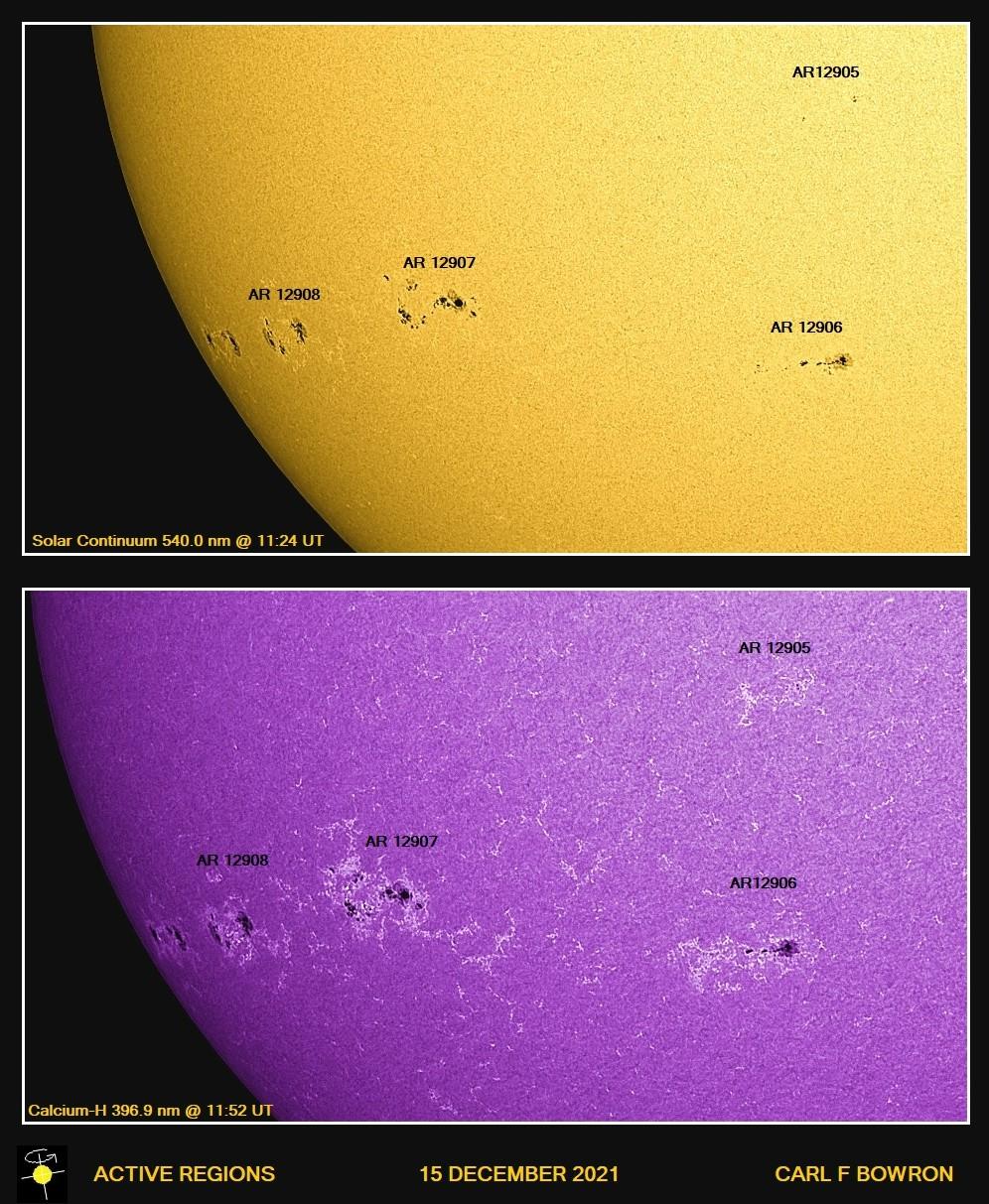
At this time the Sun appeared very spotted but many UK observers were prevented seeing it due to overcast skies.
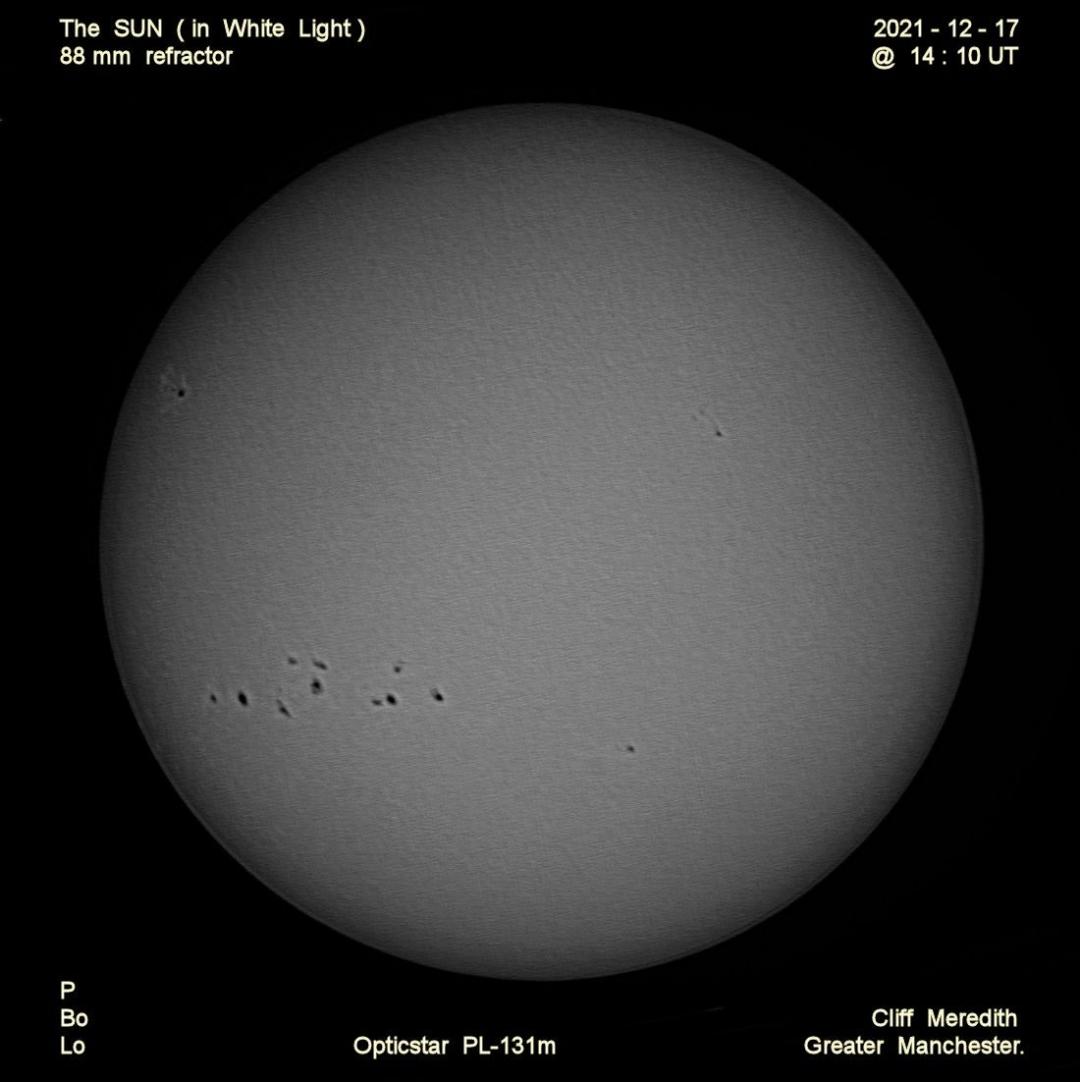
AR2909 came into view around the 16th at -21°, type Dao. It remained fairly static up until the 22nd when it seemed to fade.
AR2916 appeared on the 22nd at -16° and developed rapidly to type Ekc by the 26th. It was less flare active by the 28th by which time it was at the CM. At the end of the year AR2916 was seen to be decaying as it neared the west limb.
AR2917 appeared on the 23rd at -27° initially type Bxo but then developing to type Cro after the 24th until it suddenly disappeared after the 26th.
AR2918 also appeared on the 23rd at +20° type Cro, one of few northern hemisphere sunspot groups to appear this month. It seemed to peak around the 26th to 29th remaining visible until the end of the month.
SPA Sunspot Mean Daily Frequency: 2.04 (was 2.17)
Relative Sunspot Number: 30.20 (was 26.26)
Solar Prominences, Plage, Filaments and Flares
Very limited coverage this month due to low Sun and poor weather.
There were a few small prominences seen in early to mid-December plus some isolated filaments and areas of bright plage.
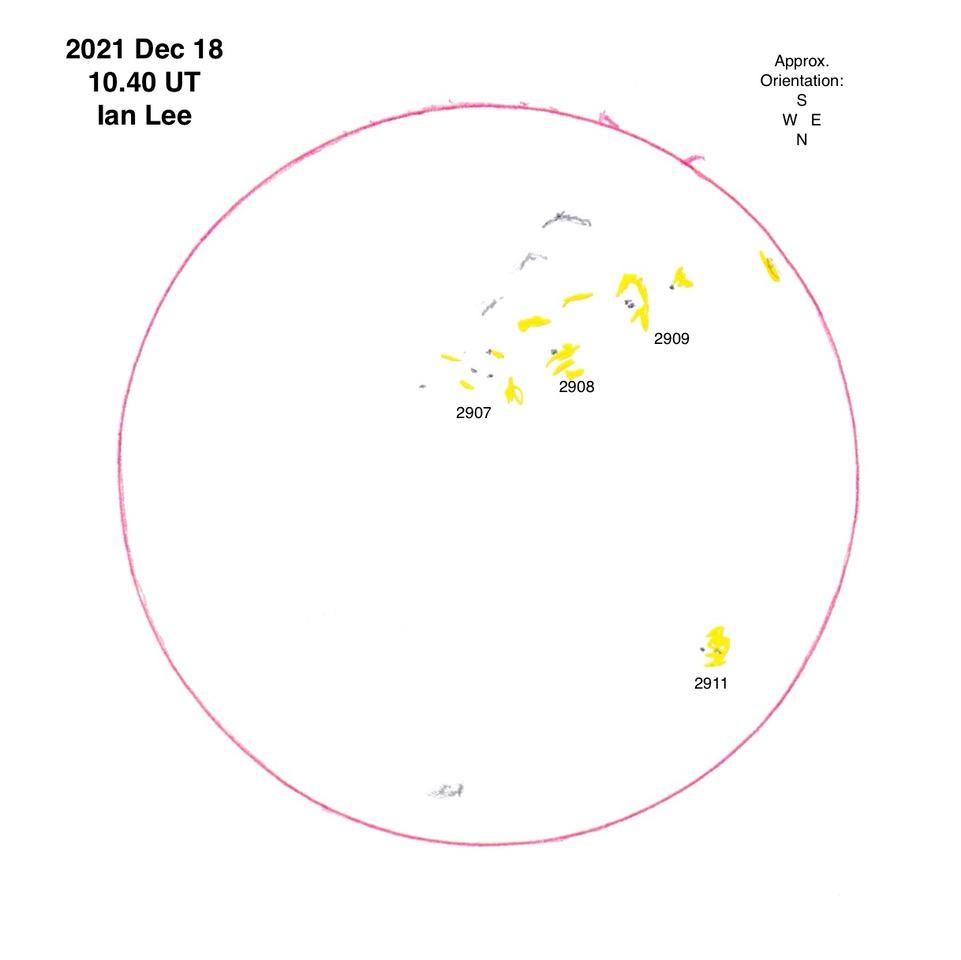
The arrival of AR2907, AR2908 and AR2909 also brought several bright areas of plage and some small filaments on the 18th. The 19th saw some particularly impressive areas of plage and filaments.
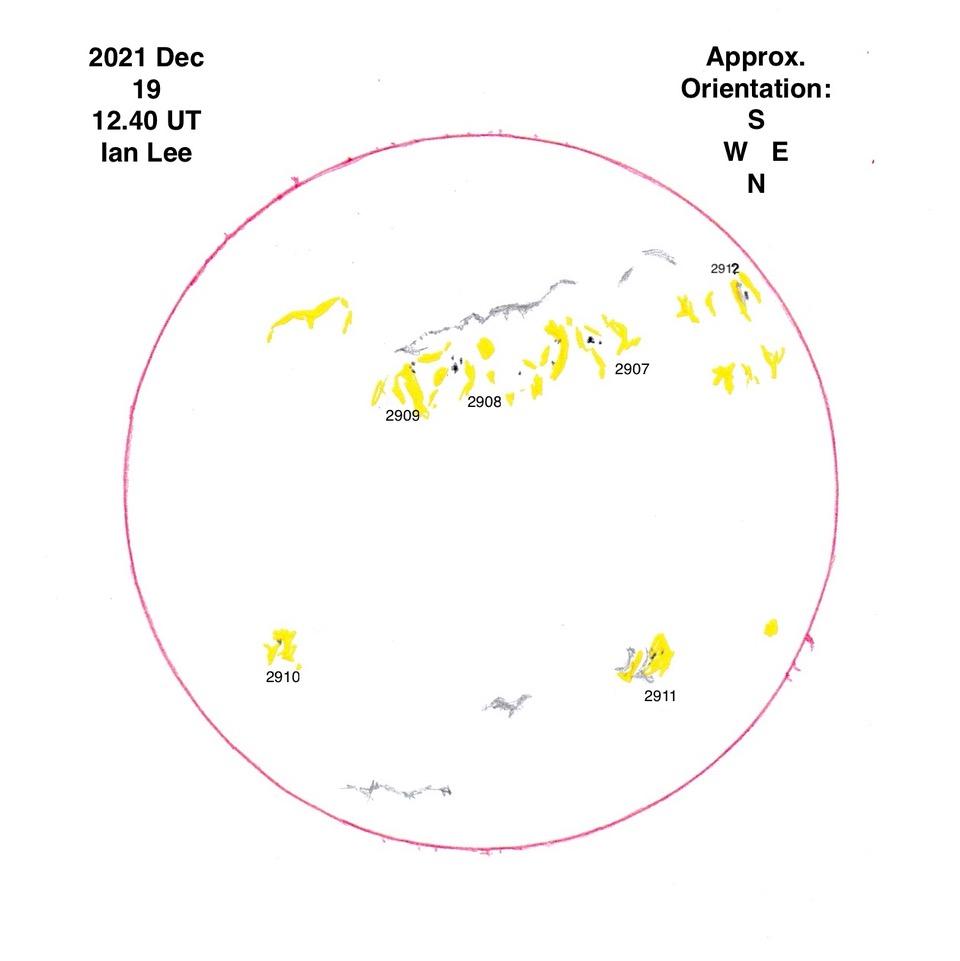
SPA Prominence Mean Daily Frequency: 2.83 (was 4.14)
Congratulations to Alan Heath who observed 16 days, to Michael Fullerton on 12 days and to Jonathan Shanklin who achieved 11 days.
Detailed count records of Active Regions and Relative Sunspot Numbers came from: Simon Brown, Michael Fullerton, Alan Heath, Ian Lee, Jonathan Shanklin, Brendan Shaw and Bob Steele.
Images and drawings were supplied by: Carl Bowron, Ian Lee and Cliff Meredith.
Geoff Elston