
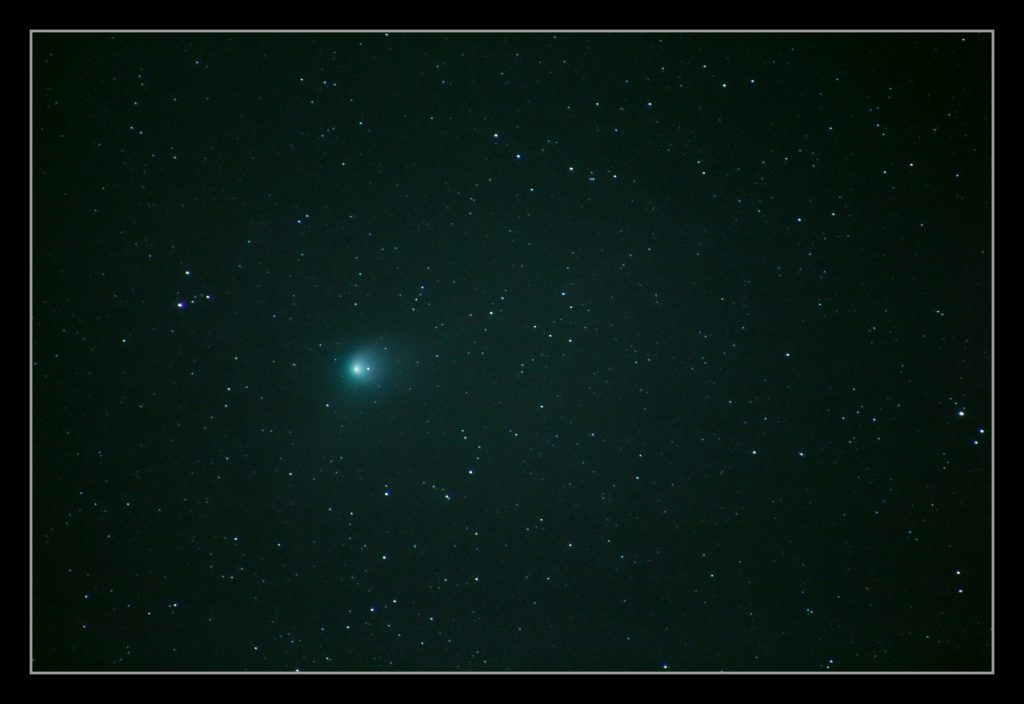
Above: Comet C/2022 E3 ZTF photographed by Stuart Atkinson using a Canon 700D DSLR on an iOptron Sky Tracker. Image is a crop from a processed stack of tracked multiple 30s images taken using a 300mm lens.
It is now almost two years since Comet NEOWISE thrilled sky-watchers with its long, curved, glowing tail. Although it was by no means a Great Comet like Hale-Bopp, Hyakutake or McNaught, that comet was so bright it was easy to see with the naked eye even from places with light pollution, and people with no knowledge of the night sky were able to find it just by going out and looking around the sky for something that looked like a comet.
Since the start of the year another comet has been visible in the sky, and although we knew in advance it was going to be nowhere near as bright or as obvious as NEOWISE, Comet C/2022 E3 ZTF has provided comet observers old and new with some lovely views. It’s still in the sky now, dimmed by the Moon but still easily visible in binoculars and even to the naked eye from dark sky sites.
It seems an age ago now, but as 2022 came to an end Comet E3 was just a small, 8th magnitude smudge glowing within the curve of Corona Borealis, visible in the hours before dawn. By mid-January it had begun to brighten, and long exposure photographs taken through state of the art telescopes and processed to bring out subtle detail and structure showed it had grown a pair of interesting looking tails, a whip-thin blue ion tail and a fatter, curved dust tail with a creamy yellow hue. The comet’s head appeared bright green in these photos, leading to it being nicknamed – with stunning originality – “The Green Comet” by many online reporters, who began to predict how it would “blaze in the sky!” and “dazzle stargazers!” when it passed Earth in early February.
As the comet finally crawled out of Corona and began moving up towards the kinked tail of Ursa Major, the Great Bear, experienced comet-watchers immune to the hype were quietly confident that the comet was going to follow its predicted brightness curve and reach a peak magnitude of 5.5, which would make it easily visible in binoculars and possibly visible to the naked eye for those lucky observers blessed with very dark skies well away from streetlights and other artificial lights. The general feeling was that E3 was on schedule to be a “nice” comet, but nothing particularly special.
Then, after rounding the Sun, the comet crossed the Earth’s orbital plane, and even the mist jaded comet observers began to sit up and take notice.
As our line-of-sight to the comet changed its appearance changed too. Its yellow-white dust tail, that had curved off to one side of the comet’s bright head swung around behind it, and an “anti-tail” – a spike of bright material – appeared on the opposite side of the head. The comet’s blue ion tail, made of gases pushed away from the nucleus by the gusts of the solar wind, split into two very definite fine strands, and images taken through telescopes showed fascinating puffs and wisps of smoky material working their way down it.
It’s now the end of January, and E3, moving swiftly past Polaris, is an unexpected but very welcome treat. Many comets are hard to find, because they drift through constellations and past stars known only to astronomers with a good knowledge of the night sky, but because E3’s path across the sky has taken it past the Big Dipper and is now sweeping it past the Pole Star people with little or no previous experience of observing comets have been able to find it quite easily. Indeed, the comet has been so conveniently placed that many people are seeing a comet for the very first time. Okay, so it doesn’t look anything like the long glowing banner seen in those stacked and processed telescope images, but that’s not the point. Many people are seeing a comet with their own eyes for the first time, and are fascinated by it.
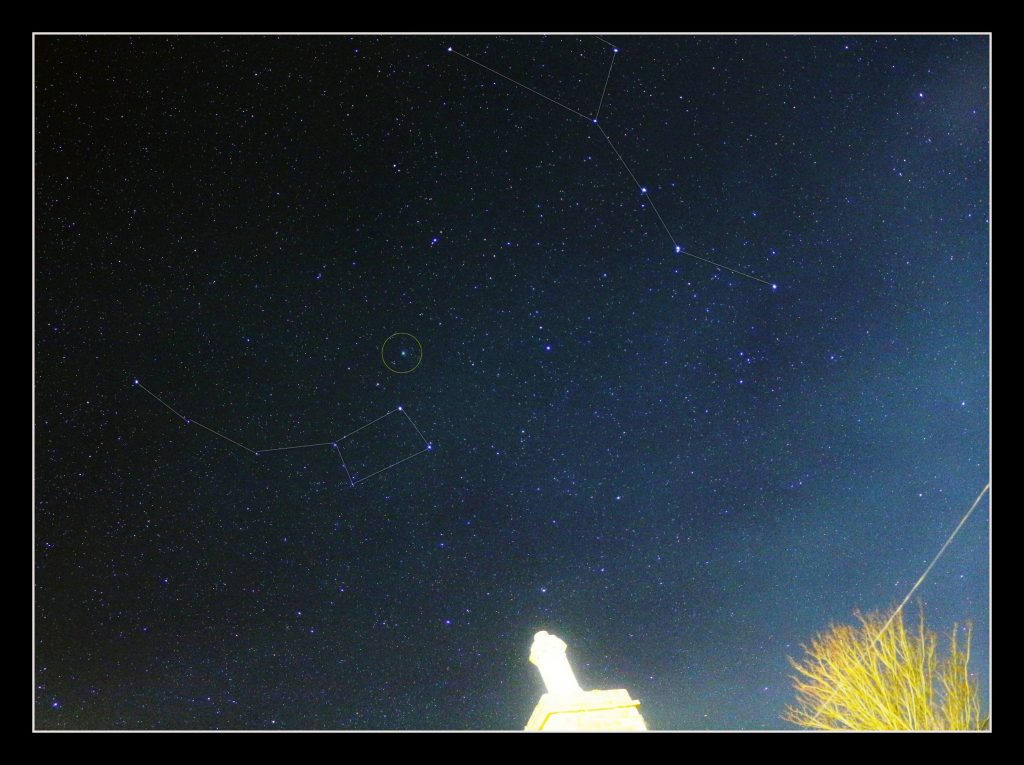
Above: Comet E3 close to the stars of Ursa Minor on the evening of January 27th 2023.
Wide field image by S Atkinson.
So how bright is E3? Well, it has beaten those early predictions of a peak magnitude of 5.5. Many observers around the world are reporting it has reached magnitude 5, and there are even reports of it achieving magnitude 4.6, from very reliable and experienced observers. Some observers are even reporting being able to see the comet with their naked eyes, despite the bright moonlight.
Having spent many weeks low in the eastern sky in the hours before dawn comet E3 is now visible all through the night, from dusk to dawn, and is almost overhead at midnight for northern observers. Unfortunately, after several weeks of being on view in a dark sky E3 is now having to fight against against increasingly bright evening moonlight. It is still visible in a dark sky before sunrise, in a brief window between Moonset and sunrise, but most people are viewing it in the evening, seeing it through binoculars as a small but definite smudge. Telescope users are being treated to high magnification views of faint plumes and jets of material within its coma.
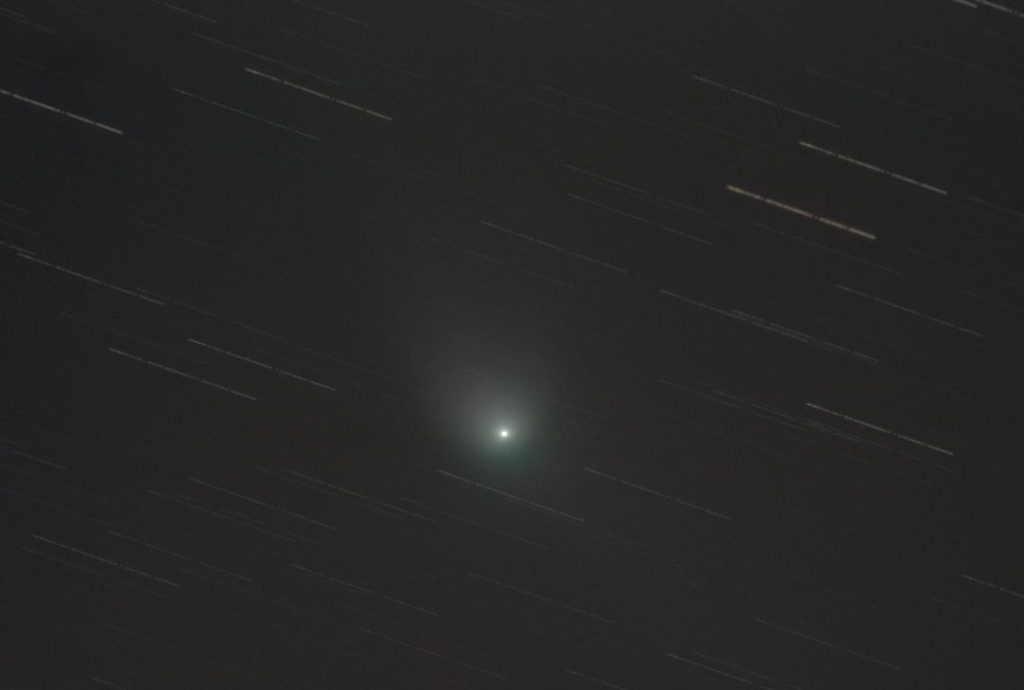
Image by SPA Member Paul Crossland. Taken 26/1/23 using a Canon 700d and a Skywatcher ED 80
Stack of 30sec exp x86 from Liverpool. UK
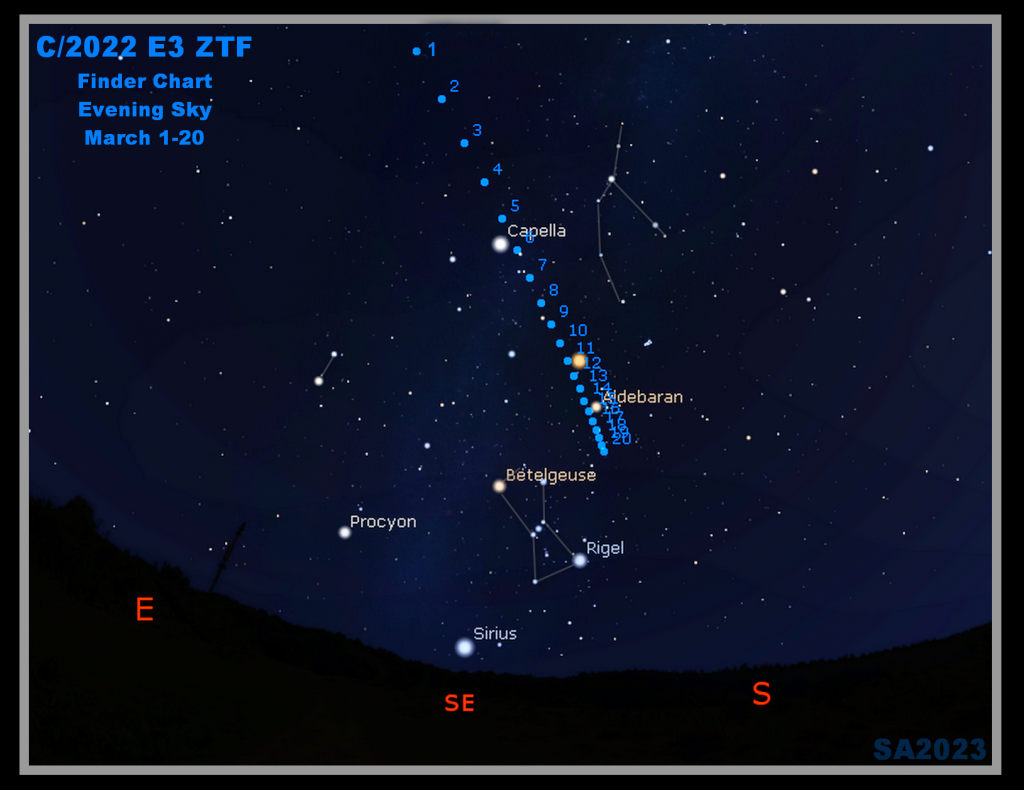
It’s possible that we have seen the best of Comet E3. The brilliance of the Moon is dimming its serene light, and making it harder to see. But it is definitely still worth looking for. Over the next couple of days it will pass Polaris, the Pole Star, and then begin to drop towards Auriga, passing very close to its brightest star Capella on the evening of February 6th. It will drift past ruddy-hued Mars several days later. On Valentine’s Day the comet has an evening date with the red star Aldebaran and the Hyades star cluster, by which time it will have lost a lot of its brightness and will almost certainly only be visible with some kind of optical assistance. But this is when observers in the southern hemisphere will finally have their chance to look at the comet, and no doubt they’ll be hoping it will so something unusual, like brightening as it undergoes an outburst of some kind, but there’s no guarantee of that.
As February ends and March begins Comet E3’s best nights will be behind it. By then it will be low in the southern sky after sunset, dropping past Orion as it heads back off into the cold depths of the solar system, climbing higher in the sky for southern hemisphere observers and leaving northern observers with some treasured memories.
Some people have said that E3 was a “meh” comet, hardly worth bothering with, but that’s wrong. Every comet is special in its own way, and worth looking for, if you have the opportunity and the right equipment. And ok, E3 hasn’t put on a grand show like NEOWISE or Hale-Bopp, but it has been fascinating to follow – and it has been many people’s “first comet” so it will always be very special to them, and they’ll miss it when it’s gone.
Stuart Atkinson.