
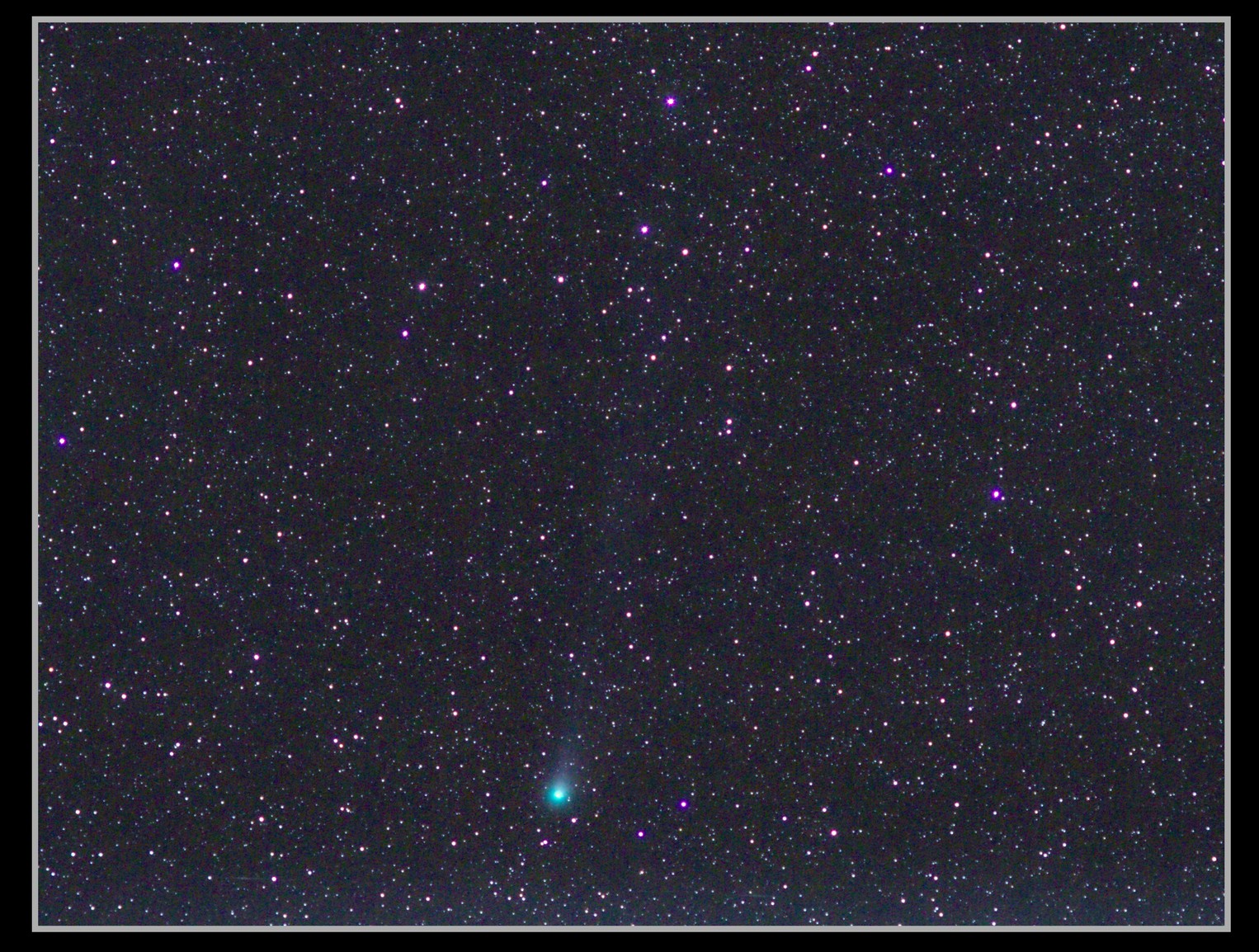
Above: Comet 12P Pons-Brooks, imaged by Stuart Atkinson from a dark sky site just outside Kendal in Cumbria on the evening of February 27th. Image is a processed crop from a stack of multiple images taken using a Canon 700D DSLR and 135mm lens, tracking the sky on an iOptron Sky Tracker mount.
It’s a widely-held belief that comets are rare visitors to our sky. In fact, that’s not true. Yes, it’s true that comets bright enough to be seen with the naked eye appear in our sky very infrequently, but on any night of the year there will be at least half a dozen faint comets up there, available for you to observe and photograph – if you know where to look, that is. And there are many more much fainter comets too, comets so faint you need a telescope to see them. If you want to know how many comets are in the sky tonight, take a moment to fire up your favourite astronomy phone or tablet app, set it to display all the comets currently in the sky and watch your screen fill with so many dots you won’t be able to see the stars and constellations for them…
There has already been so much hype about it online that I think most people with any interest in astronomy are aware that later this year there might be a comet in our sky bright enough to be seen with the naked eye. There’s a chance – albeit a very slim one – that Comet C/2023 A3 (Tsuchinshan-ATLAS) might become as bright as the famous Comet Hale-Bopp was back in 1997, but more likely it will be a good naked eye comet low in the evening sky in October. We just don’t know tho; in the past comets that have promised us great shows have fizzled and faded away, mentioning no names of course (cough “Comet ISON!” cough). In the meantime, we have a comet in our northern sky right now that is approaching naked eye visibility, and might be visible without any help from binoculars or telescopes next month.
Comet 12P Pons-Brooks was discovered by French astronomer Jean-Louis Pons in July 1812. It was recovered 71 years later by astronomer William Brooks, and so now bears both astronomers’ names.Because Pons-Brooks has an orbit that whoops it around the Sun once between every 20 to 200 years it is classified as a classic Halley-type periodic comet. Pons-Brooks takes 71 years to go around the Sun, just a few years less than Halley itself does, and it last visited our sky in 1953.
Astronomers have been looking forward to the return of Pons-Brooks for many years because it is one of the brightest known periodic comets, regularly reaching naked eye brightness when it appears in our sky. It was most recently recovered on 10 June 2020 when it was still way beyond Saturn. At that time it had a magnitude of 23. So why were astronomers so excited to know it was on its way back out of the darkness again?
Because Comet Pons-Brooks has experienced many “outbursts” on past returns which dramatically increased its brightness for brief periods. Understandably, comet-watchers are crossing their fingers, toes and everything else that it will do this again this time around, although that seems unlikely. Even if it doesn’t, Pons-Brooks should reach at least 4th magnitude, making it visible to the naked eye in a dark sky.
But that’s a big If! So, where is Pons-Brooks now, and what can we expect to see of it in the weeks ahead?
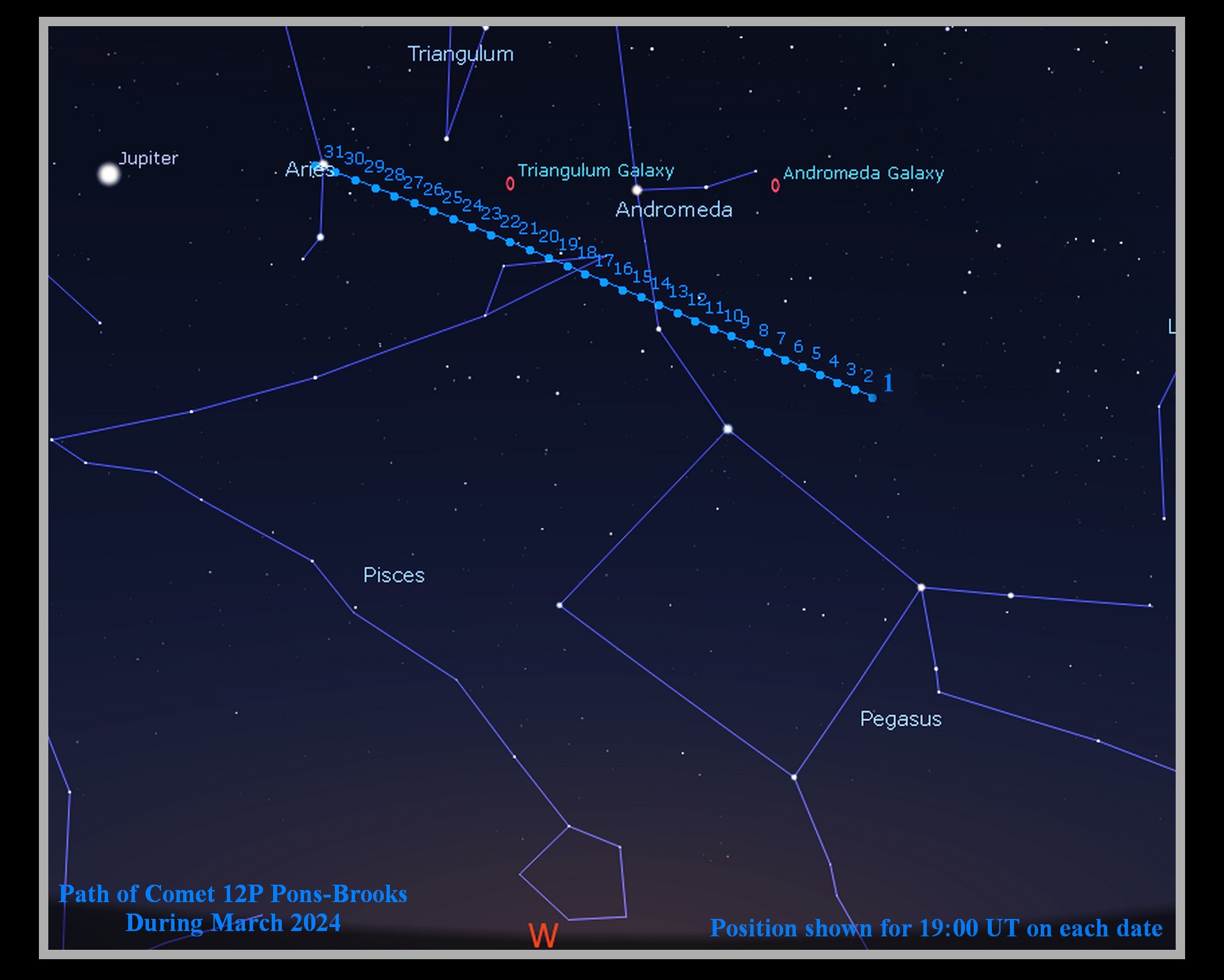
At the start of March, as I write this, Pons-Brooks has reached magnitude 6.0, so it theoretically bright enough to see with the naked eye under a pitch-black sky with no Moon or light pollution to ruin your view. It can be found low in the evening sky, to the west, in the constellation of Andromeda, a fifth of the way between the Great Square of Pegasus and the W of Cassiopeia. It is tracking slowly eastwards (right to left as you look at the sky) towards M31, the Andromeda Galaxy, and after passing beneath that around March 7th/8th will then head towards Jupiter (in the sky, not literally!). By the time it passes beneath Jupiter in early April its magnitude should have increased to greater than 4, which would make it an easy naked eye object if it was high in a dark sky, but by then it will be low in the evening twilight so you might still need binoculars to see it. Unfortunately it’s unlikely we’ll see another of those outbursts, they only tend to happen when the comet is “way out there”, so magnitude 3 or 4 is probably as good as we’re going to get. But we’ll take that!
Although the bad weather has been frustrating UK observers, the comet has been observed and imaged by many comet watchers around the world, and as I write this, on March 1st, the latest long exposure photos of the comet taken through tracking telescopes show it has developed a bright head and a 2 degree long tail. If it continues to behave itself Pons-Brooks’ tail should slowly but steadily grow longer and brighter. By early April it should be a very pretty binocular comet, a fuzzy grey-green smudge with a misty tail stretching away from it, and easy to photograph using just DSLRs on steady tripods.
If you’re preparing to go out to the US to watch the solar eclipse on April 8th you might be in for a very rare treat. As the Moon totally covers the Sun several planets will pop into view, and close to Jupiter will be Comet Pons-Brooks. If it has reached 5th magnitude by then the comet could be visible to the naked eye as a misty smudge to the upper left of the eclipsed Sun, with its feathery, glowing corona. If you’re going out for the eclipse be sure to take a moment during Totality to look for the comet.
So, while we all wait to see what Comet C/2023 A3 (Tsuchinshan-ATLAS) does in the Autumn, don’t let Comet Pons-Brooks come and go without looking for it. It’s not going to “dazzle skywatchers” or “light up the night sky!” as is being reported already online, but it should at least be a good binocular comet and might reach naked eye visibility. We’ll just have to wait and see…!
* Many thanks to Daniel Fischer for providing me with new info to help me update this feature.